We are delighted to announce our Prime Minister’s Summer Reading List for 2025.
Each year, Grattan Institute selects its best books of the past 12 months – recommended reading for the Prime Minister, and indeed all Australians, over the summer holidays.
This year’s list is:
- Exile Economics: What happens if globalisation fails,by Ben Chu
- Clearing the Air: A hopeful guide to solving climate change, by Hannah Ritchie
- Patriarchy Inc.: What we get wrong about gender equality and why men still win at work, by Cordelia Fine
- Is a River Alive? by Robert Macfarlane
- Losing It: Can we stop violence against women and children? by Jess Hill
- I Want Everything, by Dominic Amerena
Over the course of the year, the Grattan staff book club read, loved, loathed, debated, and dissected an extensive array of Australian and international novels, non-fiction books, essays, and articles.
The five non-fiction choices we landed on range across topics and genres but share two things in common: they each grapple with one of the big issues of our age, and they each chart a vision for a better future. The fiction choice reminds us of the big Australian policy changes we now take for granted, and is also a captivating read.
We’ve packaged them up and sent them off to The Lodge, in the hope that the PM might even take them on his honeymoon. They certainly deserve a spot in his beach bag – and in yours.
Grattan Institute’s 2025 Summer Reading List for the Prime Minister will be officially launched at a special in-person event at the State Library of Victoria from 5.30-7pm on Thursday 11 December, with Grattan CEO Aruna Sathanapally in conversation with ABC politics and economics journalist Tom Crowley and featuring one of the winning authors, Cordelia Fine. You can register for the event here.
Here’s the story of our top six for 2025 and why we chose them:
Exile Economics: What happens if globalisation fails
Ben Chu
Ben Chu starts Exile Economics by painting a picture of a world divided. In the face of rising inflation, increasing great power rivalry, and a surge in support for far-right political leaders, countries around the world are pulling back from the global economic system. Higher tariffs, lower migration, and foreign policy isolationism are the order of the day.
It’s a description that applies just as well to the political climate we face today as it does to that of the 1930s. And as Chu argues, there’s a reason for this resemblance. The roots of ‘exile economics’ – an economics that seeks to restrict the movement of goods and people across borders – are embedded deep in the human psyche. From George Washington to Mahatma Gandhi, many of history’s great political leaders have extolled the virtues of self-sufficiency.
But as history also shows, the interconnected nature of the global economic system defies attempts to bend it to any one nation’s will.
Chu’s book explores these issues through the lens of the commodities and resources that underpin the prosperity of developed economies around the world, ranging from food and pharmaceuticals to rare earths and PhD researchers. As his analysis shows, cutting ourselves off from these trade and migration flows isn’t just economically damaging – in many cases it’s simply not possible.
Rather than using security, sovereignty, or inequality as an excuse to shrink from our reliance on other countries, Chu makes the case for a pragmatic politics that prioritises a more secure and interconnected global community. It’s a message that all Australians need to hear: we can’t afford to face our biggest economic challenges alone.
Clearing the Air: A hopeful guide to solving climate change
Hannah Ritchie
If you want clear facts for yourself about the pros and cons of tackling climate change, or if you feel frustrated because you don’t have the facts to push back on climate action naysayers, this is the book for you. If you are a Prime Minister leading the country on climate action and needing all the arguments to refute opposers, this is also the book for you.
Hannah Ritchie’s first book, Not the end of the world, made the case for optimism about our capacity to solve the climate change problem. In this latest book, she has delivered an easy-to-digest, non-technical read with enough technology and science to be interesting. It is effectively a reference manual – not material for bedtime reading but 50 short chapters that provide responses to the negative arguments with facts and data.
Each chapter covers a proposition or question such as ‘Aren’t renewables too expensive?’. It provides a single sentence answer with supporting data and analysis, and recommendations for what needs to be done to address the challenge or deliver the opportunity. Finally, it addresses issues that should be borne in mind, such as how to understand the different ways that both sides of the debate can confuse the uninitiated with plausible misrepresentations of things like the cost of different sources of electricity.
Experts will not learn very much and may find some of the material a little simplistic. Ritchie’s answers to some of the more difficult issues such as a role for nuclear power and carbon sequestration will annoy many environmental activists. Although she aims for the manual to be comprehensive, it is not always complete. But that would be nerdy niggling over detail.
This is a timely publication. The Prime Minister, Treasurer, and Energy and Climate Change Minister should have it near to hand.
Patriarchy Inc.: What we get wrong about gender equality and why men still win at work
Cordelia Fine
For thousands of years, societies have used gender as a basis for dividing labour: men do task A, women do task B. We see similar patterns today – men hold many of the well-paid positions of power, while women do much of the unpaid care.
Australia has made substantial progress on women’s rights and workforce participation, but gendered patterns of education and work remain. Many believe there is something biological and inherent in this – that women are naturally more caring, while men naturally gravitate towards leading.
But the evidence for sex-based differences like these is flimsy, argues Cordelia Fine. Instead, the gendered divisions of labour reflect cultural and social norms which shape us into different roles depending on our sex, and institutions that work to preserve the existing hierarchies of status and resource allocation. Together, they form a gender system, which Fine dubs Patriarchy Inc.
Patriarchy Inc limits what we can choose to do, and who we can choose to be. But Fine is sceptical that diversity, equity, and inclusion (DEI) initiatives are the solution. DEI promotes gender equality as a savvy business move that’s good for the bottom line. But it misses the purpose of gender equality – fairness – and does nothing to address the structural drivers of inequalities.
Parts of this book will challenge you, and parts will make you laugh out loud (we’ll leave it to you to discover how Fine’s son’s friends made him feel better after he failed his driving test). It’s a book that will make you reflect on how we think about gender equality, in the workplace and beyond.
Patriarchy Inc. proposes a new vision of gender equality: freedom from a gender system that limits our ability to achieve wellbeing and biases what we get for our efforts. It’s not the loftiest of visions, but that’s the point. It’s a vision we should all be able to see value in, no matter who we are.
Is a River Alive?
Robert Macfarlane
Drifting from deep time to the near future, Robert Macfarlane’s Is a River Alive? asks how we might retell the story of our lives from the point of view of the rivers which nurtured us. And he does it in a way that is fun to read.
Reflective without ever losing the narrative thread, Is a River Alive? draws more from the tradition of the rollicking adventure novel than the sombre climate documentary. Macfarlane starts in a cloud forest in Ecuador, accompanied by an experimental musician, a mushroom scientist, and a grizzled environmental defender; releases turtle hatchlings in Chennai with a self-taught zoologist; and travels up a maybe-dammed river in Quebec with the mystic and poet who is trying to save it.
The author’s companions are so interesting you might Google them to check if they’re real people. Throughout, the blend of poetic descriptions of nature, legal and political history, and personal stories is seamless and compelling.
And the author’s perspective is refreshingly realistic. Macfarlane asks himself the sceptical question for us – can a river really be alive? There is a risk that we see Macfarlane’s companions as hopelessly naïve, and in doing so lose heart at the enormity of the challenge they confront. Instead, his vivid illustration of their expanded perception leaves you wanting to see and feel the world the way they do – and maybe join their cause.
At a time when we are becoming painfully aware of our shared destiny with the natural world – and where our technology is posing questions of what it really means to be living – this is a timely, mind-expanding book. Drawing from wellsprings of curiosity rather than fear, Is a River Alive? offers an encouraging way into a well-grounded environmental optimism.
Losing It: Can we stop violence against women and children?
Jess Hill
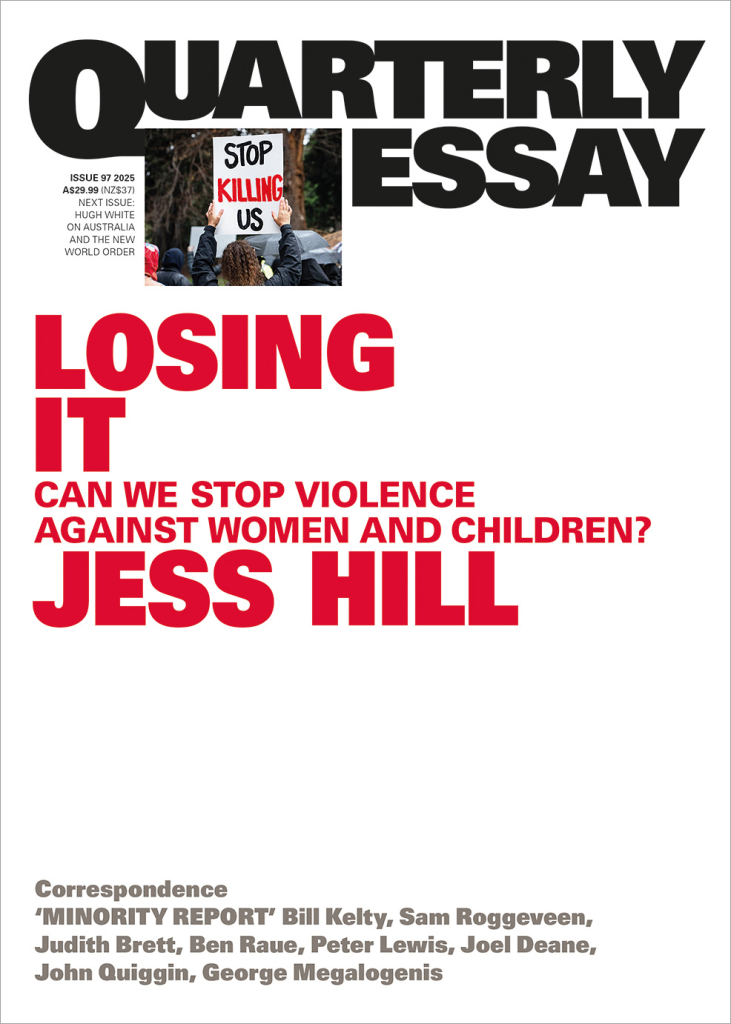
Australia is a world leader when it comes to ambition on eradicating gender-based violence, and for that, we should be proud. The objective of the 2022 National Plan to End Violence against Women and Children is to end gender-based violence in a single generation. But sadly, we cannot be as proud of our progress. Despite significant ambition and investment, the domestic homicide rate has been rising. In 2024, 57 women were killed, or one every eight days.
In Losing It, Jess Hill argues that our prevention strategy is not working. Our approach focuses too much on addressing gender norms and inequality in wider society, which will theoretically shift the social norms that tolerate violence against women. Instead, we need more emphasis on the other risk factors that contribute to gender-based violence, such as childhood maltreatment and trauma, alcohol, and gambling. Hill weaves a diverse set of stories of victim-survivors to make the point that unless we target these drivers, and interrupt the intergenerational transmission of trauma, we won’t make lasting progress.
More broadly, Losing It is a fascinating dive into the complexities of evidence-based policy. Being evidence-based means making the best decisions we can, with the information we have at the time. But it also requires us to remain open and curious as new evidence emerges, and to be willing to change our beliefs and actions. This is what Hill has spent years advocating for – an update of our strategy and priorities, now that we have better evidence on what is working and what is not.
Hill finishes on an optimistic note. She believes that if we have the courage to act on the range of evidence-based approaches to tackling gender-based violence, Australia could be the first country to end it. Now that would be something to be proud of.
I Want Everything
Dominic Amerena
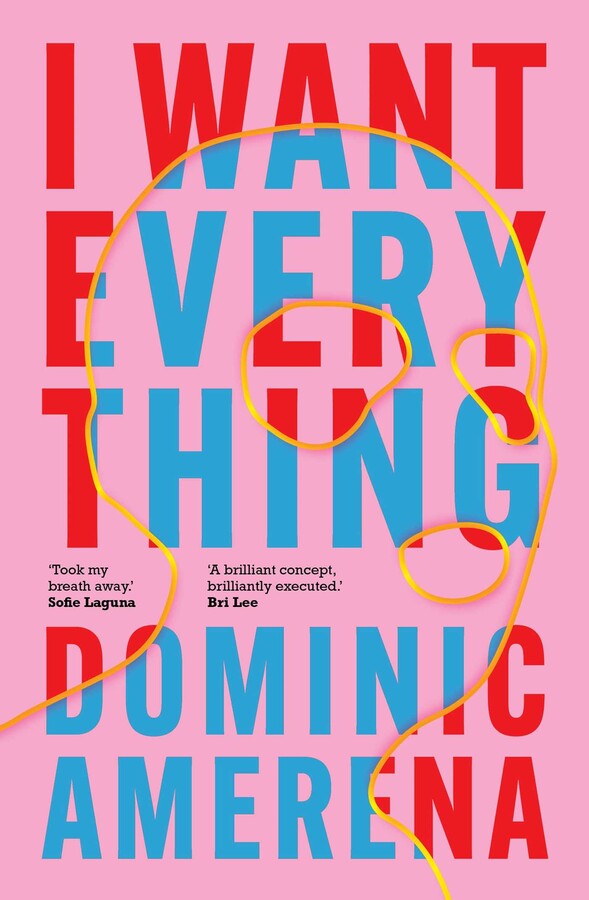
I Want Everything is summer reading at its best: juicy, beautifully written, and so captivating that three Grattan staff finished it within 24 hours.
Dominic Amerena’s debut novel focuses on a series of conversations between an unnamed narrator, determined to write the next ‘great Australian novel’, and Brenda Shales, a reclusive Australian literary icon in her 80s. As the narrator extracts Brenda’s life story from her, we get to know these two terrifically complex characters whose lives turn on a series of ethically-troubling literary decisions.
Amerena is an observant writer, with a sharp ear for dialogue. The complex web of egos, jealousies, and warmth between his characters is engrossing. His writing is rich with tiny, captivating details that feel distinctly Australian. When we first meet Brenda, she is ‘wearing a grey singlet, straight-cut jeans, and workboots too hot for the weather’ – ‘the clothes of a shearer, a wharfie, a Melbournian prose poet’. We were struck by an image of residents at the aged care facility waiting at a replica bus stop for a bus that will never come.
But make no mistake – this book is a page turner. It rips along. Amerena masterfully builds tension, turning the emotional tables chapter after chapter until you aren’t sure which of these flawed characters to believe at all.
Through the story of Brenda, the novel also offers insight into the fragility of the cultural changes of the past century. It’s tempting to look back on the rapid shifts in women’s rights and roles in the ’60s and ’70s as inevitable. But Brenda’s story offers an unsettling insight into the rearguard action that threatened those nascent reforms. It’s a reminder that there has always been pushback and that social change never comes gently.
The opening scene of I Want Everything takes place at a suburban swimming pool – we’d suggest that’s the perfect place to take this book on a summer afternoon.