Overview
Democracy is under sustained pressure everywhere. Australia is one of the world’s leading democracies, but we cannot – and should not – take ours for granted.
Around the world, democracies are backsliding, and the world order in which Australia has flourished is being seriously tested. These are more turbulent times not just for our economy or sustaining our living standards, but for liberal democracies themselves.
Compared to other countries, Australia comes from a place of strength, and has a history of democratic innovation to be proud of. Australians consistently value democracy. But satisfaction with how our democracy is working is fragile.
Without effective and trusted institutions, it will only be harder for Australians to make informed decisions, and harder for policy makers to develop and implement solutions to our most pressing challenges.
Over human history, liberal democracy is relatively recent, hard won, and precious. Ensuring Australia’s democracy is fit for the times we live in will take work, and this report sets out five priorities for Australia to build a better and more resilient democracy.
First, our elected federal parliament sits at the centre of our democracy and we can make it more representative and better functioning, to deliver better long-term decision-making and better administration of government, and to engender greater trust.
Second, we can do better to ensure that Australians have a voice and feel a sense of belonging, particularly those who find themselves on the margins of the economy and society.
Third, we must protect our public sphere – where Australians inform themselves and engage in the contest of ideas – by ensuring the sustainability of our news media and investing in institutions that produce trusted information. We should also experiment with public responses to misinformation, to work out which approaches are effective at scale.
Fourth, in a democracy, process matters, but so do outcomes. Australians need confidence that our system of government can work for them and is capable of building something better than the status quo, and acting in the public interest, not vested interests.
Finally, crises are the moments that build trust, or erode it, and we face a future of rolling shocks. Governments need to act to reduce vulnerability to known risks, and invest in the expertise to tackle hard-to-predict events. They need to preserve fiscal buffers for a more expensive future, and calibrate community expectations about what governments can reasonably do to cushion the blow.
Reforms that demonstrate governments are willing and able to act on persistent and broadly understood challenges (housing, climate, tax reform, gambling harm) in the public interest, despite noisy ‘losers’, will not only deliver better economic and social outcomes, they will build trust in our democratic system. Critically, both economic growth and distribution of that growth matter to a resilient social compact. And proceeding with imperfect reform is better than waiting for perfection.
Australians have high expectations of their governments, but in a democracy, we govern ourselves. This is a task for all of us.
1 Democracy is the foundation of Australia’s prosperity
When Australians think about their democracy, elections and parliaments immediately come to mind. But our democracy is stitched together by many institutions. These include the public service, independent agencies, the courts, civil society, universities, and the media. These institutions enable us to make and give effect to informed collective choices about the type of country we want to live in, and how we respond to our shared challenges.
Our democratic system should treat us as equal in status, give us a say in our future, ensure we draw on the expertise we need, and enable us to make necessary trade-offs as a society.
But democracies around the world are backsliding, and the world order in which Australia has flourished is being seriously tested. These are turbulent times – for economic growth, for living standards, and for liberal democracies themselves.
Compared to the rest of the world, Australia comes from a place of strength, and has a history of democratic innovation to be proud of. Australians consistently value democracy. But satisfaction with how our democracy is working is fragile and trust in political actors is low.
Over human history, liberal democracy is relatively recent, hard won, and precious. Ensuring Australia’s democracy is fit for the times we live in will take work. This report sets out five priorities for Australia to build a better and more resilient democracy.
1.1 Democracies are in decline globally
Around the world, democracy is backsliding. Most countries that were classified as ‘liberal democracies’ in 2000 have seen their democracies weaken in the following years (Figure 1.1) Autocracies now outnumber democracies, and in 2025 there were only 31 liberal democracies out of 179 countries assessed. Three-quarters of the world’s population now live in autocracies, the highest proportion since 1978. 1As measured by the V-Dem Project: Nord et al (2026). Similar declines in the reach of democracy are evident from other global measures, such as the Economist Intelligence Unit’s Democracy Index.
The quality of many democracies is also declining. The US lost its long-held status as a liberal democracy in the 2026 Democracy Report downgraded to an electoral democracy for the first time in more than 50 years, because checks and balances on power have declined, alongside freedom of expression, and civil rights and equality before the law. 2Free and fair elections are central to any democracy, but a liberal democracy has additional features including well-functioning checks and balances on executive power by the legislature and the judiciary, and a strong rule of law ensuring that equal civil liberties are respected: Nord et al (ibid). Democracies such as Greece, Argentina, and Peru have been backsliding, and others such as Hungary, India, Mexico, and Indonesia are now recognised as electoral autocracies. Freedom of expression and quality of elections have deteriorated in many more countries.3Ibid.
Democracies rarely collapse abruptly. Rather, they tend to gradually erode in ways that may not be obvious until it is too late. Problems such as polarisation, corruption, and economic inequality can provide the conditions for anti-democratic actors to rise. Dissatisfaction and grievance can then be exploited to mobilise voters and politicians to weaken checks and balances on power, and entrench divisions.4Khalil et al (2025).
Democratic erosion can also be contagious. When countries experience a downturn (or upturn) in electoral democracy, their neighbours tend to change in the same direction (albeit to a much smaller degree).5Coppedge et al (2022a). The authors also found a lesser, more positive effect for allies, with alliances appearing to inhibit the spread of downturns. These contagion effects are small year-to-year, but compound over time.6Ibid.
Australian democracy remains a bright light in this darkening global picture. But we are not immune to anti-democratic forces or the fraying international rules-based order.7Carney (2026), and Bryant (2026).
Our democracy underpins our prosperity, and safeguards our rights and freedoms. International evidence shows that democracy as a system supports peace and economic growth, while delivering longer lives and more education.8See Acemoglu et al (2019) and Tudor (2025). Acemoglu et al (2019) show that democratisation increases GDP per capita by about 20 per cent in the long run, largely driven by greater investments in capital, schooling, and health. Economic growth and trusted institutions can work together to create a virtuous cycle of broadly-shared prosperity and opportunity, boosting living standards and freedoms.9See Coppedge et al (2022b) and Tudor (2025).
Figure 1.1: Most liberal democracies have weakened since 2000
V-Dem liberal democracy index
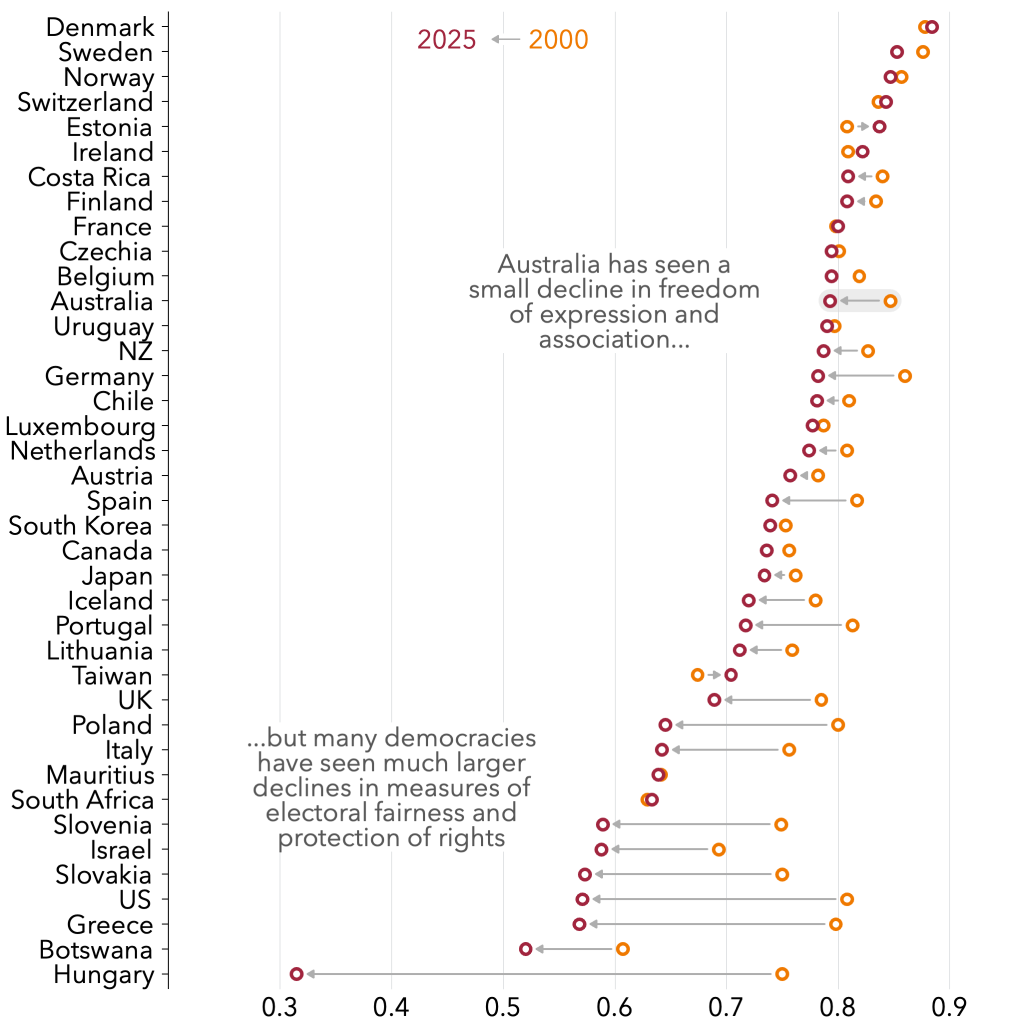
Notes: Includes countries classified as liberal democracies in 2000. The V-Dem liberal democracy index combines ratings by political experts across two areas: electoral systems (e.g. free and fair elections, freedom of association and expression) and liberal rights (e.g. equality before the law, legislative oversight, judicial independence). Source: Grattan Institute analysis of Nord et al (2026).
1.2 Australia is a leading democracy …
Australia is one of the world’s strongest democracies. We consistently rank highly on international measures of democratic health. The Economist Intelligence Unit’s Democracy Index ranks Australia 11th out of 167 countries (see Figure 1.2), ahead of peers such as Canada and the UK, behind New Zealand and Ireland, and with mainly Scandinavian countries above us.
Figure 1.2: Australia is a leading democracy
Economist Intelligence Unit’s Democracy Index
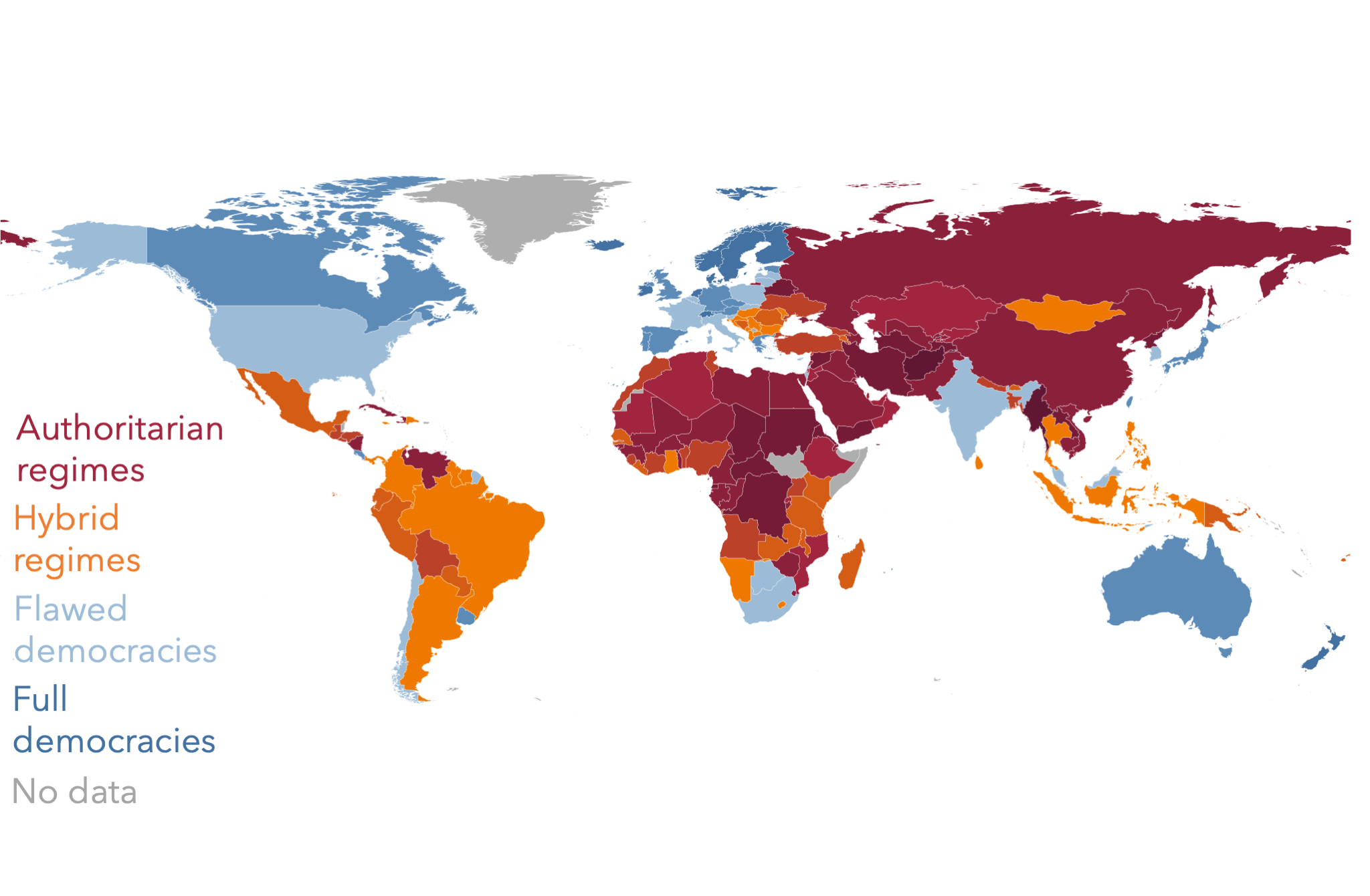
Notes: Expert estimates of the extent to which citizens can choose their political leaders in free and fair elections, enjoy civil liberties, prefer democracy over other political systems, can and do participate in politics, and have a functioning government that acts on their behalf. The index is a continuous score from 0 to 10, with countries classified as full democracies (8 or above), flawed democracies (6 to 7), hybrid regimes (4 to 5), or authoritarian regimes (less than 4). Source: Economist Intelligence Unit (2025) via Our World in Data.
The key features that underpin our democracy are: active and engaged citizens, an inclusive and equitable society, free and franchised elections, and rule of law for both citizens and government.10Parliamentary Education Office (2026). Many of these features are captured in the Australian Values Statement that new migrants to Australia are expected to understand and accept (see Box 1).11Home Affairs (2020).
Australia performs well across a suite of international economic and social measures – ranking highly on life expectancy, human development, employment, and GDP per capita.12See Sathanapally et al (2025). Notably there is a big discrepancy in outcomes for First Nations Australians though, see Section 2.3 on page 23. Public sector corruption is rare in Australia, unlike much of the world.13For example, Australia ranked equal 12th out of 182 countries in the 2025 Corruption Perceptions Index: Transparency International (2026).
Australia’s electoral system contributes substantially to our democratic resilience. Australians have high trust in Australian elections and in the Australian Electoral Commission.14APSC (2025a), OECD (2025a), and Strengthening Democracy Taskforce (2024). The independence of the Australian Electoral Commission is critical to public perceptions of electoral integrity. Features of Australia’s electoral system – including compulsory voting, preferential voting, and voting on Saturdays – mean that even disengaged Australians have a say, and political parties need broad appeal to form government.15Brett (2019), and Dunn (2025).
More than 98 per cent of eligible Australians are enrolled to vote, and just over 90 per cent turned out for the 2025 federal election.16AEC (2025a). Informal voting was 5.6 per cent for the House of Representatives and just 3.5 per cent for the Senate, similar to previous federal elections.17Ibid. And the secret ballot means Australians can vote without pressure or intimidation.18Parliamentary Education Office (2026).
Australia also has relatively high levels of social trust (Figure 1.3) and life satisfaction. Australia ranks 11th in the world for self-reported life satisfaction,19Wellbeing Research Centre (2025). and 11th in the world for social trust, with about half of Australians agreeing that ‘most people can be trusted’.20Integrated Values Surveys (2024a). Most Australians (85 per cent) also have at least ‘some’ trust in the people in their neighbourhood.21Wellcome Global Monitor (2020).
Social trust matters: countries with higher interpersonal trust tend to have higher economic growth and lower income inequality (see Figure 1.4),22Ortiz-Ospina et al (2016). which in turn support democratic resilience.23Tudor (2025). Social trust is also linked to political trust, as a necessary (but not sufficient) condition and therefore an important factor in political stability.24Newton and Zmerli (2011), and Bargsted et al (2023).
Figure 1.3: Australia has relatively high interpersonal trust
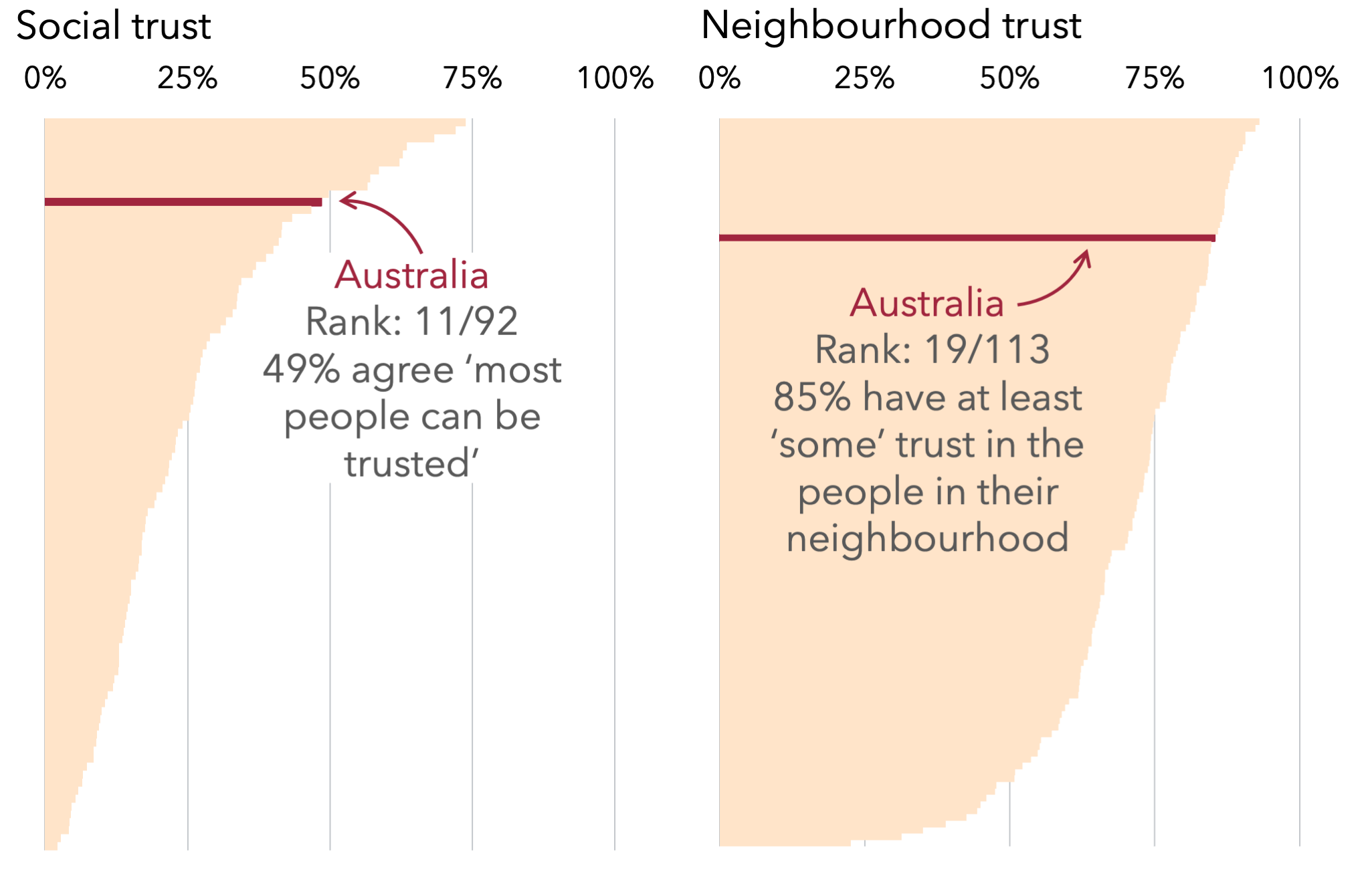
Sources: LHS: Integrated Values Surveys (2024a) (2022 data) via Our World in Data. RHS: Wellcome Global Monitor (2020) via Our World in Data.
Figure 1.4: Countries with higher levels of trust have higher economic activity
Share agreeing that most people can be trusted
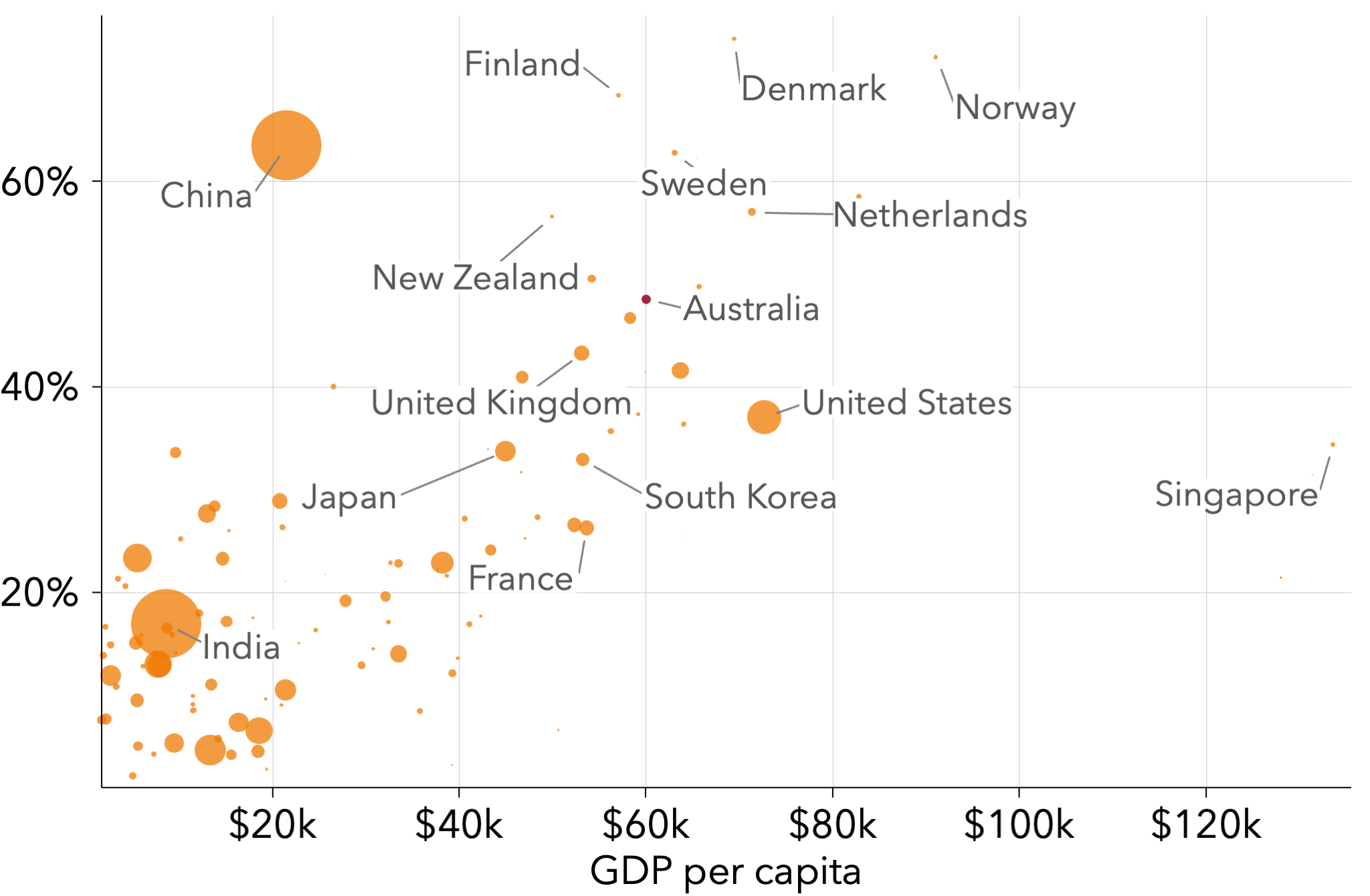
Notes: Trust data is for the latest survey wave between 2009 and 2022. GDP per capita is in 2021 international dollars, adjusted for purchasing power parity. The larger the circle, the bigger the population. Sources: Integrated Values Surveys (2024b), World Bank (2024), and UN (2024) via Ortiz-Ospina et al (2016).
1.3 … but satisfaction with democracy is fragile
Australia measures up well in international comparisons, but there are still warning signs at home.
While Australians’ support for democracy as a system has been consistently strong – even growing over time (Figure 1.5) – Australians’ satisfaction with how democracy actually works is more fragile, and sensitive to political events, including leadership changes (Figure 1.6).
An overwhelming majority (95 per cent) of Australians say that living in a democratic country is at least ‘somewhat’ important to them, and 64 per cent say it is ‘very important’ to them.25APSC (2024).
Surveys show Australians value democracy, even when it may not be working as we’d like, and even when we may not trust those in power. For example, in a 2025 survey of more than 4,400 Australians, 76 per cent agreed ‘democracy is preferable to any other kind of government’, and 55 per cent were satisfied with ‘the way democracy works in Australia’, but just 38 per cent ‘trust the federal government’.26McKinnon (2025a).
In a 2023 survey, even among the minority who were dissatisfied with the way democracy works in Australia, 77 per cent still believed ‘it’s worth trying to fix the problems that democracy may have’.27APSC (2024). In this 2023 survey, 13 per cent were dissatisfied. In the 2025 McKinnon survey reported above, 23 per cent were dissatisfied.
Australia’s democratic institutions aren’t working for everyone. Satisfaction with democracy is typically lower among groups who are less well served by the status quo.28Sathanapally et al (2025). Most obviously, our institutions have persistently failed First Nations Australians, and don’t fully support new migrants. Chapter 2 explores these vulnerabilities in more depth.
Australia generally sits above the OECD average on measures of trust in government. But absolute levels of trust in government are still low – for Australia and most of our peers.29OECD (2024), Edelman Trust Institute (2025), and Sathanapally et al (2025, Chapter 10).
Australians tend to be particularly sceptical of corporate power and vested-interest influence.30OECD (2024), and Cameron et al (2025a). Previous Grattan Institute work has examined Australia’s checks and balances on vested-interest influence and made recommendations to strengthen public decision-making.31Wood et al (2018b).
Figure 1.5: Australians consistently value democracy…
Proportion of survey respondents who agree with each statement
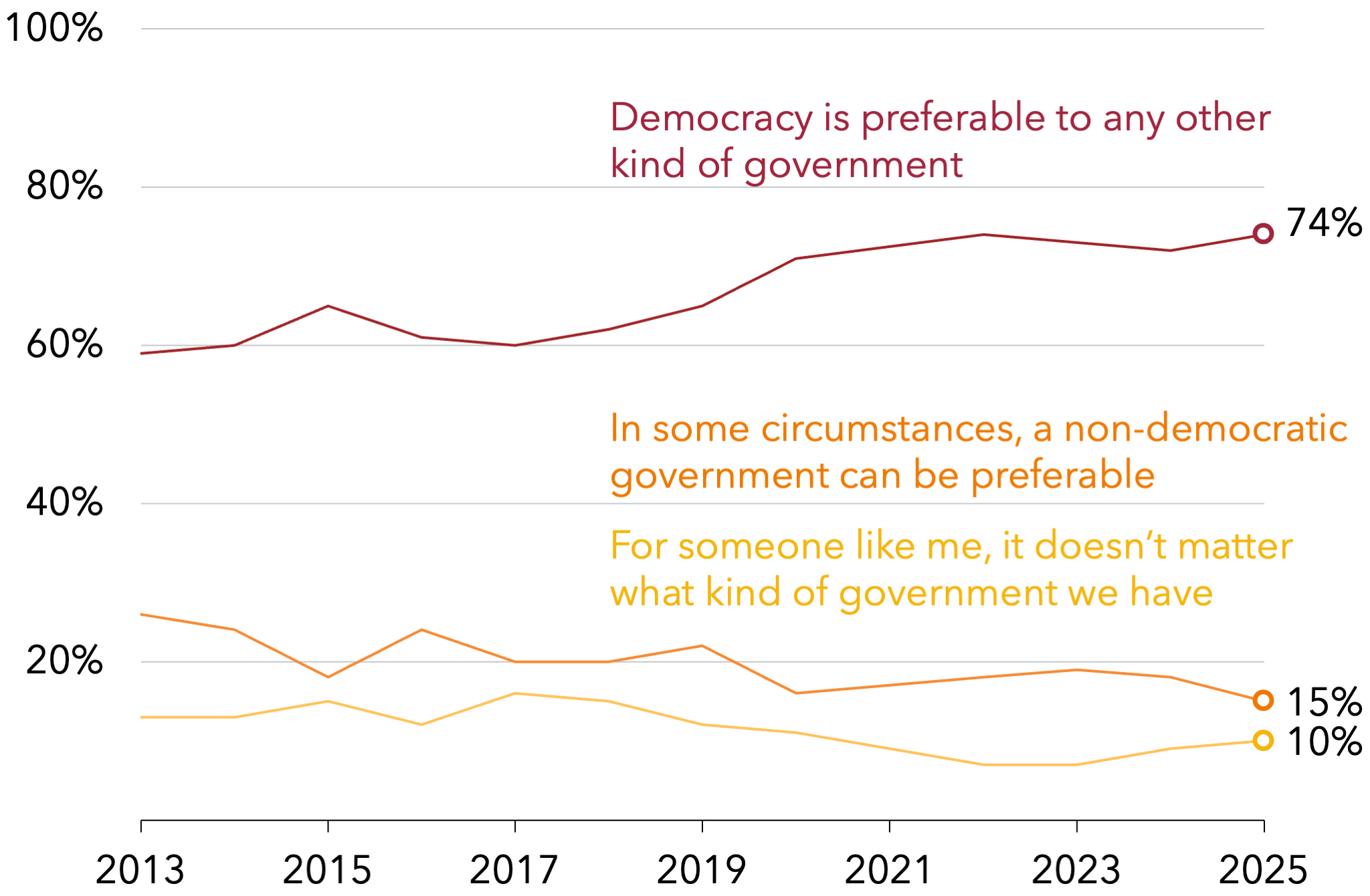
Note: Remainder answered ‘don’t know’. Source: Lowy Institute (2025).
Figure 1.6: …but satisfaction with democracy can be fragile and trust in political actors is low
Proportion of survey respondents who agree with each statement
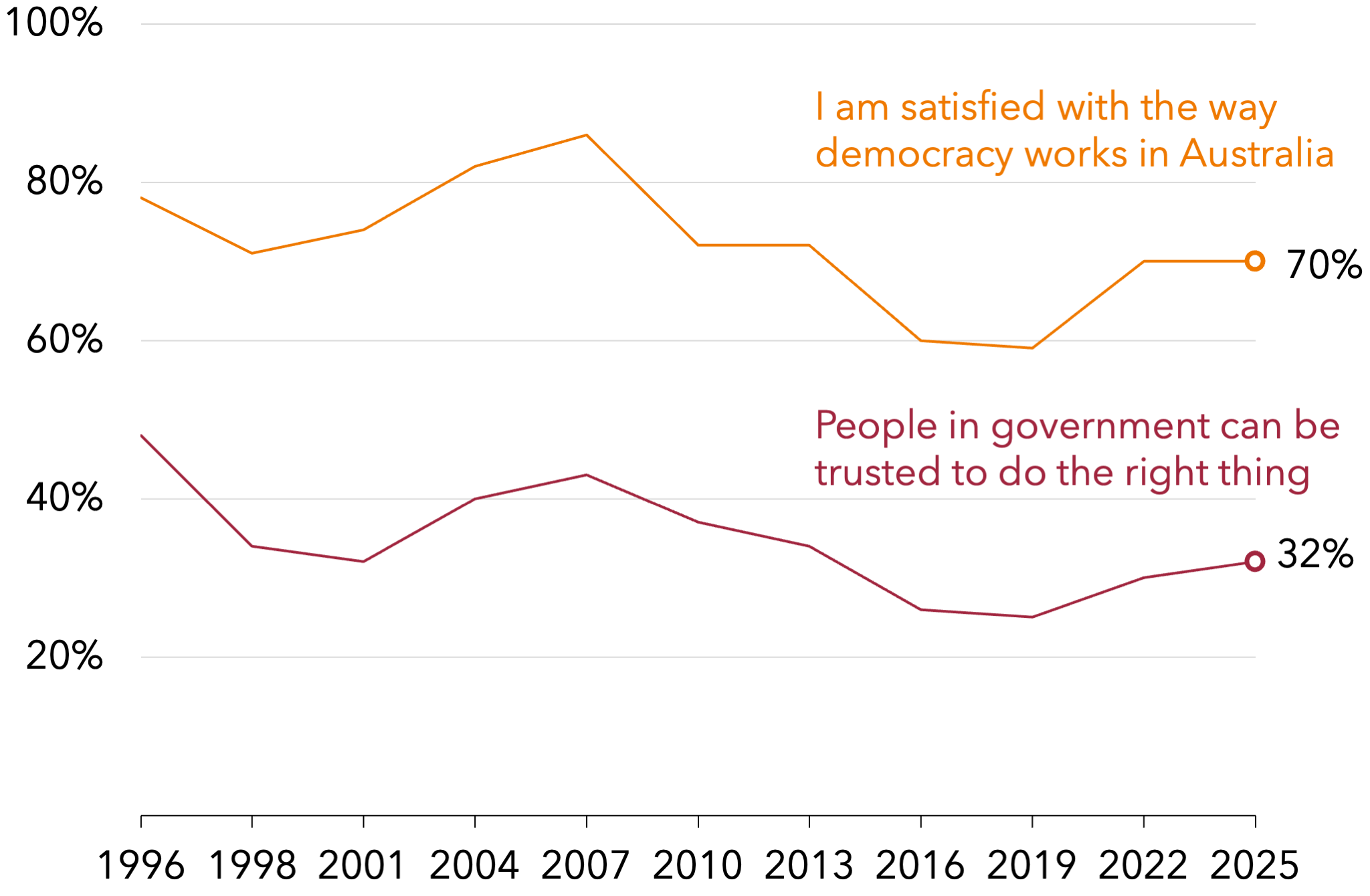
Note: Each datapoint represents an Australian Election Study post-election survey. Source: Cameron et al (2025a).
1.4 A good democracy is not a given, it is a practice
Australia has a proud history of democratic innovation and reform,32See Museum of Australian Democracy (n.d.[a]) and Museum of Australian Democracy (n.d.[b]). including early voting rights for women, and electoral innovations such as the secret ballot, compulsory voting, and preferential voting.33Hill (2021) and Brett (2019). Examples of Australia’s democratic ingenuity were recently documented by the federal government’s Strengthening Democracy Taskforce (2024). But our efforts to update our democratic machinery have fallen off in recent decades.34For example, referendums are much less frequent now than they were in the 20th Century: AEC (2025b). See also Museum of Australian Democracy (n.d.[a]).
Australia is fortunate to have the knowledge systems of the longest continuing cultures in the world,35Behrendt (2025), and M. Graham and Brigg (2020). institutions founded in Western liberal democratic principles, and the broad acceptance of difference that comes from being a nation of migrants.
Our nation faces some real stressors in the coming years – including a harsher physical climate, the energy transition, rapid technological change, unaffordable housing, and the growing needs of an ageing population.36See Sathanapally et al (2025). Our democratic system needs to meet these challenges in a more fragmented information environment, a more unstable global economy, and deteriorating geopolitics.
Australians want and expect our institutions to meet the moment. This report shines a light on what it will take: examining where we are vulnerable (Chapter 2), exacerbating risks (Chapter 3), and the opportunities we should seize to build a better and more resilient democracy (Chapter 4).
Box 1: Australian values
The Australian Values Statement captures a set of core broadly-held values, that all new migrants to Australia are expected to understand and accept. These values are: (a)
– respect for the freedom and dignity of the individual;
– freedom of religion (including the freedom not to follow a particular religion), freedom of speech, and freedom of association;
– commitment to the rule of law, which means that all people are subject to the law and should obey it;
– parliamentary democracy, whereby our laws are determined by parliaments elected by the people, those laws being paramount and overriding any other inconsistent religious or secular ‘laws’;
– equality of opportunity for all people, regardless of their gender, sexual orientation, age, disability, race, or national or ethnic origin;
– a ‘fair go’ for all that embraces: mutual respect, tolerance, compassion for those in need, and equality of opportunity for all; and
– the English language as the national language, and as an important unifying element of Australian society.
a. Home Affairs (2020).
2 Australia’s social compact is under pressure
Discontent with democracy and disengagement from our democratic processes are not especially elevated in Australia, nor does the data suggest they are spreading. But our social compact is under pressure. This is showing up in growing economic pessimism, worry about the prospects for future generations, concern about unfairness, and a declining sense of belonging.
Many of these concerns are common across the developed world, as nations grapple with lower growth, an ageing population, growing wealth divides, and climate change. Critically, both economic growth and how we share the benefits of that growth matter to a resilient social compact.
Efforts to strengthen our social compact may require extra focus on the groups who lack security, opportunity, or solidarity in our society. These factors are important to trust, satisfaction, and engagement.
2.1 There are small pockets of discontent and disengagement
Most Australians value democracy, and think it is preferable to any other system. Some are discontent – meaning they have grievances and deeper frustrations with the system – but the data suggest this share is low, and has been falling in recent years (Figure 2.1).
Figure 2.1: Discontent with the democratic system is low in Australia
Proportion of survey respondents who agree with each statement
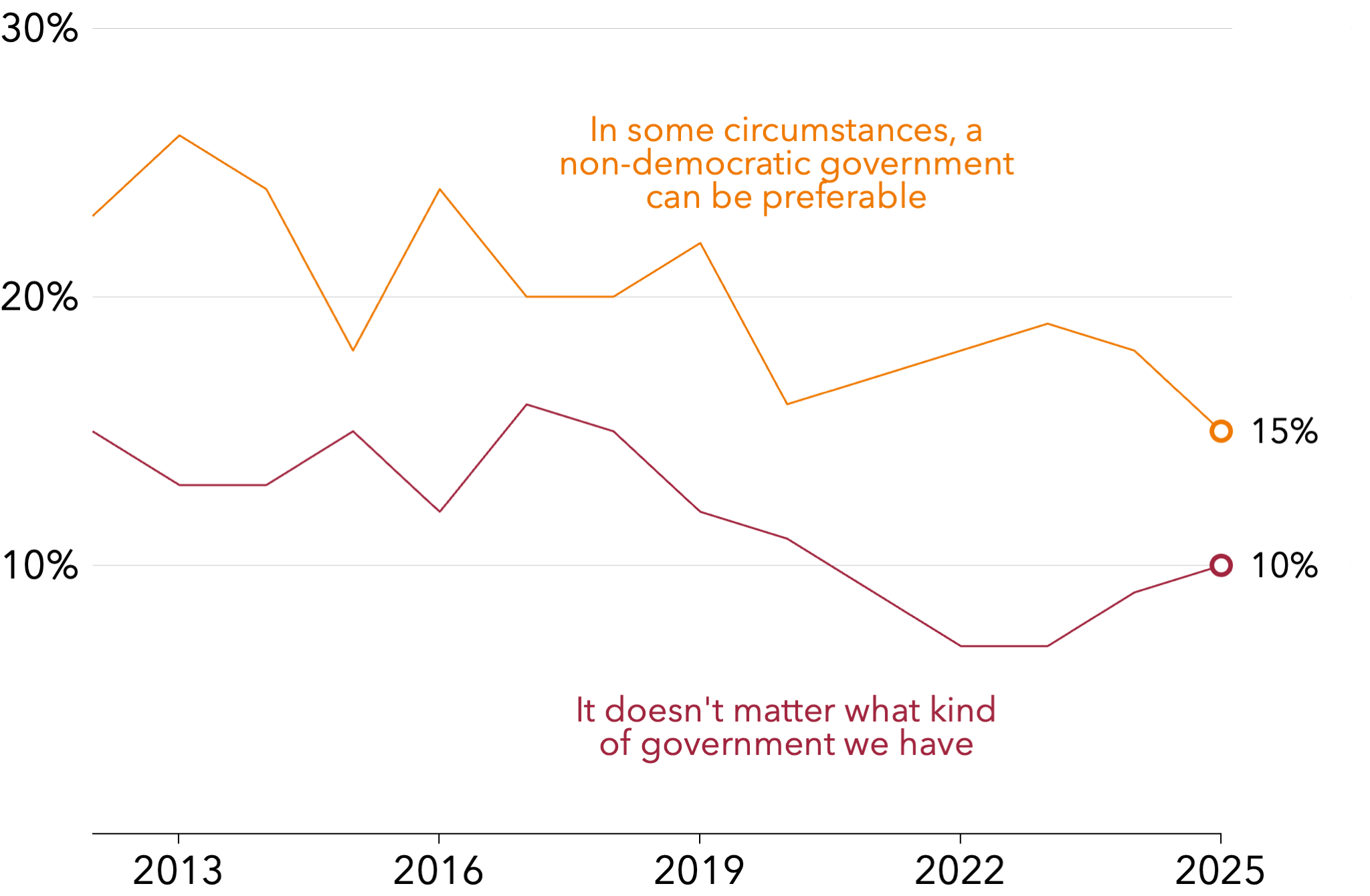
Note: Remainder thought democracy was preferable to any other kind of government. Source: Lowy Institute (2025).
Some groups are more likely than others to be discontent with the system. People with low life satisfaction more generally, and people who have faced discrimination, are more likely to want to ‘remove the current system and start again’.37APSC (2025b). Younger Australians are less likely than older Australians to think democracy is better than any other form of government. But this has been consistent over time, suggesting that a lower attachment to democracy is related to being a young person, rather than being a young person today.38Lowy Institute (2025).
The sovereign citizen movement is one niche but extreme anti-government ideology, where people reject the state and believe they are not bound by the law. A growing number of sovereign citizens are appearing before the courts in disputes with various jurisdictions.39Rule of Law Education Centre (2026), and Roose (2025). While the numbers are still small, these disparate individuals can form communities online, entrenching and encouraging dangerous views (including that laws are optional), and occasionally turning violent.40Hobbs et al (2025), and Sarteschi (2021).
Even among those who support democracy, there is still some tolerance for undemocratic behaviour. In a hypothetical example, Australian and UK voters who would typically preference a democratic leader, on average preferenced an undemocratic leader if it was in service of a policy goal they agreed with.41Werner and Snagovsky (2025). And about nine per cent of Australians agree that ‘it is sometimes justified to use extreme measures such as violence to advance a cause you care about’.42McKinnon (2025a).
Others who feel frustrated with democracy disengage from the system, only participating in minimal ways. Disengagement is a worry because it undermines the legitimacy of governments and can weaken their capacity to govern effectively.
In most democracies around the world, disengagement shows up as empty polling booths.43For example, in the UK, turnout was 72 per cent for the 2016 Brexit referendum (The Electoral Commission (n.d.)) and less than 60 per cent in the 2024 election (The Electoral Commission (ibid)). Turnout in the past two US elections – 66 per cent in 2020 and 64 per cent in 2024 – has been the highest since the 1960s: Hartig et al (2025). But Australia’s system of compulsory voting makes disengagement harder to observe.
Informal voting – when ballot papers are not filled out correctly – tends to be low, though it has risen a little over the past two decades, particularly in regional and rural areas.44Informal votes in regional and remote divisions have increased from 4.5 per cent of the House of Representatives vote in 2001 to 5.9 per cent in 2025. Grattan analysis of AEC (2025c) and ABS (2021). At the 2016 federal election, the AEC estimated that only about 2.7 per cent of votes cast were intentionally informal.45AEC (2018, p. 47). Intentionally informal votes were defined as blank or scribbled- upon ballots with no clear first preference. Another 2.4 per cent of votes cast were estimated to be unintentionally informal.
Survey data suggest that about 15 per cent of voters only vote because it’s compulsory, or because they want to avoid a fine. And another 10 per cent are unsure if they would vote if they didn’t have to.46In the 2025 Australian Election Study, about three quarters of people said they would still vote if it were not compulsory: Grattan Institute analysis of McAllister et al (2025). According to the McKinnon Index, 17 per cent of people say the main reason they voted was to avoid a fine: McKinnon (2025a). This suggests about a quarter of Australians are at least somewhat disengaged, the highest rate since the Australian Election Study began tracking these measures in 1996. For a growing share of Australians, voting is a chore to be ticked off the list, rather than an opportunity to make their voice heard.
Australia’s minor-party vote has grown in recent decades – from about one in five Australians in 2001 to about one in three in 2025 (Figure 2.2). Minor party voting suggests dissatisfaction with the major parties, but is not necessarily a sign of broader discontent or disengagement with democracy.
However, within Australia’s single-member preferential voting system, high rates of minor party voting can translate to limited power in the House of Representatives – especially if such votes are spread across multiple electorates. As such, current trends in support for minor parties risk creating a well of voters who may not see their interests represented in the corridors of power.47See Sheppard (2025). Our multi-member Senate voting system is more proportional, but does not hold the power of governing.
Figure 2.2: Minor party voting is on the rise
Share of first preference votes in the House of Representatives
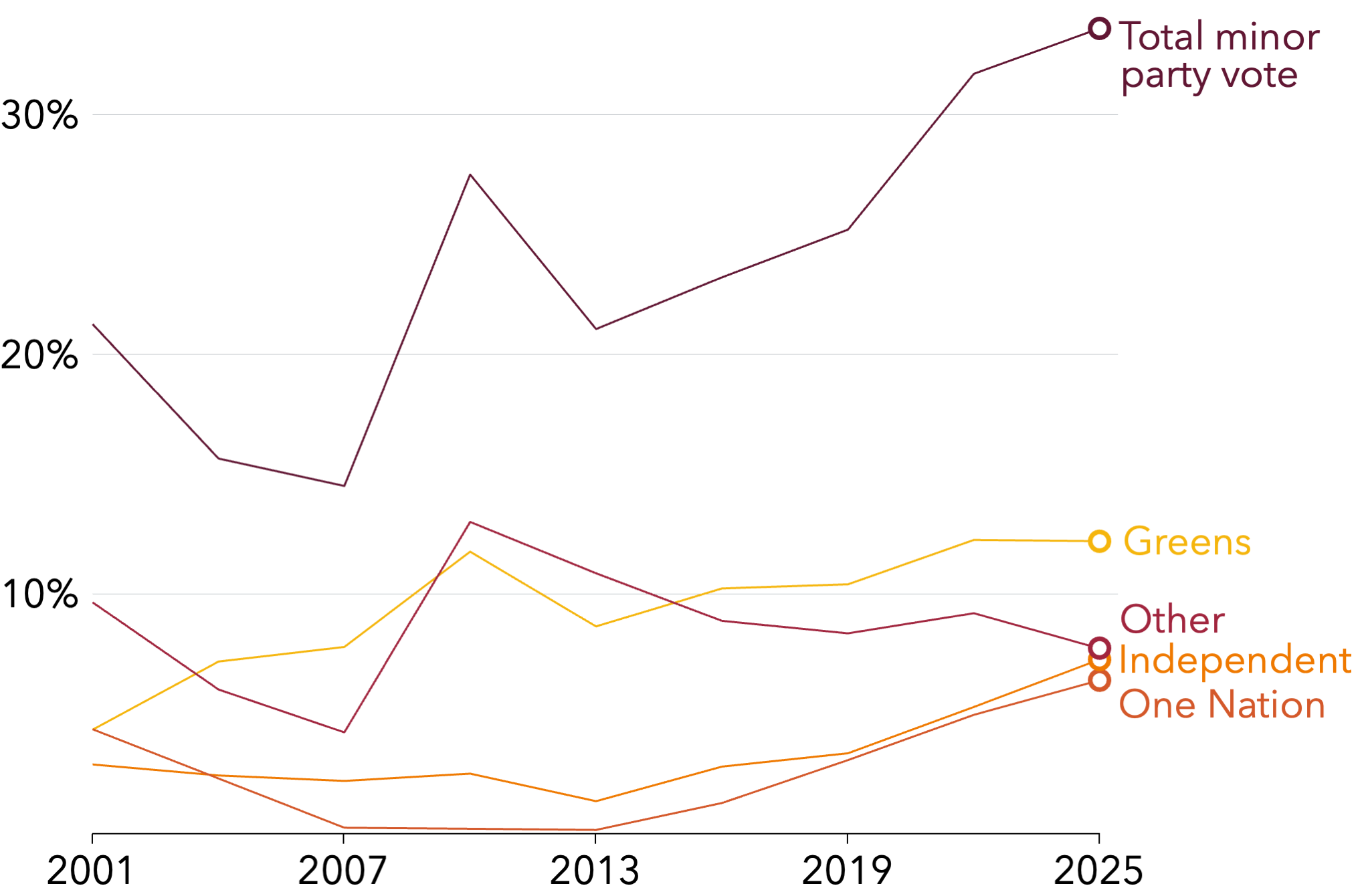
Notes: ‘Independent’ includes all candidates who do not belong to a registered political party. ‘Other’ includes votes for all other registered minor parties. Source: Grattan Institute analysis of AEC (2025c).
Beyond voting, participation in other democratic activities is generally low (Figure 2.3). Signing a petition is the most common activity after voting. About 3 in 10 people signed a petition in the past year,48APSC (2024). rising to about half who signed one in the past three years.49Scanlon (2024). Just 13 per cent of Australians contacted a politician in the past year (20 per cent in the past three years). And fewer than 1 in 100 Australians are members of a political party.50Jordan (2025). Although other data sources suggest that the share of Australians participating in candidate electoral campaigns has increased somewhat, with more than one in ten joining campaigns at the 2025 election: Cameron et al (2025b,p. 13).
Protests are a mixed signal. They can be a broader sign of discontent, but attending a protest is also a well-established pro-democratic behaviour, and one way in which Australians are able to express their views on issues important to them. In 2023, about six per cent of Australians said they had attended a protest, march, or demonstration in the previous year (Figure 2.3).
Recent efforts to restrict protests in the wake of concerns about hate speech and public safety may themselves foster dissatisfaction with how our democracy is working: measures restricting freedom of expression and freedom to assemble peacefully need to be carefully targeted to preserve this channel for Australians to have a voice, while protecting against harm to others.51O’Sullivan (2026), and Ryan et al (2018).
Discontent and disengagement are risks for any democracy, and should be watched with caution. But we shouldn’t wait for them to become widespread before thinking about whether our democracy is functioning as best it can.
Figure 2.3: Democratic engagement beyond voting is fairly low in Australia
Participation in civic activities in the 12 months to June 2023
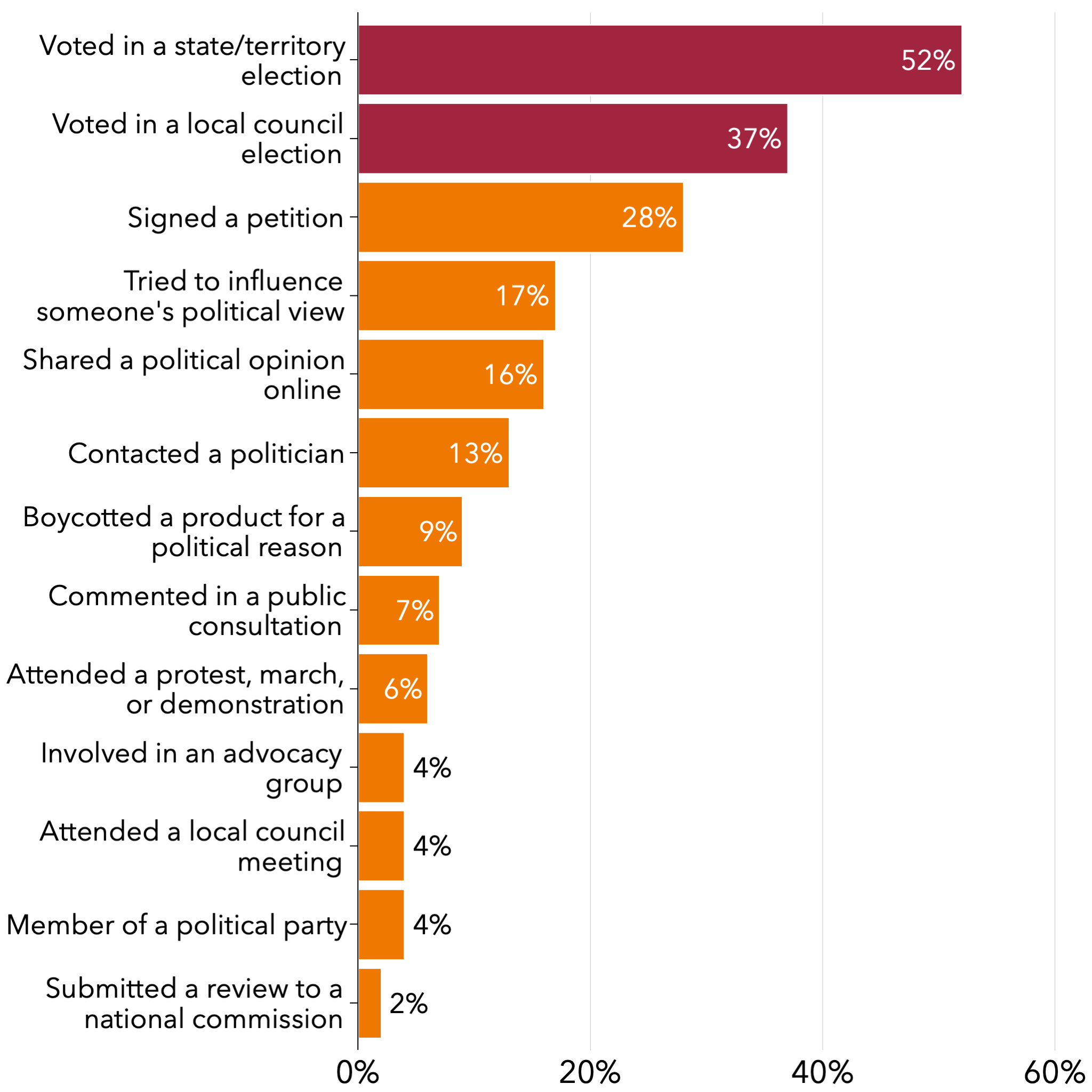
Note: The sample size was 5,039. Source: APSC (2024).
2.2 The social compact is under pressure across the developed world
In a democracy, the people grant power to governments, with the expectation that those they elect will represent them and will make decisions in the public interest. This forms the social compact, wherein we agree to follow the rules and respect public decisions.52E.g. see The Ethics Centre (2016), Zack (2018), and Loewe et al (2021).
Citizens’ expectations help hold governments to account, although these expectations won’t always be aligned with what is feasible or realistic for governments to deliver,53E.g. see Mair (2009) and Allen et al (2018). and there will be reasonable disagreement about what is and isn’t in the public interest.
Some degree of dissatisfaction with how things are working is inevitable and not necessarily a problem for a healthy democracy – it’s an important feedback mechanism, and can be a powerful incentive for governments to respond to people’s concerns. For some people, feelings of dissatisfaction can spur stronger engagement with the system. For example, there is some evidence that while people who don’t trust the government are less likely to vote, they are more likely to engage in other activities such as boycotting products, protesting, and providing feedback on government policies.54Prats et al (2024).
But persistent dissatisfaction or belief that the system is ‘stuck’ and cannot deliver prosperity and fairness is a concern.55Sathanapally (2024). We should be alert to broader dissatisfaction before it hardens into discontent or disengagement. People who feel left out or left behind are particularly vulnerable.
2.2.1 There is a growing sense of economic pessimism
How we feel about the economy is linked to how we feel about democracy.56Biddle (2025a) and Cameron (2020). People who are down about the economy are more likely to feel dissatisfied with democracy, and have lower trust in government.57Biddle (2025a) and Singh and Mayne (2023, p. 205).
The past few years in Australia have been marked by a surge in inflation, and high interest rates as the Reserve Bank has tried to bring inflation back to target. Cost-of-living pressures have been felt disproportionately by the young, the poor, and renters (Box 2).58Sathanapally et al (2025). Though the labour market has remained strong, productivity growth has been weak, house prices and rents have increased rapidly in many high-demand areas, and real incomes have fallen.
A substantial share of Australians feel pessimistic about the economy and the future outlook more broadly. Nearly half feel pessimistic or very pessimistic about Australia’s economic performance in the world over the next five years,59Lowy Institute (2025). Aside from the pandemic period, this is lower than any other time since the survey began in 2005. The sample size is about 2,000. and at the 2025 election only a quarter of Australians thought the economy would improve over the next year (Figure 2.4).
To some extent, these negative expectations reflect a more volatile global economy, over which Australian policy makers have limited control. Trade barriers, inflation, and geopolitical tensions have all contributed to a more uncertain economic outlook. Indeed, economic pessimism seems to be the norm across many countries around the world.60The Gallup International End-Of-Year Survey of 60,000 people in 60 countries (including Australia) found that economic pessimism for the year ahead outweighed optimism in 47 countries: Gallup International Association (2025). A different survey of 20,000 people across 27 countries (not including Australia) found that nearly three-quarters expected life to be harder for the next generation: FGS Global (2026).
A further complication is that economic sentiments don’t necessarily accord with economic reality.61Lower-income Australians and those with financial concerns tend to be less satisfied with democracy (see Section 2.3 on page 23), but many who are financially well-off still exhibit economic pessimism. Perceptions of the national economy – rather than voters’ individual finances – tend to shape their political views,62Lewis-Beck and Stegmaier (2000), and Biddle (2025a). and there are many factors beyond aggregate economic outcomes that influence these perceptions, including media reporting and party allegiances.63Harris and Sojourner (2024).
Past evidence generally suggests that economic voting in Australia is limited,64Hellwig and McAllister (2016). although people who have negative economic expectations are more likely to vote for independents and minor parties.65This association has become stronger since the 2010s: Botha et al (2025).
The risk for Australia’s social compact is if economic pessimism becomes more entrenched, particularly for groups that have been doing it the toughest.
Figure 2.4: Many Australians are pessimistic about the economy
What do you think the general economic situation in Australia will be in 12 months’ time?
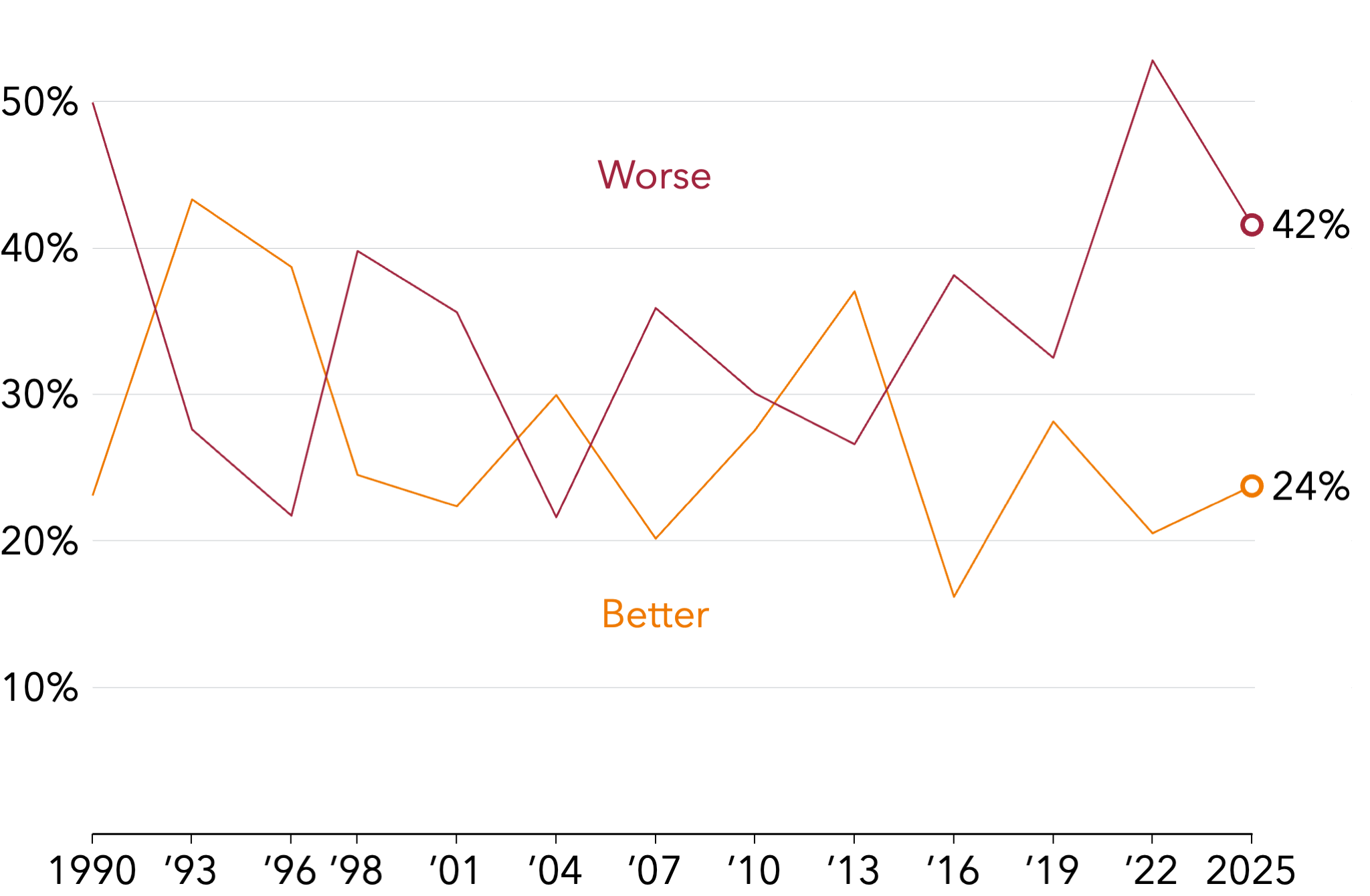
Notes: Share of survey respondents who expect the economy will be a little worse or a lot worse, or who think it will be a little better or a lot better. Australian Election Study surveys are conducted after each federal election. Sources: McAllister et al (2025) and McAllister et al (2024).
Box 2: Financial stress has been rising
Finances are tight for many Australians because of rapid increases in the cost of living over the past few years. Inflation began to pick up in the second half of 2021, peaking at 7.8 per cent in late 2022. In response, the Reserve Bank lifted interest rates from 0.1 per cent in April 2022 to 4.35 per cent in November 2023.
Higher interest rates flowed through to large increases in repayments for many mortgage holders. Rental prices also jumped significantly.(a)
As a result, the share of Australians finding it difficult or very difficult on their current incomes rose from about 21 per cent in 2020 to 35 per cent in 2025.(b) Nearly 13 per cent of people reported multiple indicators of financial stress, the highest rate in more than a decade.(c)
High inflation is harmful for everyone, but it hurts some groups more than others. People on low incomes who have low financial buffers are particularly vulnerable, because they spend more of their income, and have less capacity to absorb higher prices.(d) Renters, single parents, and unemployed people are disproportionately likely to be financially stressed.(e)
a. Hanmer and Marquardt (2023).
b. AIHW (2025a), citing ANUPoll data.
c. Grattan analysis of Laß et al (2025).
d. Bullock (2024).
e. B. Phillips and Narayanan (2021).
2.2.2 Australians are concerned about the fair go
This economic pessimism extends to beliefs about future prospects more broadly. Belief in the ‘fair go’ – the idea that hard work brings a better life – is declining. Just three in five Australians agree this is true, compared to four in five a decade ago.66Scanlon (2024). 2025 data provided to Grattan Institute on request. See Figure 2.7 on page 20. This decline is particularly pronounced among younger Australians.
In another survey, about half of respondents thought life would get worse over the next 50 years for people like them, while only 16 per cent thought it would get better.67Biddle (2025a). And about 60 per cent of Australians think that the income distribution is unfair, a belief which is also associated with lower satisfaction with democracy.68Biddle and Gray (2024).
Measures of inequality show that the top 10 per cent of Australians own about 58 per cent of the nation’s wealth, and that this share has been slowly but steadily growing (Figure 2.5). By contrast, the bottom 50 per cent own just 5 per cent of the nation’s wealth, again steadily shrinking. Income measures show the top 10 per cent earn 35 per cent of the nation’s income, up from 27 per cent in 1970.69World Inequality Database (2025).
Inequality and poverty are weakening flows in a democracy, but tend to be slow-moving.70For example, the Gini coefficients for income and wealth are relatively stable over time: ABS (2025a). Crises and economic shocks can be exceptions to this (see Section 3.7). But perceptions of unfairness may matter even more than actual experience to how we feel about democracy.71Biddle and Gray (2024).
Growth in intergenerational inequality is much more stark. The wealth gap between young and old has widened substantially in recent decades (Figure 2.6), largely driven by the housing price boom and growth in superannuation assets.72Wood et al (2019), and Sathanapally (2024).
These days, older Australians have much greater wealth, income, and expenditure than older Australians did three decades ago. Living standards have improved far less for younger Australians over the same period.73Wood et al (2019).
At the same time, younger Australians face the brunt of climate change and an ageing population, and are far more likely to be affected by threats such as the potential for AI-driven job losses. According to the latest Edelman Trust Barometer survey, just 17 per cent of Australians think the next generation will be better off.74Edelman Trust Institute (2025).
A sense that one generation is drawing down more than is sustainable, or constraining opportunities for subsequent generations, can undermine the social compact, and this phenomenon appears to be playing out across the developed world.75Ibid.
Figure 2.5: Wealth inequality is higher than income inequality, but both are slow-moving
Income and wealth shares of 10th and 50th percentiles
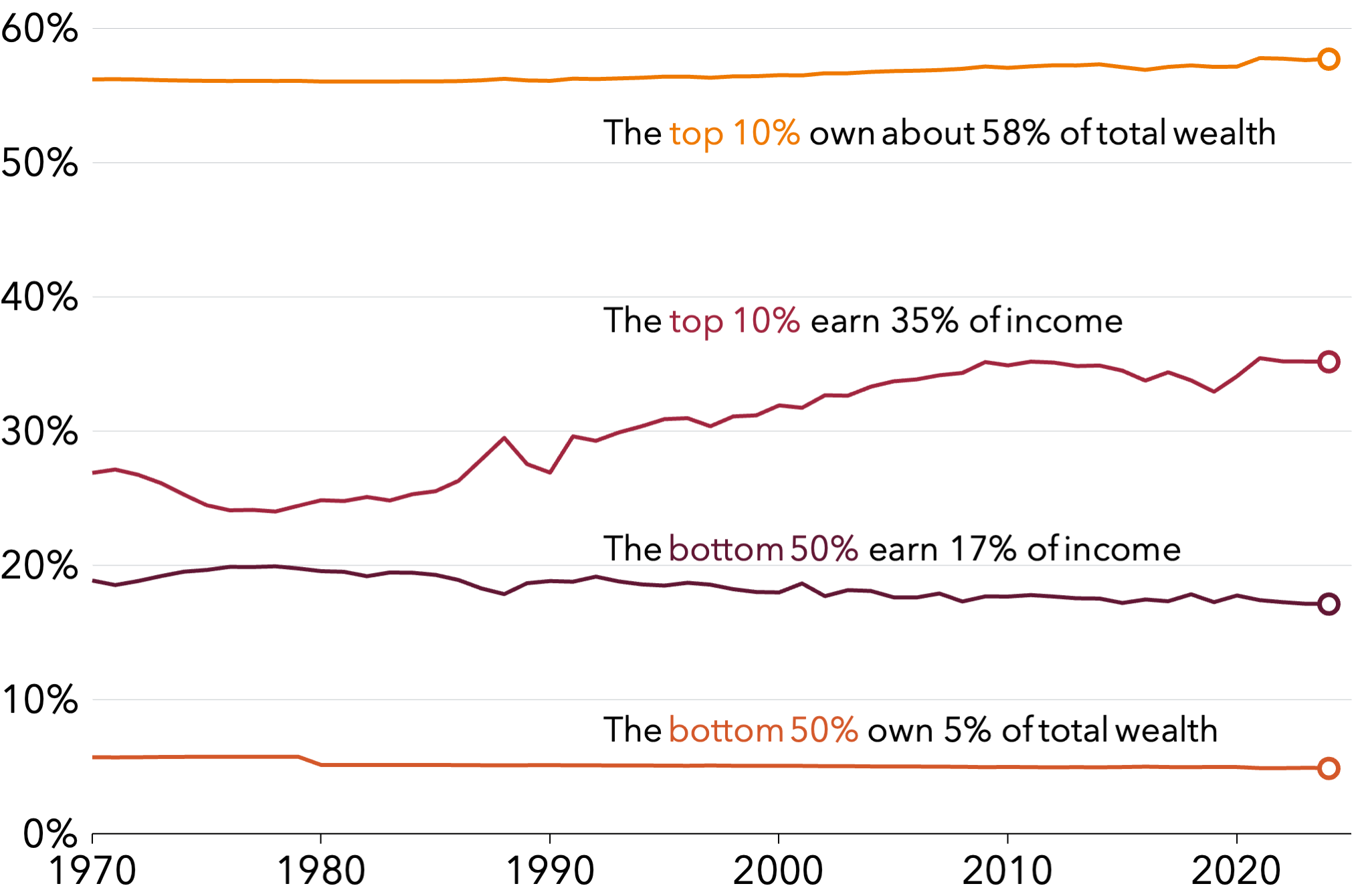
Sources: Fisher-Post et al (2022) and Bajard et al (2025).
Figure 2.6: The wealth gap between young and old is growing
Mean net wealth by age of the head of the household, constant 2025 dollars
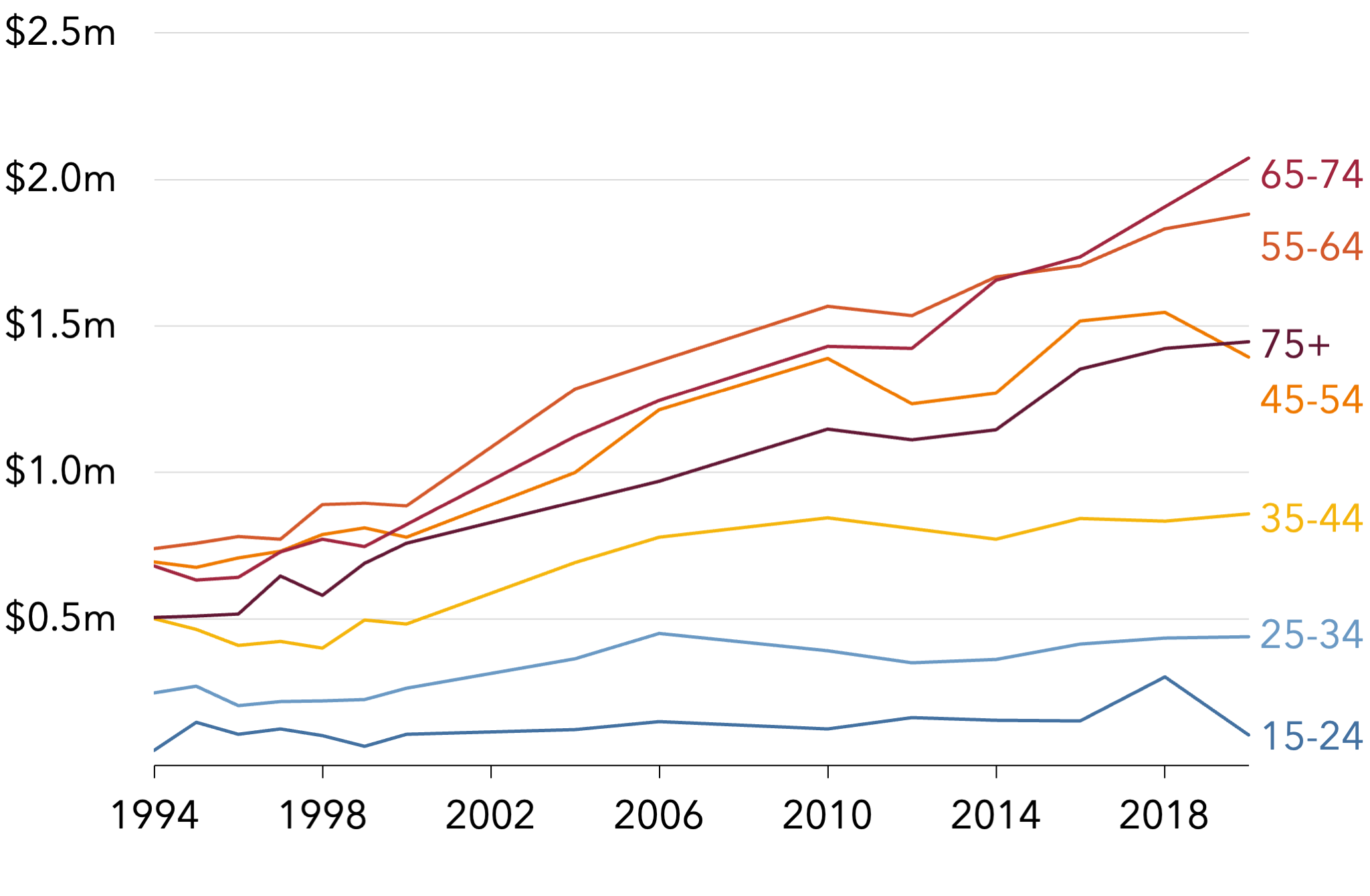
Note: Figures are inflated to 2025 dollars using CPI. The latest data available are for the 2019-20 financial year. Source: ABS (2022) and ABS (2026).
2.2.3 Sense of belonging is declining and recent arrivals face particular barriers to inclusion
Concerns about the economy and fairness are linked to a declining sense of belonging over the past decade. Like economic pessimism, a low sense of belonging is associated with lower trust in government and lower satisfaction with democracy.76Scanlon (2024), and McKinnon (2025a).
In the space of five years, the share of Australian adults who said they felt they belonged in Australia to a great extent fell from 63 per cent to 46 per cent (Figure 2.7).77Scanlon (2025). Most of this decline occurred between 2020 and 2023.
Many things influence our sense of belonging, including changing attitudes to patriotism and how we identify ourselves in relation to our country. Changes driven by these factors are not always a concern for democratic resilience. But we should be alert to decline driven by disadvantage and by exclusion.78Scanlon (2024).
Younger Australians, and Australians who are struggling financially, are more likely to report a lower sense of belonging.79Scanlon (2025). Those who are concerned about economic justice – and think that the gap between high- and low-earners is too high – are less likely to feel they belong.80Ibid.
People who were born overseas in a non-English speaking country are also less likely to feel that they belong. More than one in three in this group say they have experienced discrimination (Figure 2.8) – the antithesis of belonging.81Scanlon (2024).
Recent permanent migrants face barriers to full economic participation that may contribute to their lower sense of belonging. About 44 per cent of recent permanent migrants are working and earning at skill levels below their qualifications and experience – compared to 35 per cent of Australian-born workers.82SSI (2024).
These Australians must also wait up to four years before they can access social security supports.83Services Australia (2025).This contributes to permanent migrants working in jobs below their skill level, and can stop them from undertaking further education and training,84CEDA (2021). hampering their ability to progress to better jobs.
The waiting period was introduced in 1993, when temporary migration was a small part of Australia’s migration system. But nowadays, most people who get a permanent visa have already been living in Australia on a temporary visa for years.85The share of permanent visas granted to people already living in Australia on temporary visas has increased from about 33 per cent in 2004 to more than 60 per cent today. See Bernard et al (2025). So migrants could be in Australia working and paying taxes for almost a decade before having access to Australia’s social safety net.86For example, two years on a working-holiday visa, then three years on a temporary-skilled visa, and then another four-year wait as a permanent resident.
And with the time it takes to gain citizenship also growing, an increasing number of migrants in Australia are living for lengthy periods under a political system that denies them the right to vote (see Section 4.2).
Social isolation is also rising. About 15 per cent of Australians feel socially isolated. Social isolation and loneliness both rose during COVID, and social isolation has remained elevated since.87AIHW (2025b).
The information environment may be partly responsible for Australians’ declining sense of belonging. As people’s realities and experiences become more fragmented and less overlapping, there will be less of a common perspective and understanding of our core institutions and values.88See Chapter 3 and powell and Menendian (2024). Qualitative data also suggest social media makes divisions more visible: Scanlon (2024).
Figure 2.7: Australians’ sense of belonging and opportunity has declined
Proportion of survey respondents who agree with each statement
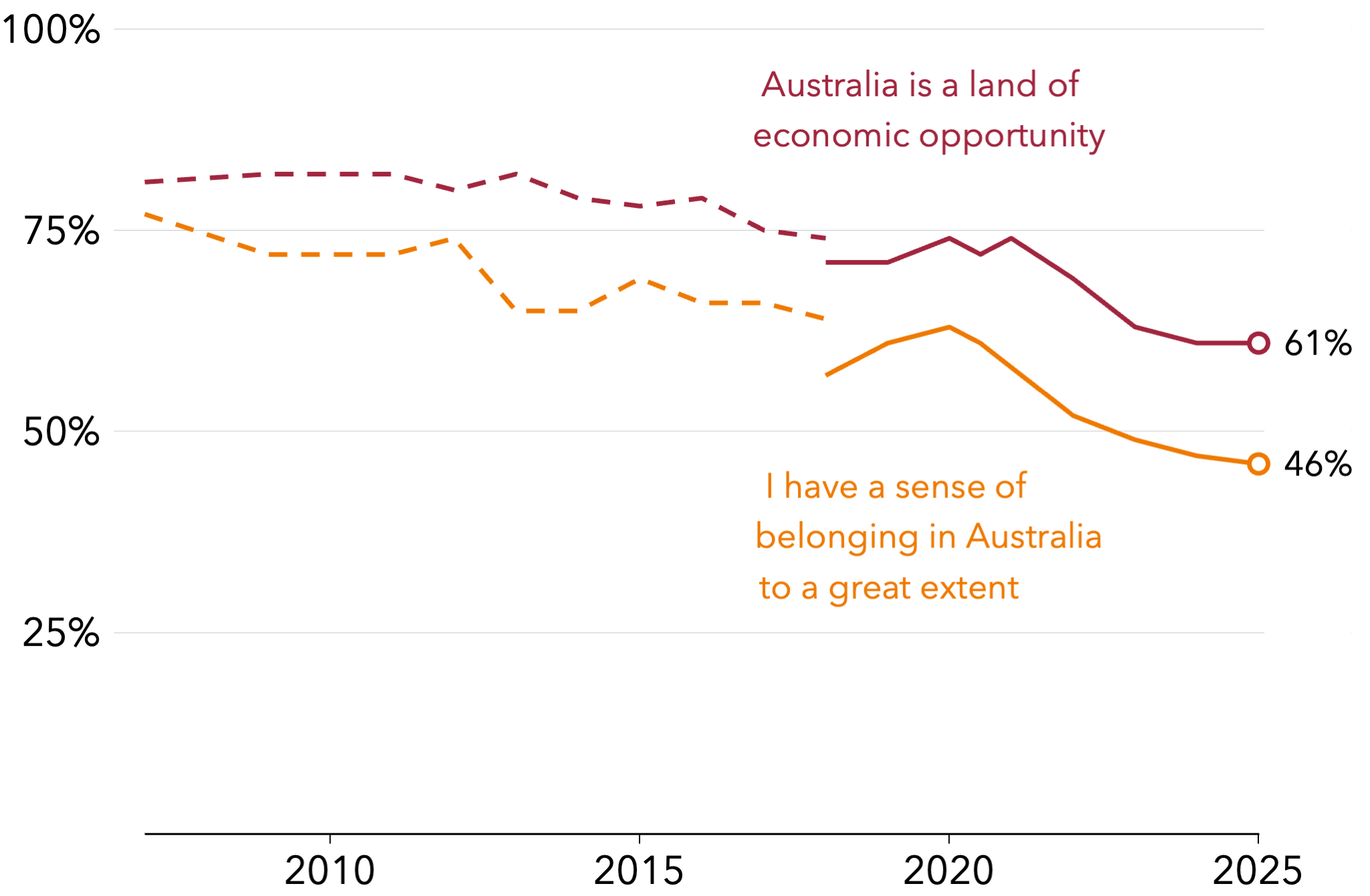
Notes: The full statement on economic opportunity was ‘Australia is a land of economic opportunity where in the long run, hard work brings a better life’. 2025 data on this question was provided to Grattan Institute by Scanlon Foundation. Dashed lines represent when the survey was conducted by telephone. Solid lines represent when the survey was conducted using the largely online Life in Australia panel. Sources: Scanlon (2024) and Scanlon (2025).
Figure 2.8: One in three overseas-born Australians whose first language is not English have experienced ethnic or religious discrimination
Share of adults who had experienced discrimination over the past 12 months
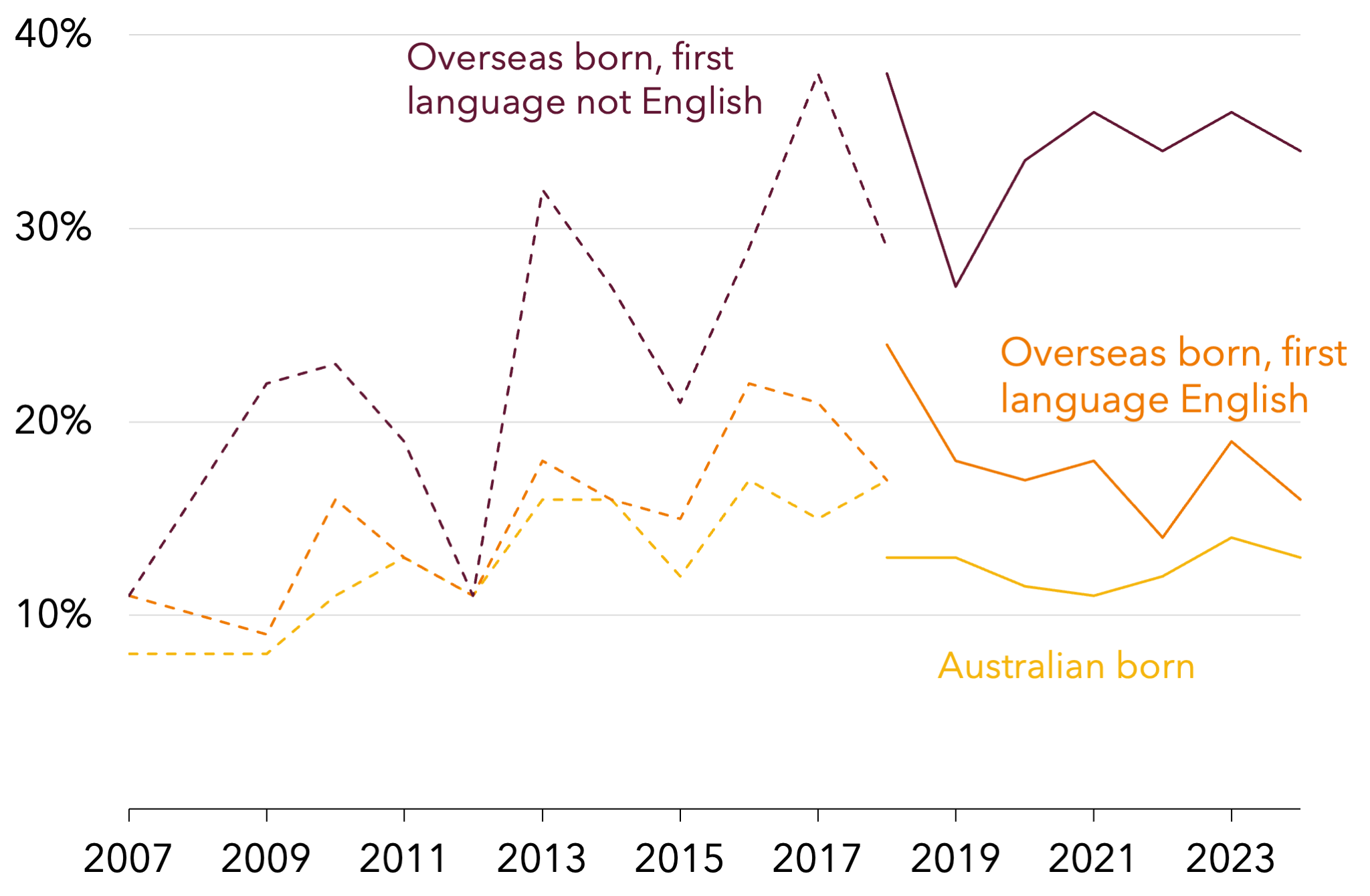
Notes: The full question was whether people had ‘experienced discrimination because of their skin colour, ethnic origin, or religion over the past 12 months’. 2020 data points are an average of two surveys conducted that year. Dashed lines represent when the survey was conducted by telephone. Solid lines represent when the survey was conducted using the largely online Life in Australia panel. Source: Scanlon (2024).
2.2.4 Trust in government is low
The 2025 Australian Election Study reported that just 32 per cent of respondents trust the government to do the right thing at least some of the time (Figure 2.9). This number has risen from a record low of 25 per cent before the pandemic, but remains below the levels seen in the 2000s and early 2010s.89Cameron et al (2025b).
Annual data show trust in government peaking at just over 50 per cent early in the pandemic, before dropping back to the long-run trend of 30-to-40 per cent (see Figure 3.6).
Only two in five Australians think that the federal government is effective, and that political leaders have the capability to solve long-term challenges.90McKinnon (2025a). Fewer than half of Australians think the government is effective at balancing the interests of current and future generations.91OECD (2025a).
Trust in institutions and government effectiveness can be mutually reinforcing. Post pandemic, declining trust in public health guidance on vaccines has at least partly contributed to considerably lower rates of childhood vaccination, leaving communities more vulnerable to severe illnesses such as measles, mumps, and whooping cough.92Breadon and Jessurun (2026), and Steffens et al (2026).
Many Australians are also sceptical about who government serves. Only 41 per cent think government institutions act in the best interest of society.93OECD (2025a). About half of us think the government is run for a few big interests, while seven in 10 think that people in government look after themselves.94Cameron et al (2025b). Indeed, the only measure of trust in government on which Australia performs worse than the OECD average is whether government would refuse requests from corporations that harm the public interest.95OECD (2024). This is despite the fact that Australia performs extremely well on international measures of corruption.96For example, Australia ranked equal 12th out of 182 countries in the 2025 Corruption Perceptions Index: Transparency International (2026).
Australians aren’t brimming with confidence that governments are always acting in our best interests, or able to tackle our big challenges. Yet, many other public institutions are perceived more favourably. In particular, emergency services and public health institutions – the types of organisations that people deal with directly – enjoy high levels of confidence.97APSC (2024). See also Figure 3.2 on page 27. Some of these institutions are highly trusted in part because people have seen them work effectively.98OECD (2025a).
Figure 2.9: Trust in government has risen from recent lows
Share of respondents who agree with statement
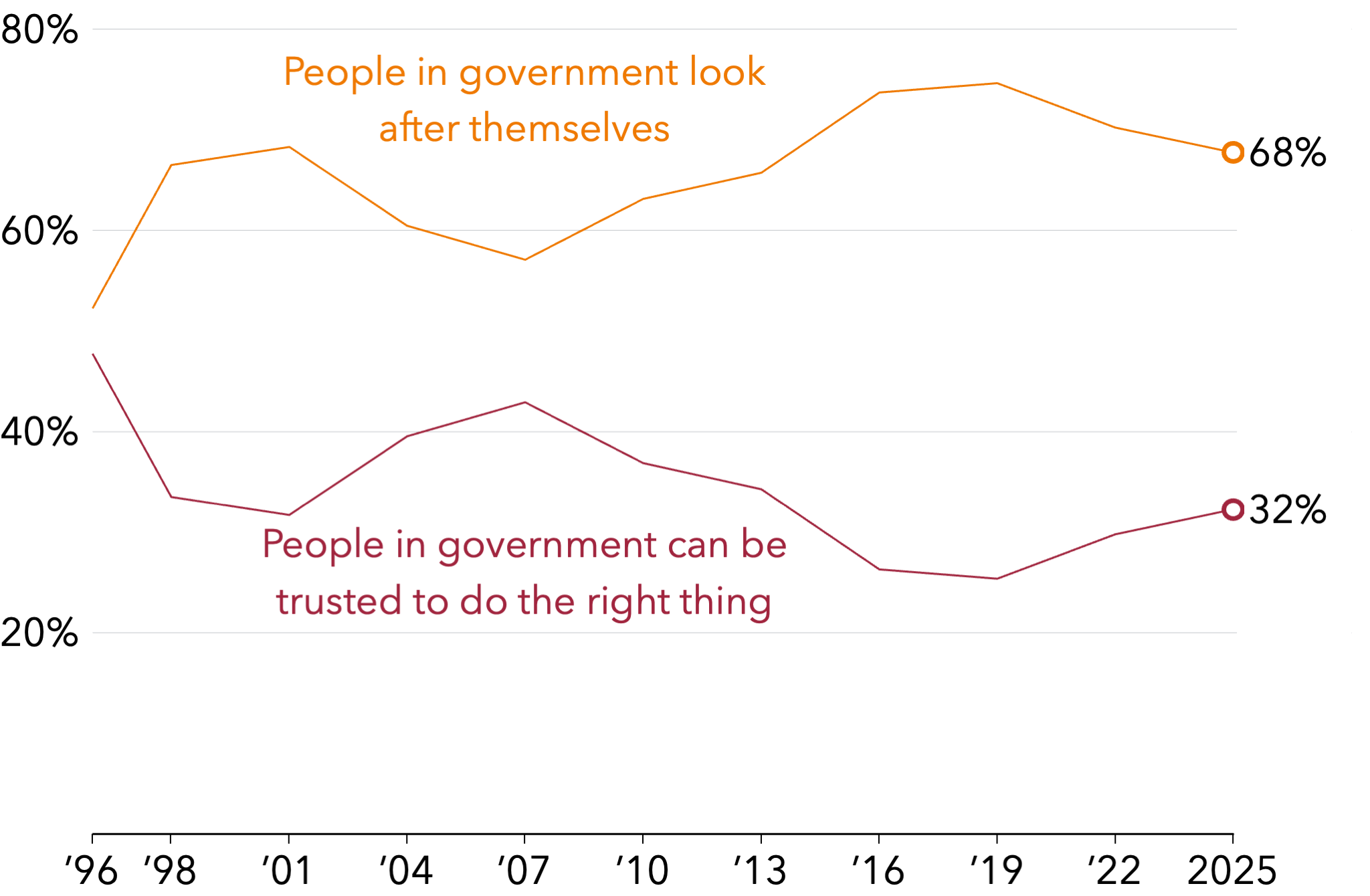
Note: Australian Election Study surveys are conducted following each federal election. Sources: McAllister et al (2025) and McAllister et al (2024).
2.3 Some Australians are feeling it more than others
Lower-income Australians and those with financial concerns persistently report lower trust, and tend to be less satisfied with democracy.99Cameron et al (2025a), Edelman Trust Institute (2025), OECD (2025a), and Biddle (2025b). Renters are persistently less satisfied than homeowners, and people in regional areas are on average less satisfied than people who live in cities.100Cameron et al (2025a), APSC (2024), and McKinnon (2025a). Young people tend to be less satisfied than older Australians.101APSC (2024), Biddle and Gray (2026), and McKinnon (2025a). In the latest Australian Election Study, early satisfaction with democracy among 18-24 year olds is quickly lost, and satisfaction increases with age thereafter: McAllister et al (2025).
Negative life events correlate with dissatisfaction with democracy, including social isolation, financial hardship, unemployment, disability, and discrimination.102APSC (2024).
Migrants are an interesting exception here. Migrants (except for those from the UK) are typically more satisfied with the way democracy works in Australia than people born in Australia,103Ibid. despite the disadvantages they often face living here. This may, at least in part, be due to direct experience with other systems.
Australia’s institutions have long failed to represent or deliver for First Nations people.104For example, assumptions of terra nullius, the state-sanctioned removal of children from their families, only having the right to vote since 1962, and only being counted in the Census from 1971. History naturally shapes people’s feelings about government and their trust in the system.105Taplin (2026). And racial discrimination is still entrenched in our Constitution.106See Behrendt (2025).
About half of First Nations people say they have experienced major discrimination (such as being fired unfairly) in the past two years, and everyday discrimination (such as being treated poorly by others) at least weekly.107Faulkner et al (2022).
Racism and discrimination are associated with a wide range of negative wellbeing outcomes for First Nations people.108Thurber et al (2021). Closing the Gap reports persistently show worse outcomes for First Nations people across a range of measures including health and wellbeing, education, employment, justice, safety, and housing.
Trust in government is generally lower among people who feel they have less political agency. For example, 63 per cent of people who feel confident participating in politics have high or moderately high trust in government, compared to just 28 per cent of those who don’t. And trust is lower among people who feel part of a discriminated group than among those who don’t (56 per cent compared to 69 per cent).109OECD (2024).
People need confidence that the system can work for them, even if it doesn’t always. Groups who persistently lack security, opportunity, and solidarity under the current system cannot reasonably be expected to trust or defend it.
3 Global challenges are testing democracies
Since the end of World War 2, Australia’s political institutions have evolved within a world where democracy was on the rise. As colonial empires were dismantled, a growing proportion of the world’s population lived under systems that treated them as citizens, not subjects. Australia was a leading voice in this post-war movement to embed fundamental human rights and freedoms, alongside other institutions of liberal democracy.
But these are turbulent times for democracies. Our institutions face three interrelated global challenges.
First, the decline in traditional news media and the rise of online and social news sources is fragmenting our information environment, and making misinformation and extreme views more salient in people’s daily lives.
Second, anti-democratic forces are gaining power across the world, and global political tensions are testing Australia’s social cohesion.
Third, the heightened probability of economic, social, and environ-mental shocks increases the challenges democratic governments face to deliver better outcomes for their people.
Although these headwinds are fierce, they need not blow us off course. Australia’s democracy has withstood previous periods of global turmoil, and the broadly healthy state of our institutions equips us well to do so again.
But policymakers need to be clear-eyed about the times we live in. The current global environment shows that safeguarding democracy requires conscious, continuous effort.
3.1 Our information environment is increasingly fragmented
Until recently, most Australians received information about politics and public policy through the TV, radio, or newspapers, even if they were not particularly politically engaged.110Prior (2007). But the rise of online and social media has created a more fragmented information environment.111Aelst et al (2017).
While TV is still the most-used source of news media in Australia, especially among older Australians, almost half of Australians now regularly rely on online sources or social media (Figure 3.1). The habits of younger Australians have changed the most, with more than half of under-35s regularly using online or social media as a source of news.112P ark et al (2025).
This reflects broader shifts in how Australians spend their time, with Australians watching less free-to-air TV and radio, and more streaming music and video content.113ACMA (2024).
The rise in online information is not itself a problem for democracy – online and social media play an important role in how we find and share credible information.114Stier et al (2022). But these shifts in the information environment still present a risk, because they create rapid channels for the spread of misinformation, and they mean Australians can receive ever more disparate news and content, eroding our shared fact base.
Figure 3.1: Social media is now a key news source, especially for younger Australians
Share of respondents who used each source for news in the past week
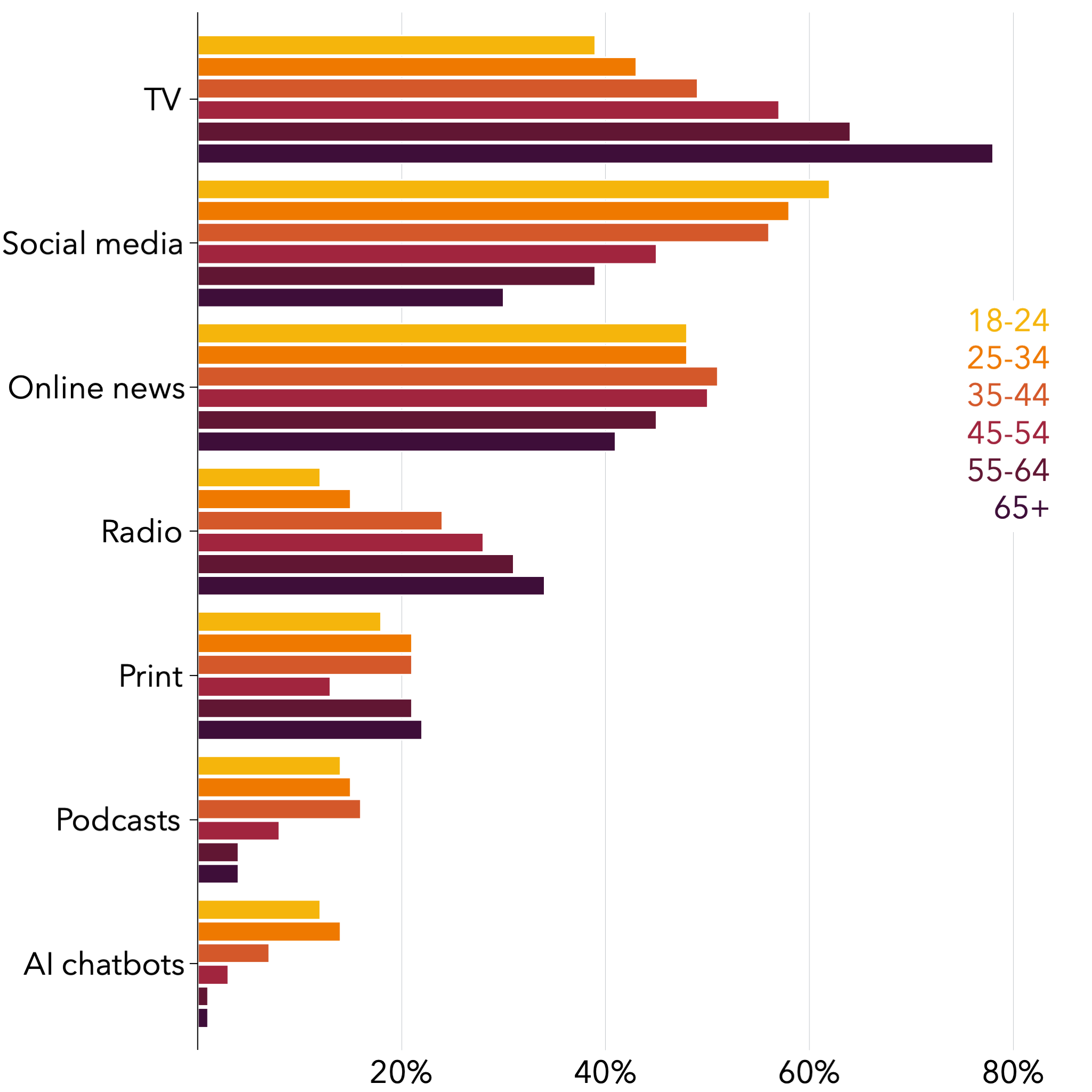
Note: The 2,006 people polled could select multiple sources. Source: Park et al (2025, Figure 4.7).
3.2 News media – an essential democratic institution – is in decline
A strong media ecosystem is essential as a trustworthy source of information for citizens, while also informing policy makers about the views of the electorate and problems facing society. High-quality journalism provides the transparency citizens need to hold their governments to account, acting as a bulwark against corruption and political malpractice.115OECD (2018).
Even when the news media fails to live up to these lofty ambitions, it still plays a key role in promoting democratic norms.116Graber (2003). At the extreme, the censorship of independent media can be an enabler of anti-democratic political forces.117Knight and Tribin (2021).
But the business models that once enabled high-quality news media to thrive in Australia are under threat. And the rise in social media and AI are changing how the public engages with news and information.
3.2.1 Changing news consumption habits put our news media at risk
Journalism has traditionally been able to fund itself through the sale of advertising or by being packaged within broader entertainment products.118Pew Research Center (2014).
The public shift in news consumption from broadcast and print to online and social media has disrupted this model. Among newspapers and their online counterparts, sales of advertisements and subscriptions have failed to make up for the loss of print ad and subscription revenue.119Chyi and Jeong (2024).Only a small number of people are willing to pay a significant sum for high-quality news media.120Næss (2025).
News consumed on social media is also increasingly difficult to monetise, because platforms such as Facebook, X, TikTok, and WhatsApp share only limited advertising revenue with content creators.121See ACCC (2019) and Section 4.5 on page 49. Increasingly, social media platforms are de-prioritising news media.122E.g. see Heath (2025). And the use of AI as a means of accessing online content will only increase the challenge of monetising digital media.123E.g. see Metz and Grynbaum (2025).
These global trends are playing out in Australia, where consumption of print and radio journalism is declining, and there is some evidence that Australians are becoming less interested in engaging with news content.124Park et al (2025, p. 35). As a result, news media in Australia has contracted, with the number of journalists employed declining from 16,100 in 2011 to 13,100 in 2021.125ACMA (2024), and ACCC (2019).
This is particularly the case in regional and rural areas, with many seeing declines in local news production, and 29 local government areas having no local print or digital news source at all.126Draffin et al (2024). Australians who rely on AI or algorithmically-driven social media platforms for their news may also be less likely to see relevant local news stories, because these tools generally rely on information from dominant US or European news providers, at the expense of Australian sources.127Koskie (2025).
Evidence from overseas suggests that these shifts can harm local politics. One study from the US found that reduced local newspaper coverage led to more partisan local elections, with debates increasingly focused on national rather than local issues.128Djourelova et al (2024).
While publicly-funded media such as the ABC and SBS play a key role in creating and distributing high-quality news, these institutions alone cannot be expected to fill the gap left by the decline in their commercial counterparts.
3.2.2 Australians are consuming more online media, but don’t trust it
While Australians are increasingly turning to online and social media for their news, they also generally report lower trust in online news sources and social media companies, compared to traditional public and commercial broadcasters (Figure 3.2).129See also Park et al (2025, p. 111). This might suggest a healthy scepticism in navigating the online world, but it also risks lowering public trust in information more broadly.130Fletcher et al (2024).
A clear decline in media trust isn’t yet evident. Trust in Australian media has fallen from its pandemic spike, but is still higher than a decade ago. Yet at just 37 per cent it is still lower than Australians’ trust in government (47 per cent), and well-behind leading countries such as Singapore, the Netherlands, Italy, and Canada, which all record majority trust in media (Figure 3.3).131See also A. Carson and Grömping (2024).
There is also the risk that increasing pressure to generate revenue may encourage both traditional and start-up news media producers to act in less trustworthy ways, such as by cutting costs with AI-produced articles, or producing ‘sponsored content’ that blurs the boundaries between news and advertising, further eroding trust.132E.g. see ABC (2026).
On a brighter note, Australia’s public media has been able to maintain relatively higher levels of trust,133See Figure 3.2. and Australians still turn to mainstream media during elections.134Cameron et al (2025a).
Figure 3.2: Australians have relatively low trust in media, especially social media
Share who trust institutions to act in the best interests of Australians
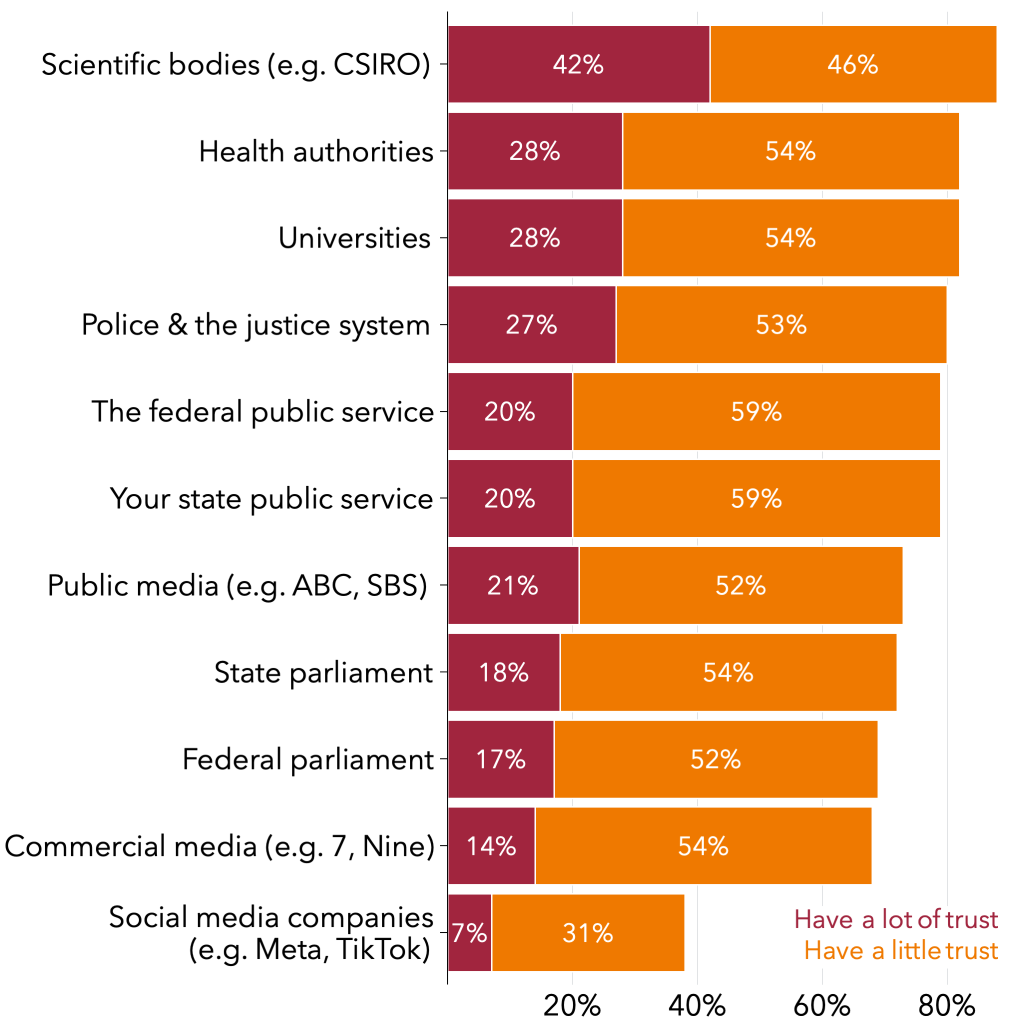
Notes: The question was: ‘How much trust do you have in the following institutions and organisations to act in the best interests of everyday Australians?’. The 2025 survey was of 4,057 people. Source: Provided to Grattan Institute by McKinnon.
Figure 3.3: Australians are less trusting of the media than people in many other countries
Share of respondents who trust the media to do what is right
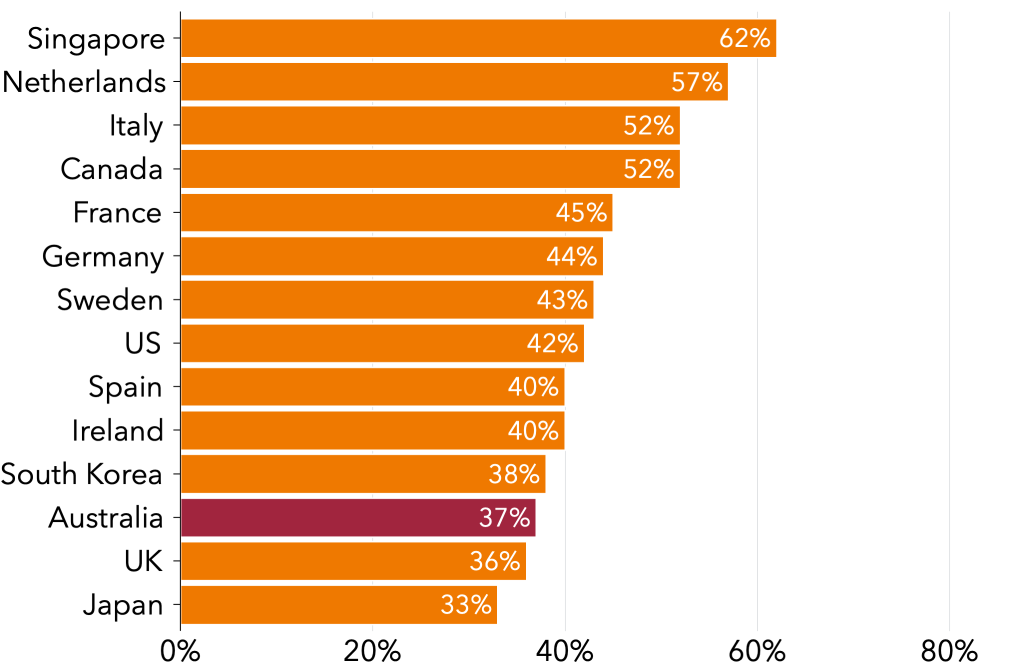
Note: ‘Trust’ defined as individuals who rank trustworthiness as four or above on a nine-point scale. Source: Edelman Trust Institute (2025).
3.3 Australians are increasingly concerned about misinformation and disinformation
Three-quarters of Australians say they are concerned about misinformation, with the majority categorising it as a ‘big’ or ‘very big’ problem.135 And there is particular concern about the volume of misinformation on social media platforms.136
Three in five Australians reported encountering political misinformation in the two weeks before the 2025 federal election.137 The most common types of misinformation Australians say they encounter concern societal groups (for example false information about ethnicity or disability), followed closely by misinformation about health and medical issues, and geopolitical issues (Figure 3.4).
Misinformation – the unintentional spread of false news – has become a matter of concern for democracies around the globe. Experts have ranked it the second-highest short-term global risk for 2026.138
But not all ‘fake news’ is the same. Some fake news is intentionally spread (known as disinformation) and some truthful content can be harmful too, such as malicious rumours (known as malinformation).139
Misinformation in politics is nothing new: infamously, false rumours about an elite plot to hoard grain was an inciting factor in the 1789 French Revolution.140 Yet a high volume of misinformation in the public sphere remains a significant risk for democracies, because it muddies the flows of information that underpin democratic deliberation.141
Whereas in the past key media gatekeepers sought to combat misinformation, today its spread is accelerated by the fragmentation and decline of news media, and people either opt into or are nudged toward more polarised online spaces.142 In some contexts, online platforms may even indirectly incentivise misinformation, by surfacing and even remunerating creators of extreme content.143
More recently, the rise of generative AI has vastly increased the volume and ‘quality’ of misinformation and disinformation. Artificial videos, photos, and audio can more easily be produced and distributed than ever.144 While people are often sceptical of information they know is AI-generated, AI itself often draws on or creates false content.145
There is evidence that AI has had an impact on elections in at least 50 countries, including Canada and the UK.146 Political biases can be deliberately or accidentally built into AI tools.147
Taken collectively, these trends increase the ability of misinformation to confuse public understandings and expectations of our democratic system.
Indeed, a high volume of misinformation makes it harder for people to hold governments to account.148 And disinformation is linked to growing harassment of elected officials, potentially deterring people from standing for office and making parliaments less representative.149
Figure 3.4: Misinformation about minority groups or health and medical issues is common
Share of respondents who saw or heard each type of misinformation in the past year
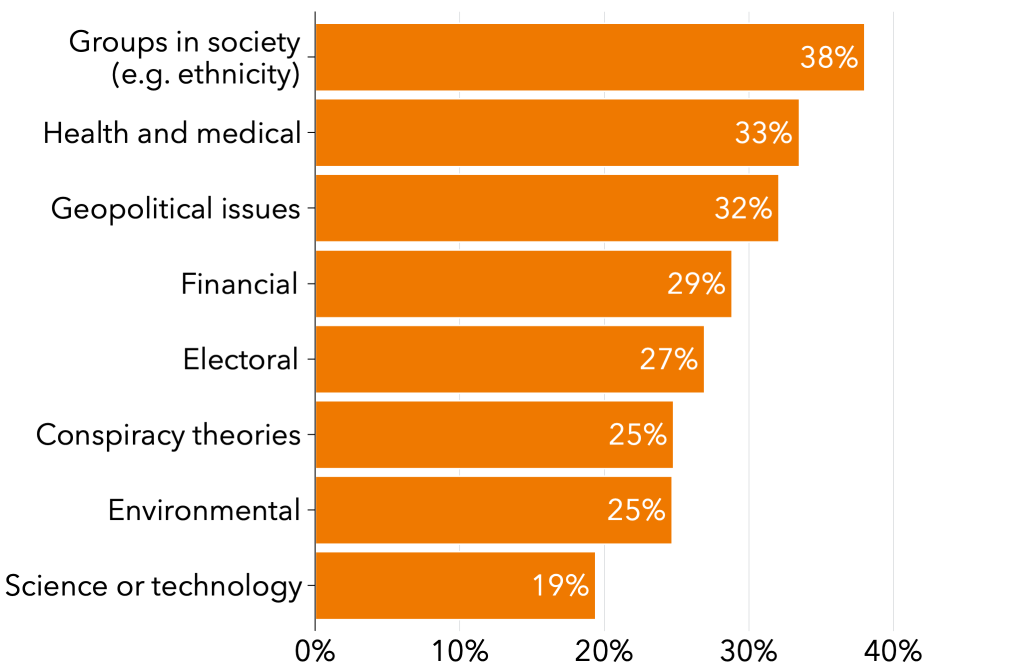
Note: Respondents were able to nominate multiple options. The effective sample size was 5,307. Source: ACMA (2025).
Misinformation may be as much a symptom as a cause of democratic backsliding
The dangers of misinformation should not be overstated: even online, misinformation makes up only a tiny proportion of all information people encounter, and its ability to shift individuals’ opinion is limited.150
Moreover, evidence suggests that misinformation is more likely to take hold where it aligns with people’s broader ideologies, beliefs, and political commitments.151 This means that misinformation may be an indicator of democratic ill-health – it is likely to be more prevalent where communities are divided, politics are polarised, and truth-seeking institutions are less trusted.
Given this, policy makers should be concerned as much about the ‘demand’ for misinformation – the factors that drive people to seek out and accept false ideas – as they are about the ‘supply’.
3.4 Democracies around the world are increasingly threatened by polarisation and extremism
In a democracy, there will inevitably be conflicting ideas on important political issues. Disagreement is often healthy – and in a healthy democracy there will be reasonable disagreement on important principles that society needs to work through constructively and openly.152
But polarisation – often defined by heightened political conflict over core democratic norms – can make it harder to maintain healthy disagreement, creating a ‘doom loop’ that weakens key democratic norms and the institutions holding governments to account.153
Taken to its extreme, polarisation can inflame ethnic and social divisions and incite violence toward political opponents.154 And survey research suggests that people are more likely to support political violence when they believe their political opponents already support such extreme measures.155
3.4.1 Australia is not particularly polarised, but there are
Most indicators suggest Australian politics are not highly polarised.
Surveys of political experts suggest that polarisation in Australian politics has been relatively stable since the 1970s (Figure 3.5).
Polls of everyday Australians paint a picture of a community that is generally able to overcome its political divisions.156 Only about 1 in 10 Australians say they could not be friends with people of different political views, and fewer than 1 in 10 say that the use of political violence is sometimes justified to advance political causes.157 Political affiliations appear less central to social relations in Australia than in highly polarised countries such as the US.158
These indicators are reassuring, but Australians should still be on guard against the risks of heightened political division. Expert ratings indicate there has been growing political polarisation in the past decade in peer democracies – notably the US, UK, and New Zealand (Figure 3.5).
New approaches for understanding and tracking what binds and divides us may provide better leading indicators.159
Migration in particular can be a polarising political issue for Australia,160 and many other democracies, animated by economic and social concerns, but also by nativist movements that seek to exclude or diminish people based on ethnic or religious origin (see Box 3).
And more broadly, the global spread of extremist ideologies can stoke social divisions within Australia. This can be seen in the growing presence of fringe political movements in local government elections, and the popularity of anti-feminist ‘manosphere’ ideologies among some Australian men.161
Extremist ideologies can lead to horrific violence, as Australia saw with the antisemitic terrorist attack at Bondi Beach in December 2025. Criminal proceedings are currently examining how the massacre unfolded, and a Royal Commission is investigating the surrounding circumstances and what Australia can do to prevent future attacks and strengthen social cohesion.162
Figure 3.5: Australia has not grown more polarised in recent years – but some peer democracies have
V-Dem index of political polarisation
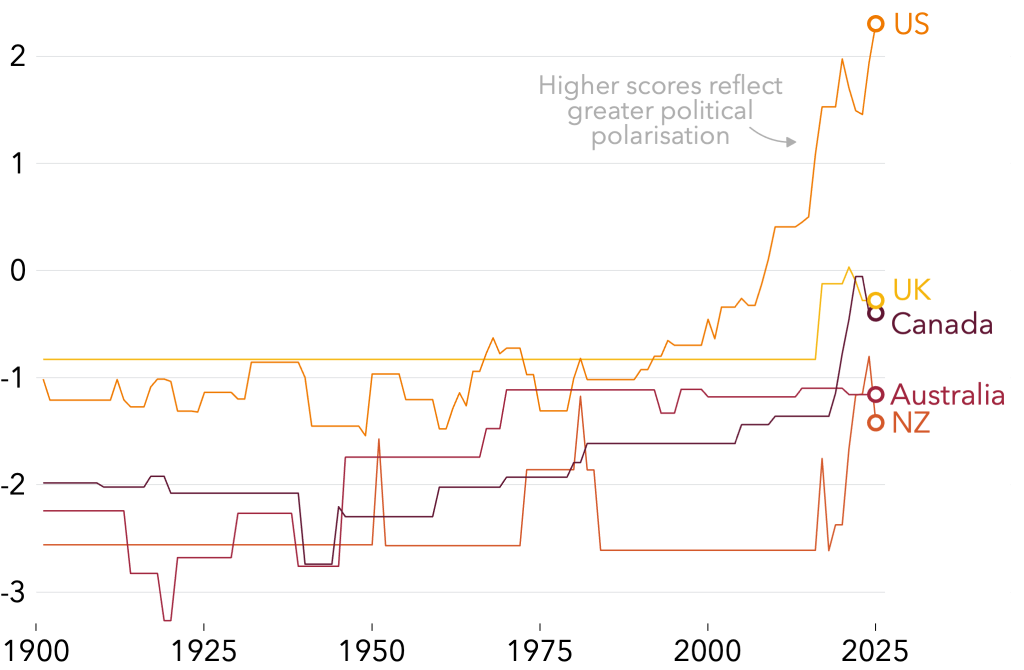
Note: The V-Dem index aggregates expert ratings on whether society in a country is ‘polarised into antagonistic political camps’. Source: Nord et al (2026).
Box 3: Migration can be a polarising political issue
People who are dissatisfied with democracy also tend to have less favourable views of migration.(a) But the recent uptick in anti-migration sentiment(b) poses a deeper risk to our democracy.
Debates around migration are fertile ground for movements who do not accept core liberal democratic principles of equal dignity, irrespective of race or religion. When emboldened, these movements seek to amplify divisions, increasing the prevalence of racism toward new migrants and minority ethnic groups.
In Australia, concerns that migration levels are too high typically relate to concerns about crime, the economy, and housing, with support for multiculturalism more generally remaining relatively high.(c) Indeed, opposition to migration is often rooted in people’s perceptions of its effects, rather than personal experience – anti-migration sentiment is often higher in areas with fewer migrants.(d)
But dangers to social cohesion still remain: in other democracies, more explicitly racist movements have gained prominence, and brought illiberal ideas into the mainstream.
Inflammatory statements about migration and race often receive sustained media attention. In these circumstances we must reinforce broadly-held values: Australia is a country of migrants, and while migration numbers are necessarily limited and contested, Australians of all backgrounds belong here as equals.(e)
a. Biddle et al (2025).
b. Grattan analysis of Cameron et al (2025a).
c. Scanlon (2025). See also Parkinson et al (2023).
d. See Kustov (2021) and Wood et al (2018a, pp. 61–65).
e. Home Affairs (2020), Sathanapally (2026), and Petter et al (2026).
3.5 Anti-democratic forces are on the rise globally
The steady rise of anti-democratic actors around the globe also threatens to spill over into Australia, including through attempts at foreign interference in political processes.
These actors vary in both their scale – from extremist political movements to authoritarian nation states – and their motivating ideologies. But they are unified by their willingness to export anti-democratic practices such as political violence and manipulation of the information environment to other countries.
Within Australia, public attention has often focused on attempts by foreign actors to influence the political behaviour of diaspora communities. In some instances, foreign actors have sought to disrupt pro-democracy protests, and punish the overseas family members of Australians who speak in opposition to authoritarian regimes.163
A 2023 Senate inquiry into foreign interference on social media also found that online platforms were being used in a coordinated way by foreign actors to monitor and harass dissidents, and spread disinformation about disfavoured politicians.164
But much of this influence is less overt. Increasingly, international actors opposed to democracy have sought to fund politically-aligned think tanks and news organisations.165 Such actors seek to make extreme views appear more widespread, and target groups who are often ill-served by existing news media and other democratic institutions.166
3.6 Shocks beyond our control could change the game
The risks to Australian democracy are not limited to slow-moving challenges of media, misinformation, or polarisation: geopolitical tensions, rapid technological change, and the impacts of climate change also loom large. As has become evident in 2026, the world is more volatile, and disruptions beyond our control can substantially change Australians’ lives and livelihoods.
External shocks can expose and often deepen existing inequalities, undermine trust, and strain social cohesion.167 They are particularly dangerous when they lead voters to turn toward illiberal politicians who promise security at the expense of democratic checks and balances.168
The OECD has identified 25 emerging challenges that could shift the policy landscape between 2030 and 2050.169 Several of these shocks present particular challenges to Australia’s democracy:
- Armed conflict, both within and between states, has become more common in recent years.170 Australia’s response to these conflicts may force difficult ethical and fiscal choices, stoke political divisions at home, or lead to increased irregular migration flows.
- Falling global co-operation is undermining multilateral organisations that previously upheld liberal democratic values, and leading to economically-damaging trade barriers.
- Climate change increases the likelihood and severity of natural disasters, including heat waves, bushfires, and floods.171
- Artificial intelligence could begin to replace a large share of the workforce in key sectors, even as economic growth increases.
The range of potential shocks makes it likely that states will face rolling crises or concurrent shocks over the coming decades, with governments expected to (largely) shield populations from their impact.172 Most Australians anticipate multiple, intersecting shocks, with particular concern about economic, climate, and AI-related shocks, that some Australians are already living with.173
Government actions to prevent and respond to crises matter, but so does the broader health of our institutions and practices. A resilient public sphere is an essential support to effective crisis response.
This means that the media, government, and society at large must be able to continue to generate credible and trusted information, while sustaining tolerant public debates.174
Key factors in the face of shocks include unifying public discourse from political leaders, responsible media reporting, strong engagement with civil society, and continued participation of diverse voices in the public sphere.175
Crisis response also requires ready access to expertise, and effective cooperation among expert bodies globally, for example central banks and health authorities. Investments in technical knowledge and in relationships across borders enable more effective responses to hard-to-predict events.
3.7 Fiscal and economic shocks are stress tests for democracies
Australians turn to government – and expect leadership – in crises. If governments step up, they are rewarded with trust, as we saw at the height of the pandemic (Figure 3.6). And if they don’t, the public turns on them, as we saw during the 2019-20 bushfires.176
Australian governments and expert institutions have historically performed very well in global economic shocks, as well as health crises such as the COVID pandemic. At the same time, the nature of Australia’s federation means that different and sometimes overlapping responsibilities can be a challenge for coordinated national action, and for public confidence and understanding.
The ability to draw on a strong fiscal position is one of the main defences Australia has in the event of an economic downturn. Having the funds and political capital to spend big when needed cushions the blow, which was crucial to Australia’s relatively speedy economic recovery from both the Global Financial Crisis and the COVID pandemic.
Today, Australia’s national fiscal position is strong in comparison to peer advanced economies, but state budgets in particular are under pressure.177 History also shows that while economic responses to shocks are meant to be temporary and targeted, in practice governments find it hard to pull back spending. An underlying imbalance between our spending and the revenue we raise to pay for it – if left unaddressed – weakens our ability to respond to future crises.178
Figure 3.6: Trust in government often peaks during crises
Share of respondents who say they trust government all or most of the time
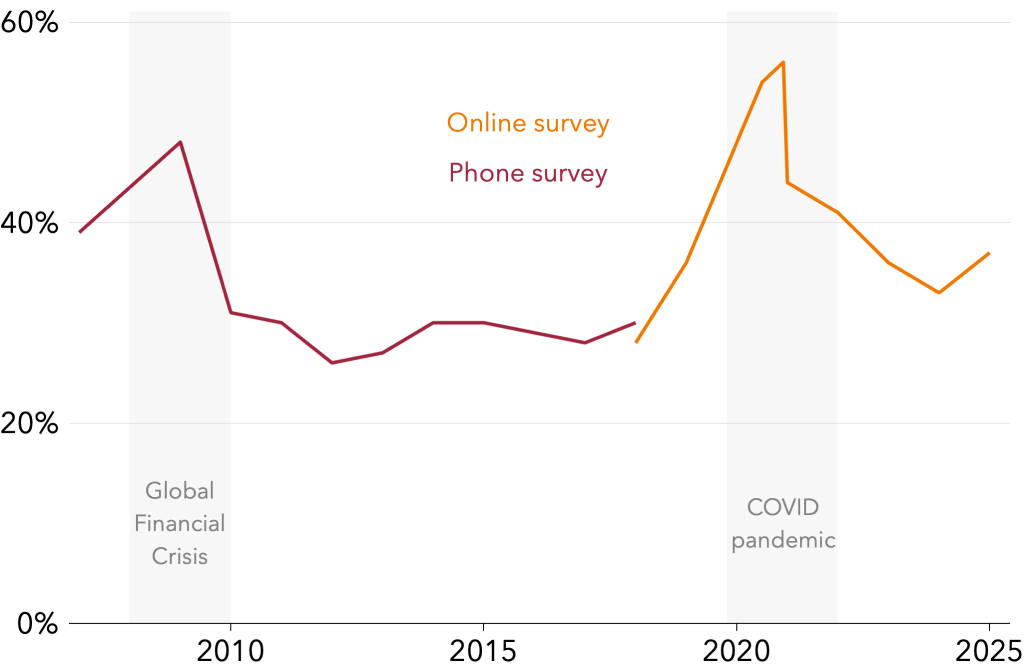
Notes: The question was: ‘How often do you think the government in Canberra can be trusted to do the right thing for the Australian people?’. The survey method changed from telephone surveys to the Life in Australia online panel from 2018. Source: Scanlon (2025).
Austerity and recessions often increase polarisation
Economic downturns – and government responses to them – can be a moment for governments to build trust in our democratic system. But they can also increase support for populist or extreme politics.
Historically, economic crises have tended to increase government turnover, policy uncertainty, and political polarisation.179 They also tend to increase support for populist parties, despite the fact that populist policies then subsequently result in worse economic performance.180
Government responses can further exacerbate these issues. In particular, fiscal austerity can increase political polarisation and support for radical politics.181 One study suggests that experiences of austerity in the early 2010s were a contributor to the subsequent 2016 Brexit vote.182
Conversely, a failure of governments to effectively respond to high inflation can also result in increased support for extremist and anti-system political parties.183
4 Opportunities to strengthen Australia’s democracy
Australians should be proud of our democracy, but we must not take it for granted. Democracy takes work. If our system is unable to adapt over time, if we do not tackle emerging threats, and if governments cannot deliver the results Australians expect, then our democracy will be less resilient to challenges at home and abroad.
Australians need our system of government to represent us. Our democracy needs to cope with reasonable disagreement by creating channels for information, deliberation, and feedback. Ultimately, our institutions need to enable us to make, and give effect to, collective decisions on how to tackle our biggest challenges and opportunities, while providing checks and balances on power.
Grattan Institute research and consultation suggest there are many opportunities to do better, within our existing institutions and through innovation. In this chapter we identify five priority areas: making the most of our parliament, nurturing belonging and engagement, protecting our public sphere, tackling the known policy challenges, and better preparing for the future.
In each area, we set out some practical reforms to help future-proof Australia’s democracy.
4.1 Make the most of Australia’s parliament
Parliamentarians are the principal way in which Australians are represented in the halls of power, and we invest considerable time and resources in a federal institution that brings together representatives across this vast country.
Our elected federal parliament sits at the centre of Australia’s democracy and it will need to be more representative and better functioning if we are to build trust in politics, improve administration of government, and see better long-term decision-making. Two practical reforms would help: reducing the influence of money in politics, and commissioning an independent review of parliament.
Reduce the influence of money in politics
Reducing the influence of money in politics would help strengthen our parliament and the integrity of our politics.184
New rules from 1 January 2027 will improve transparency of political donations and introduce caps on donations and electoral expenditure. Unfortunately the design of the caps leaves too much money in politics, and advantages incumbents over new entrants.185
In particular, the total cap of $90 million for electoral expenditure by a political party is too high. Reducing this cap would help reduce the fundraising ‘arms race’ between parties, and their consequent reliance on major donors. Senior parliamentarians would also have more time to do their job, if there was less need to chase funding.
Other elements of the new rules advantage major parties and disadvantage new entrants. For example, the per-seat cap of $800,000 is too low, advantaging incumbents over new entrants. New entrants typically need to spend more to introduce themselves to their electorates. There is also a loophole in the design of the donations cap that advantages major parties by allowing the cap to apply separately to each branch of a party.186
The new caps should be reviewed and amended before the next election, to level the playing field.
Commission an independent review of Australia’s parliament
Our federal parliament should be the central forum where Australians work through our policy challenges and hold government to account. This means that parliamentarians should be supported to direct sufficient time and energy to their work on legislation, parliamentary committees that bring information and expertise into parliament, and being the link back to their communities.
Australia’s federal parliament has some clear strengths as a deliberative body. The existence of the Senate has enabled time to be given to greater legislative scrutiny than some other parliaments. We have made important strides in terms of representation of women, and First Nations Australians.187
But in other areas, parliament’s structures and processes diminish its ability to do the job Australians need and expect of it. An independent review would help to identify areas where we can do better.
For example, Australia’s population has grown substantially, while the number of people representing us in federal parliament has barely changed since in 1984.188 We have quite an uneven distribution of voters per electorate nationally.189 Our population is more diverse, but parliaments have been slow to reflect that diversity.190 Minor parties and independents are now much more present in our federal parliament than they used to be.191 And the complexities of governing – including the workload and expectations of modern politics – are greater, yet the resources and supports have not kept pace.
The behaviour of politicians is a driver of trust in political institutions and government.192 While open incivility is relatively rare in the Australian parliament, party composition and parliamentary rules do play a role in shaping the conduct and behaviour of parliamentarians. Processes dominated by the power of major parties can support ‘partisan warfare’ rather than deliberation.193 This compromises the experience of our elected representatives, and the willingness of Australians to put their hands up for the job.
An independent review should consider how to improve the representative, legislative, and executive functions of Australia’s parliament, including through potential reforms to:
- the size of parliament;
- functioning of committees;
- standards and codes of conduct for parliamentarians;
- minimum standards and transparency requirements for political
parties; - parliamentary training and induction; and
- the resources available to parliamentarians to do their job.
The Joint Standing Committee on Electoral Matters has considered and continues to consider some of these questions.194 But in reviewing aspects of parliament – particularly the size of parliament, resourcing for parliamentarians, and minimum standards – an inquiry that is conducted independently of politicians can help build public understanding, provide parliaments with the benefits of independent analysis, and may carry more weight with the public.
Political parties play a key role in the functioning of Australia’s parliament, and in Australian democracy more generally (Box 4). Minimum standards for political parties on governance and integrity might help rebuild some trust with the Australian people and arrest the multi-decadal decline in party membership.195
For example, publishing party membership numbers could encourage parties to broaden their base, higher standards might make party membership more attractive to Australians, and publishing manifestos in advance of elections could give everyone better information on which to base their vote.196
The review should also consider how parliaments could be more responsive to public ideas. Petitions – even those with hundreds of thousands of signatures – generally have limited success.197
Ideas with strong public support won’t necessarily be good public policy, but some acknowledgement and response is important to ensuring people feel heard. For example, in Denmark, citizen proposals with sufficient public support are automatically debated in parliament.198 And in Madrid, citizen proposals with sufficient public support are evaluated by a citizens’ council, which puts forward a subset of the ideas for referendum.199
Box 4: Political parties play an important role in our democracy
Organised political parties play several critical roles in our democracy. Most obviously they govern, or, when not in power, they hold government to account. And to be elected to govern, they need to recruit, select, and develop political leaders, formulate viable policy agendas, and frame political choices.(a)
Parties that aim to govern need broad appeal, and play a role in aggregating preferences into a coherent and negotiated whole. Political parties are also often the guardians of liberal democratic norms and values.(b)
But Australia’s major political parties are in decline. First preference votes are down,(c) public trust in political parties is low,(d) and membership is dwindling.
‘Strong memberships are the foundations of strong parties who are the foundation of strong democracies’.(e) Yet political party membership has been in decline for decades, with fewer than 1 in 100 Australians now members of a party.(f)
Most of the hard work to reinvigorate and renew sits with political parties themselves. But setting minimum standards and transparency requirements for political parties could help nudge them in the right direction.
a. Evans et al (2025).
b. Jordan (2025), and Evans et al (2025).
c. At the 2025 federal election, more than one in three voters voted for a non-major party in the House of Representatives. See Figure 2.2.
d. Political parties are among our least trusted institutions, only ahead of multinational corporations: APSC (2024).
e. Jordan (2025).
f. Ibid.
4.2 Nurture belonging and engagement
A resilient democracy constitutes more than formal institutions. It is also about social trust, shared values, and belonging.200 More inclusive public narratives would be a good start to help nurture and reinforce belonging (see Box 5).
Social infrastructure – the spaces where people make connections with others, and build community – is a critical support to build belonging, as well as a protective feature against loneliness and distrust of others.201 For example, community facilities such as libraries and daycare centres benefit individual wellbeing as well as community connectedness, by creating opportunities for ‘bridging’ and ‘linking’ connections.202
These connections are especially important in periods of transition: moving to a new place, having a child, losing your job or a family member, or retiring.203 And at large, these connections support communities to prepare, respond, and recover more effectively from disasters and shocks.204
But belonging requires agency too: opportunities to have a say and be heard.205 Australians say they want more opportunities to participate in decisions and have a say,206 but many also feel that they don’t have the time, or it won’t make a difference anyway.207 There is a considerable gap between the importance Australians place on people having a say on government priorities, and perceived performance on the same measure.208 Where expectations consistently fall short, it can erode public trust.209
Access and influence in Australian politics tend to be dominated by the well-resourced and highly motivated.210 For most Australians, political agency is limited to contacting your local Member of Parliament, or protest politics.211
Creating more ways to have a say and be heard would give more Australians a voice, nurture belonging, and support policy makers in deciphering the public interest. It may also help counter disengagement (Chapter 2).
Box 5: Leaders should embrace more inclusive public narratives
Leaders shape the narratives we affirm as a nation, and public narratives matter to our democratic resilience:
‘The language used by leaders in the public domain about threats to democracy or in response to shocks like a violent extremist attack plays a crucial role in protecting and sustaining democratic resilience.’ (a)
Some narratives are particularly harmful, such as ‘us vs. them polarisation’ (which reduces complex issues to binary conflicts, eroding compromise and trust), ‘exclusionary nationalism’ (which marginalises groups within the community, weakening social cohesion), and ‘anti-institutionalism’ (which frames institutions as corrupt, undermining trust).(b)
Other narratives are perhaps less harmful, but still unhelpful. For example, the idea that we can solve big challenges without trade-offs, or that we can meet growing needs and expectations for public services while lowering taxes and contributions.
Politicians may be tempted to adopt these narratives for political opportunism or convenience, but if such narratives take hold, they have long-term costs, making it harder to govern effectively.
What would more inclusive public narratives look like?
– Embracing plurality: the clash of contending opinions, ideas, and interests is part of a healthy democracy.
– Belonging without othering: building on shared values, recognising we all have multiple social identities, and acknowledging each other’s humanity even in disagreement.(c)
– Recognising our interdependence: collaboration over confrontation, contributing as we are able, listening, crediting others, ‘humble government’.(d)
– Serving the common good: policy is rarely easy, won’t always be popular, and trade-offs are inevitable. But policy should always be in the public interest, and policy makers should accept public accountability, including taking responsibility and accepting consequences for mistakes.(e)
– A more civil tone: Honest and civil, rather than superficial and divisive; constructive rather than fear-mongering; authentic and empathetic leadership.(f)
a. Strengthening Democracy Taskforce (2024).
b. Angus (2024).
c. powell and Menendian (2024).
d. Interdependence is a philosophy long embedded in First Nations knowledge systems: Behrendt (2025) and M. Graham and Brigg (2020). See also Lowther and Guzman (2025).
e. See Wilson (2024).
f. See Allen et al (2018), Valgarðsson et al (2024), and Democracy: Differently (2025).
Greater engagement and public deliberation
Citizen engagement is a core responsibility of politicians and public servants – not a side project, or something that can be left to new institutions to solve. Our public sector leaders need to be actively stitching public engagement into the fabric of our existing institutions.
For some institutions, this might mean embracing policy review processes that seek out a range of voices. Various institutions and processes already facilitate this and could provide a guide, including the Productivity Commission inquiry process, and Senate and House of Representatives committee hearing processes.
Online consultation hubs also reduce barriers to engagement for many.212 And innovative use of AI can support community consultation efforts, including enabling interrogation of community consultation data over time.213
Disclosing ministerial diaries would encourage our most senior politicians to broaden their engagement,214 and help counter the prevailing skew in access and influence towards those with greater power and resources.215
Public funding may also be needed to support advocacy efforts and focused deliberation among under-represented broad-based groups (such as young people, people with a disability, and First Nations people). The Uluru process was one of Australia’s most powerful examples of deliberation in action, comprising 12 regional dialogues and a national convention, culminating in the Uluru Statement from the Heart and the Voice referendum.216
Citizen assemblies, ‘mini-publics’, consensus conferences, and other deliberative processes and forums explicitly seek out representative views from the public, and can be convened to inform any stage of the policy cycle.217 They can be expensive to set up and run well, but they are a valuable tool to gauge the public interest, grapple with trade-offs, and build consensus, trust, and legitimacy.218
Deliberative processes and forums, done well, can be a much more meaningful form of consultation for those involved, because these processes usually carry some power. The group might be asked to vote on a question, make recommendations, or prepare a public report.219 And the broader public is often more inclined to trust a decision that has been influenced by ordinary people than one made solely by government.220
Deliberative processes and forums may therefore be particularly useful in working through policy gridlocks and questions where the social license is weak or uncertain. These approaches are widely used in Australia at state and local levels but rarely at the federal level.221
Clearer pathways to citizenship
Having a vote and being able to stand for office are foundational to having a voice in a democracy. Yet a growing share of Australia’s population are long-term residents without a say in the system that governs them (Figure 4.1).
Permanent residency is a necessary step to citizenship, but it has become more expensive, slower, and more complicated to achieve, even for those who have built a life in Australia. The federal government should restore permanency to the centre of Australia’s migration system. This means reducing long-term ‘temporariness’ and offering clear pathways to permanent residency (if not permanent on arrival), with timely processing.222
Greater permanency has broader economic and social benefits too: better career outcomes with greater likelihood people will be in jobs that match their skills and experience, reduced worker exploitation, and attracting higher-skilled migrants and students to Australia. While policy changes in this space remain vulnerable to politicisation (see Box 3), Australians also show higher support for a migration program that is built around permanency, not ‘guest workers’.223
Under the existing annual permanent intake of just under 200,000 people, it’s impossible to guarantee all long-term temporary visa-holders a permanent pathway. Visa reforms in 2024 made important improvements,224 but there are still opportunities for Australia to create clearer and more certain pathways, and improve existing selection mechanisms for permanent skilled visas.225
Overall, Australia enjoys relatively high rates of citizenship uptake by permanent migrants, and recent reforms have ensured migrants from New Zealand (a sizeable number of Australians) have an accessible pathway from residence to citizenship. New citizens also have high electoral enrolment rates.226
However, the drop in the percentage of citizens among our long-term resident population (Figure 4.1) correlates with citizenship applications being left to build up without timely decisions.227 While processing has subsequently improved, the backlog of citizenship applications that grew substantially from 2014 to 2017 has still not subsided.228 These delays have real impacts for people, who are unable to vote at elections or stand for office until their application is assessed, they pass the citizenship test, and then complete their citizenship ceremony.
It is also important that new Australians, and their children, are not treated like ‘second-tier’ members of our society (see Section 2.2.3). The government should review extended waiting periods for permanent migrants to access services and social security payments, that are a core part of Australia’s social compact.229
Figure 4.1: More long-term residents lack permanency or citizenship
Status of temporary migrants who arrived seven years prior
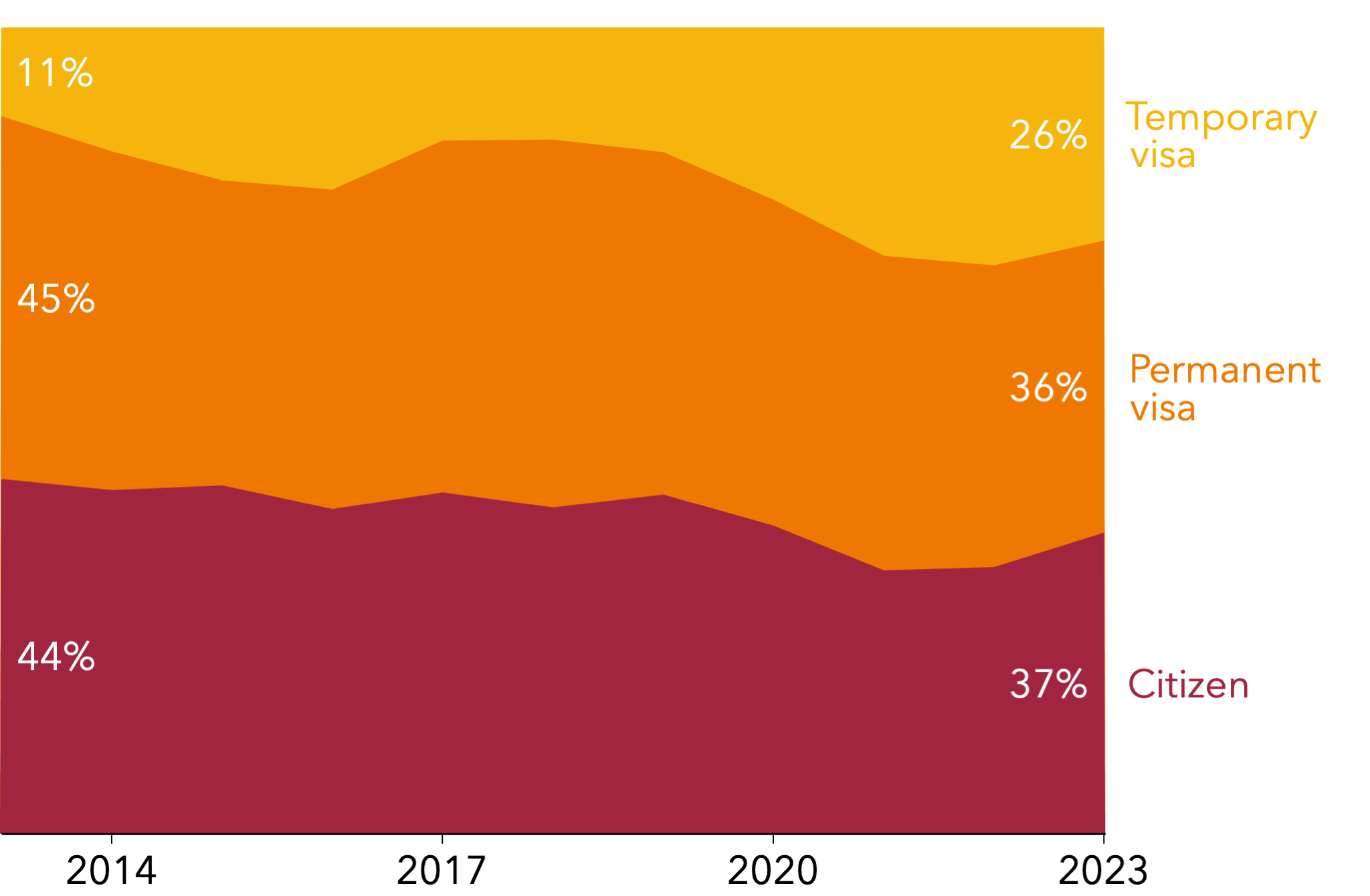
Note: Excludes temporary migrants no longer residing in Australia. Source: Bernard et al (2025).
Reinvigorate local government elections
Engaging with local government is among the most accessible ways for Australians to have a say about the goings on in their area. Local politics has the potential to nurture a sense of community belonging, and create cross-cutting political identities that diverge from more nationalised partisanship.
But while federal and state elections attract significant public attention, local government elections are often overlooked.
Turnout for local government elections is significantly lower than for state and federal elections. In South Australia for instance – where voting in council elections is not compulsory – turnout in 2022 was just 34.5 per cent, compared with more than 91 per cent at that year’s federal election.230
Engagement with local elections is stronger in states such as Victoria, where voting is compulsory, but at 83 per cent in the 2024 council elections it was still about 10 percentage points lower than at the 2025 federal election. And participation wasn’t equally distributed: turnout was lower in council wards where renters made up a larger share of the population (Figure 4.2).231
These figures also do not include the many long-term residents within many council areas who are not citizens. For instance, long-term temporary and permanent residents make up more than one in five adults in seven local councils across Australia, including Wyndham in Victoria, Cumberland in NSW, and Wanneroo in WA.232
In Australia, residents who are not citizens are generally not eligible to vote in state or local elections.233 Whereas in New Zealand, the Netherlands, and the UK, residents are eligible to vote in local elections regardless of citizenship.
Voting in Victorian, Tasmanian, and South Australian local council elections is further skewed by property and business franchise, which allows some property- or business-owners to vote multiple times, or in multiple councils.234
This uneven engagement with local elections has flow-on con-sequences for the policy decisions councils make once they’re elected. For instance, opposition from a vocal minority of residents has often led local governments to reject or delay new housing projects, in part because consultation processes on such projects tend to under-represent the views of younger residents, renters, and those who live in apartments.235
State governments should reinvigorate local government elections by making voting fair and easy. This should include reforming voting laws along the principle of ‘one resident, one vote’, as Queensland has already done.236 And states should ensure that the voting experience in local government elections is consistent with that in state and federal polls, by making voting compulsory and adequately funding electoral commissions to deliver high-quality in-person and absent voting options.
But states should also go further, by extending voting rights in council elections to all long-term residents – including non-citizens – as already occurs in the City of Melbourne.237
Figure 4.2: In Victoria, turnout at council elections is lower in wards with more renters
Voter turnout at 2024 council elections
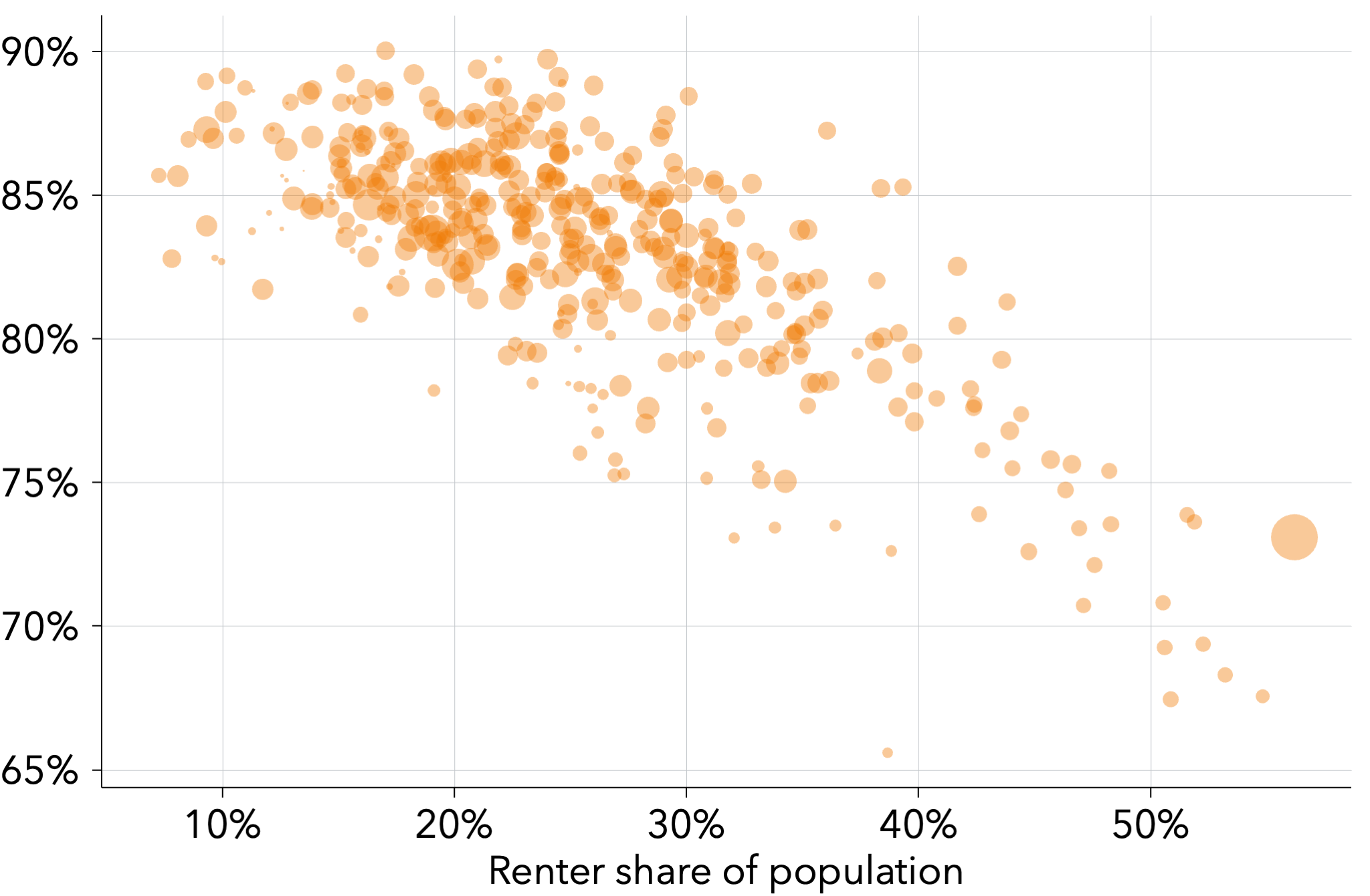
Notes: Dots represent council wards; the bigger the dot, the higher the population. For councils that are not subdivided (such as the City of Melbourne), dots represent the entire council area. Turnout rates are for state-enrolled voters, and so exclude votes by council-enrolled property owners or businesses. Renter share of ward population estimated based on matching of ward boundaries with SA1 Census data. Renters include people living rent-free. Sources: VEC (2025b), DTP (2026), and ABS (2023a).
4.3 Protect the public sphere
The public sphere is where Australians inform themselves and engage in the clash of ideas that shape Australian society. But misinformation, disinformation, and polarisation present substantial risks for the health of our public sphere (Chapter 3).
In this section we identify reforms to help tackle misinformation and support a healthy and constructive public conversation.
Invest in the institutions that produce credible, trusted information
Australia has many strong public institutions, producing credible, trusted information, including in the media, and in specific fields (for example, the Australian Bureau of Statistics, the Australian Electoral Commission, health authorities, universities, the CSIRO, the Australian National Audit Office, and the Parliamentary Budget Office). Trusted institutions are critical to grounding the public conversation in a shared knowledge base and understanding.
Many Australians don’t follow the news regularly,238 and may get most of their information from social media or friends and family (Chapter 3). But it remains critical that when they do seek reliable information, it is available to them from a credible, trusted institution.
These institutions are our knowledge guardians – measuring and reporting on the things that matter to Australians, maintaining records over time that ground our understanding of the present, and evolving to help us monitor and understand emerging risks and opportunities.
Stable public funding is needed for these ‘go to’ institutions that Australians trust.
Support public interest journalism and review the news media business model
Accurate, reliable news and journalism are at the heart of public discussion, diversity of voice, open justice, accountability, and informed decision-making.239 Good journalism helps societies understand themselves.
Public interest journalism is supported by funding from governments, not-for-profits, and through various media business models, but all these income streams are experiencing growing pressures.240
In late-2025, the federal government announced some initiatives, including a Journalism Assistance Fund offering direct grants, and a News Bargaining Incentive, designed to encourage large tech companies to fund news media.241 These are welcome reforms, but may not go far enough to ensure the sustainability of public interest journalism, particularly for regional and local media.
The News Bargaining Incentive should be accelerated. It should include all media outlets producing public interest journalism, and should ensure that the relevant platforms do indeed carry news.242 A similar model is probably needed for media entities to bargain with AI companies on content use.
A public review of the news media business model would help shed light on additional opportunities. The ACCC’s digital platforms unit should be asked to look into the influence of digital platforms on the media, and the lack of competition in digital markets that media businesses deal with.243
Supporting public interest journalism goes beyond funding models and revenue sources.244 Public interest journalism is a craft and profession that needs cultivation and recognition. The Alliance for Journalists’ Freedom has proposed a voluntary certification program to help the public distinguish quality journalism in an increasingly crowded information environment.245
Experiment in tackling misinformation and disinformation
Misinformation and disinformation are widespread in our public sphere, and Australians are deeply concerned about this (Chapter 3). Many approaches can help tackle misinformation and disinformation, though it is not yet clear which if any might work best at scale.
Different approaches might suit different institutions to trial. For example:
- Pre-bunking: warning people about manipulative tactics before they encounter false content.246
- Verifying content and authorising information: for example, embedding machine-readable provenance signals in digital content, and identifying content sponsors.247
- Systems for misinformation detection and response: AI can be helpful in identifying and flagging content that is bot-generated and/or carries other common signatures of misinformation.248
- Platform councils to inform platform governance: forums made up of tech experts and average digital users that convene regularly to help shape the rules of a particular platform and make decisions on content moderation and de-platforming, or the removal and banning of a registered user.249
- Digital literacy embedded within schools, community programs, and civic institutions: can equip citizens to question sources and understand the mechanics of online influence.250
A disinformation response playbook has been developed for cities – capturing ideas for how cities and local governments can respond.251
4.4 Tackle the known challenges
Citizens expect governments to tackle the big challenges. In a recent survey, Australians said the most important factor in deciding their vote at the 2025 federal election was a party or candidate’s plan to address Australia’s long-term issues (Figure 4.3).
Grattan Institute’s Orange Book 2025 outlines five long-term challenges governments need to tackle to set Australia on a more prosperous path:
- Transitioning to net zero: we need to further bend the curve on emissions, and focus on the economic transformation that accompanies decarbonisation.
- Tackling the housing crisis: we need to boost supply, relax planning constraints, and support mobility.
- Deepening talent pools: we need to improve our school systems, early childhood education, skilled migration, and delivery of human services.
- Meeting the needs of an ageing population: we need to get better at tackling chronic disease, and shore-up sustainable retirement and aged-care systems.
- Fixing the structural budget problem: we need to introduce bold tax reforms, implement sensible savings, improve productivity in the health system, and rein in NDIS costs to make the scheme sustainable.
Many of these challenges have been brewing for decades, and governments are not starting from scratch in responding either.252 But making substantial progress on these known challenges would put Australia in a much better position to manage the uncertainties ahead.
In particular, tackling these challenges would help reduce intergenerational inequality. The growing divide between old and young – in wealth, opportunity, and optimism about the future – has become a fault line in our social compact (Chapter 2).
The common tenets of Australian life, particularly buying a home, are less of a reality than they used to be (Box 6). And while there are many economic and demographic pressures contributing to intergenerational inequality, the policy choices of successive governments are also to blame.253
Governments have a role to play in boosting economic growth, which benefits everyone, but particularly young people because their employment and wages are more sensitive to the economic cycle.
Our Orange Book 2025 has many recommendations to help lift Australia’s economic performance, and share the benefits more fairly.254
Figure 4.3: Tackling the big challenges matters to voters
Share who say factor is important in deciding which candidate they vote for
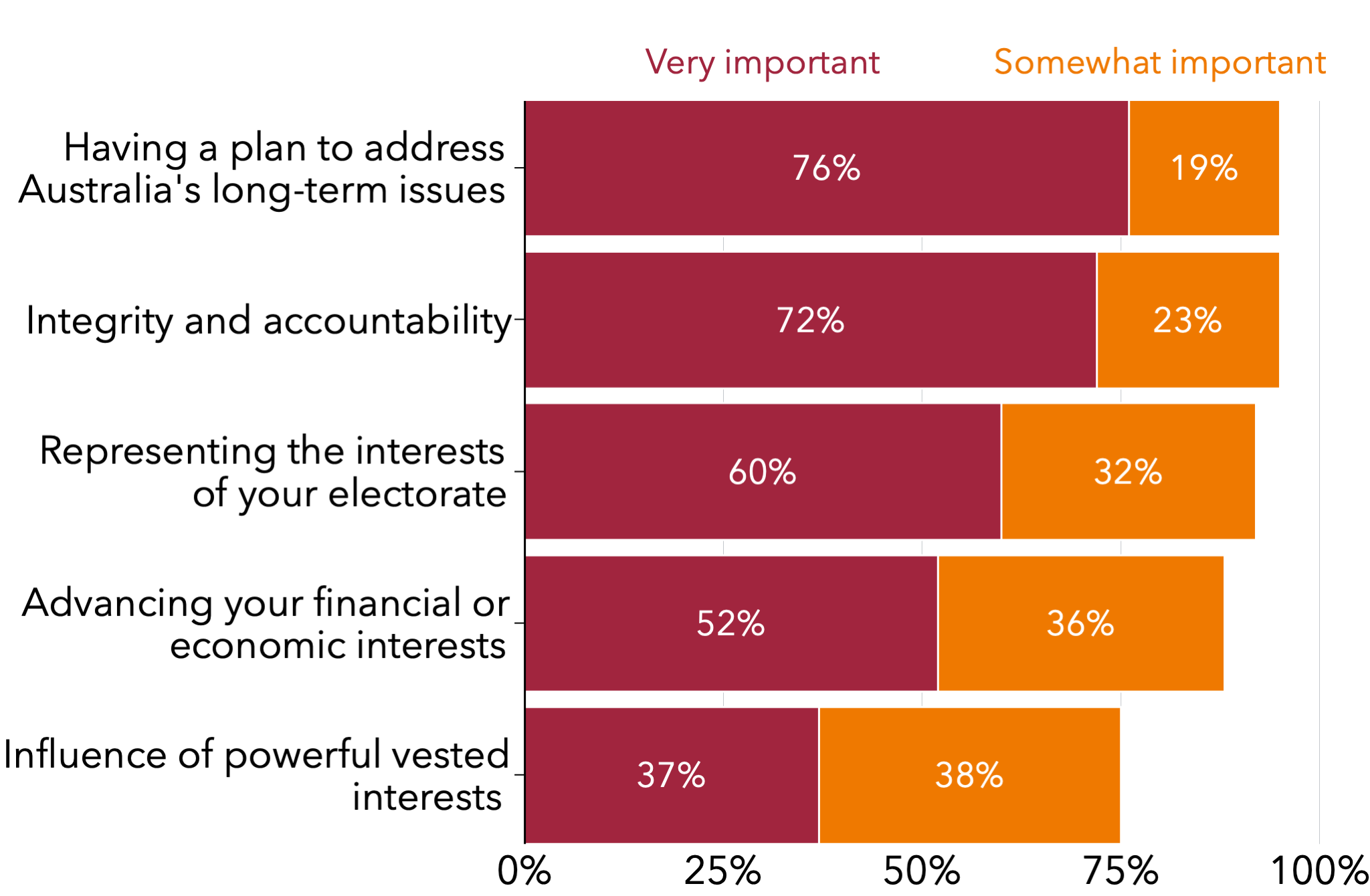
Notes: The question was ‘How important are each of the following when it comes to deciding how you vote at federal elections?’. The 2025 survey was of 3,697 people. Source: Provided to Grattan Institute by McKinnon.
Box 6: Housing affordability is a big opportunity to strengthen Australia’s social compact
One of the biggest contributors to the disparities in wealth accumulation between generations (Chapter 2) has been failures in housing policy.(a)
Housing in Australia’s major cities is among the least affordable in the world. Housing is a major driver of inequality in Australia, and the lack of well-located homes divides families and communities, and robs young Australians of their best chance in life.(b) Making housing more affordable is therefore a particularly important opportunity for governments to strengthen the social compact.
To make housing more affordable, state and territory governments need to substantially boost housing supply,(c) and the federal government should support and encourage the states in this endeavour while also unwinding tax incentives that unhelpfully inflate demand.(d)
a. Wood et al (2019).
b. Coates et al (2025a), Wood et al (2019), and Daley et al (2018).
c. Specific reforms are detailed in Coates et al (2025a).
d. Specific reforms are detailed in Sathanapally et al (2025) and Coates et al (2025b).
Improve transparency and accountability
How governments do economic reform matters too. Citizens expect clear communication, open and transparent decision-making, and policy processes that are fair, evidence-based, and involve broad consultation, among other things (Figure 4.4).
Australians tend to be particularly sceptical when it comes to potential misuse of public office for personal or political gain. To maintain the trust and confidence of the people, our institutions need to serve – and be seen to be serving – the public interest, not vested or political interests.
Half of Australians think government is run for a few big interests.255 Publishing ministerial diaries would give Australians greater visibility of who has access to decision makers and, perhaps more importantly, who doesn’t. It could help to level the playing field and protect the public interest by alerting under-represented groups to speak up, and by encouraging policy makers to seek out a wider range of views.256
There are also opportunities to improve policy-making processes to better protect against politicisation. Many Australians are suspicious that politicians misuse their power for political advantage. Appointing ‘mates’ to powerful or well-paid jobs, allocating grants based on electoral considerations rather than need (‘pork-barrelling’), and using taxpayer-funded advertising to spruik the government of the day are corrosive to public trust. Better processes for public appointments, grants, and taxpayer-funded advertising would help to safeguard the public interest from partisan influences.257
The ‘revolving door’ between politics and lobbying roles is particularly corrosive to public trust. There are restrictions in place on post-ministerial employment but they are largely ineffective.258 Potential breaches should be independently investigated, and if a breach is determined, then the relevant political party should encourage the former minister to resign from the new role or defer taking on the new role. Sanctions should apply if they don’t.259
Perhaps the best action governments can take to counter perceptions of corporate influence and politicisation is to visibly stand up to vested interests. Gambling regulation is one example where public and vested interests don’t align.260 Better regulation is needed to prevent gambling harm, and there is strong public support for reform, but federal and state governments have been reluctant to take on the powerful vested interests involved.261 Even if these sorts of reforms draw on political capital in the short-term, a stronger stance in the public interest may help build trust in the longer term and strengthen the social compact.
Figure 4.4: How governments do economic reform matters too
Importance for building trust in the economic reform process
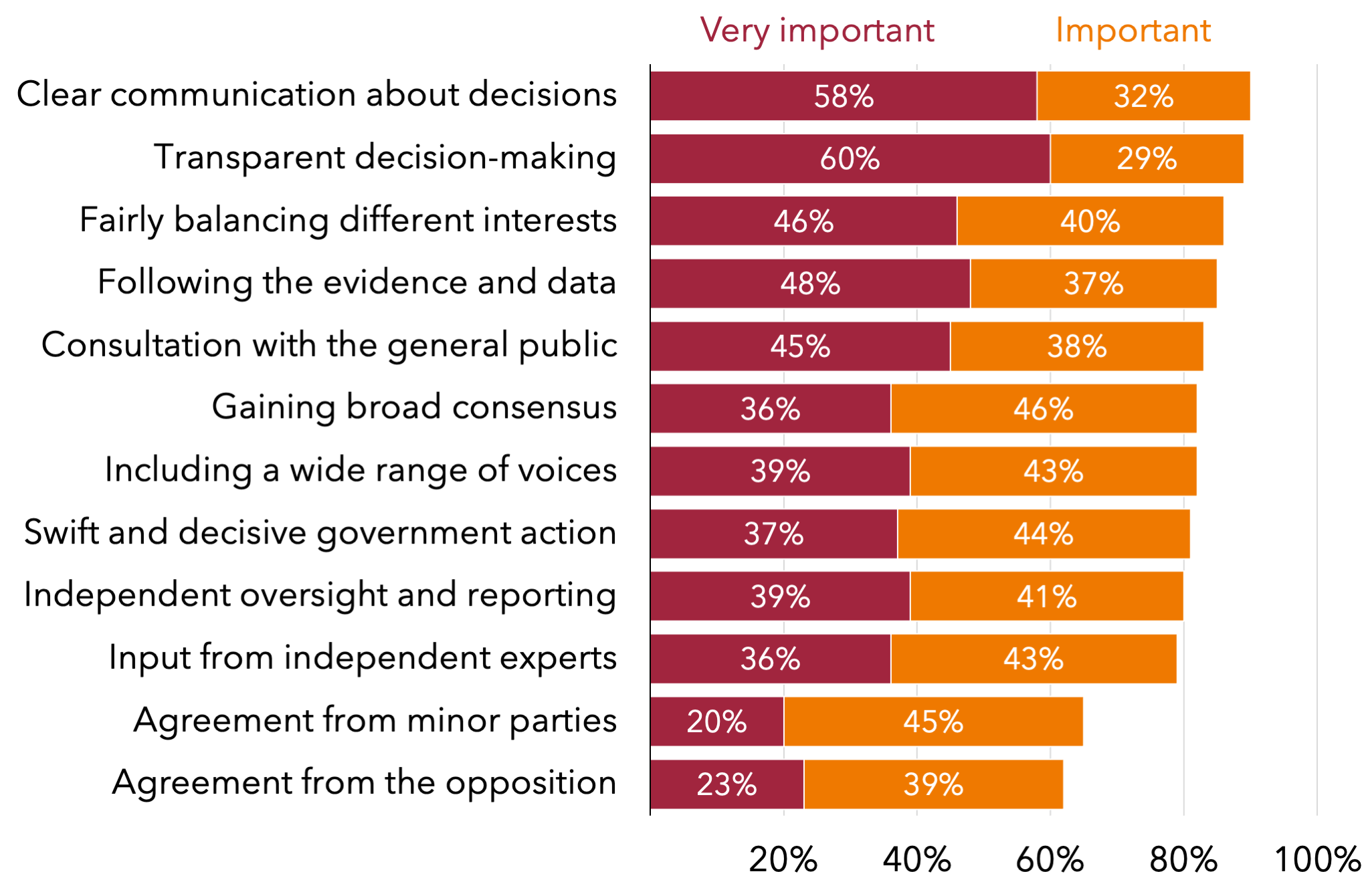
Note: Poll of 2,000 people, conducted in August 2025. Source: McKinnon (2025b).
4.5 Prepare for the future
Rolling, intersecting shocks on the horizon could challenge Australia’s democratic resilience (Chapter 3) and may necessitate a more active role for governments.
Governments can best prepare by tackling the known challenges (crises make these harder and more urgent), planning for unknowns (such as fiscal policy options in the event of a downturn), and calibrating public expectations through honest conversations about what governments can and can’t do to cushion shocks.
Many of the other reforms identified in this chapter – including nurturing belonging and cultivating a healthier public sphere – also position the nation better to cope with rolling or even concurrent shocks.
Have fiscal firepower at the ready
Fiscal firepower was key to Australia’s relatively successful cushioning of households and businesses during COVID and the Global Financial Crisis. Being on a fiscally sustainable path – and being seen to be so – is important for a government to be able to ramp up spending and/or reduce taxes in response to shocks.
Fiscal sustainability does not require governments to run balanced budgets or surpluses every year (indeed, responsible fiscal policy will see deficits expand during downturns). But in a world of rolling crises, governments must be able to look beyond short-term priorities in order to progress structural budget reforms. Without this, they may not have the fiscal headroom or political capital to spend big when needed.
Previous Grattan Institute reports detail specific reforms to help improve federal and state budget positions.262
Plan for unknowns and set realistic expectations
Australia has a range of plans and systems in place to manage and coordinate during a crisis, but appears less well-prepared in terms of policy options and potential responses.
For example, the federal government has a Crisis Management Framework, which covers a wide range of identified hazards. But it does not include financial and economic crises, nor does it address prevention, longer-term recovery, reconstruction, or risk reduction.263
Australians worry we are under-prepared. The National Security College recently surveyed Australian attitudes to a wide range of potential threats. Across two-thirds of the threats, more than half the public felt Australia was ‘not prepared at all’ or only ‘slightly prepared’.264
Federal and state treasuries may well do scenario planning, and have a range of policy options worked-up, out of public view. But there are advantages to publicly sharing (at least some) scenarios and policy options in advance of a crisis.
The New Zealand Treasury recently published a crisis playbook, which canvasses policy options and seeks to manage public expectations.265 For example, the playbook explains that: ‘In recent times, financial support has been used more during shocks to offer speedy, temporary relief to those facing the brunt of them… [but] Higher debt reduces our capacity and choices responding to future challenges… Overall, fiscal policy should aim to lift living standards for New Zealanders in the longer term rather than lessening economic ups and downs.’
Another option for Australia would be to more explicitly build crises into budget forecasts.266 We don’t know exactly what’s around the corner, but we do know that it won’t always be smooth sailing – yet budget forecasts often assume smooth sailing in the absence of better information. Forecasts that account for the probability of shocks over time would provide a more conservative view, and inform the public conversations we need to be having about a more expensive future, and the measures needed to mitigate future costs or lessen vulnerabilities. This includes investment in technical expertise, scenario planning, and cross-border relationships between agencies.
Public communication can help build public confidence, increase awareness and understanding of government’s role, and inform local-and community-level preparedness.267 Federal and state governments should also share and learn from each other in preparing for potential shocks.
Research and monitoring remain critical to crisis preparedness, so governments should ensure they are investing sufficiently in understanding the potential challenges ahead, and maintaining the necessary capabilities to respond.
Acknowledgements
This report was written by Aruna Sathanapally, Kate Griffiths, Matthew Bowes, and Jessica Geraghty. It was edited by Paul Austin.
We would like to thank Glyn Davis, Alex Fischer, Ryan Goss, Lydia Khalil, Tom Rogers, Jill Sheppard, and Henry Sherrell for reviewing this report, and all participants in the 2026 Grattan Gathering for generously sharing their ideas.
The opinions in this report are those of the authors and do not necessarily represent the views of Grattan Institute’s founding members, affiliates, individual board members, Grattan Gathering participants, or reviewers. The authors are responsible for any errors or omissions.
Grattan Institute is an independent think tank focused on Australian public policy. Our work is independent, practical, and rigorous. We aim to improve policy by engaging with decision makers and the broader community.
We acknowledge and celebrate the First Nations people on whose traditional lands we meet and work, and whose cultures are among the oldest in human history.
Grattan Institute Report No. 2026-01, April 2026
This report may be cited as: Sathanapally, A., Griffiths, K., Bowes, M., and Geraghty, J. (2026). For the people: Future-proofing Australia’s democracy. Grattan Institute
ISBN: 978-1-7641250-4-8
All material published or otherwise created by Grattan Institute is licensed under a Creative Commons Attribution-NonCommercial-ShareAlike 4.0 International License.