How to get the gas reservation right
by Hamish McKenzie
Six months after announcing plans for a national gas reservation, the Federal Government has released a detailed blueprint for how the scheme will work.
The challenge is to design a scheme that delivers a goldilocks amount of gas – enough to resolve future domestic shortfalls; but not so much it floods the domestic market. As both supply and demand fluctuate, this is chasing a moving target.
So, the government must walk a tightrope: the scheme must have flexibility to deliver different volumes of gas in different years and to let unneeded gas be exported, but too much flexibility risks creating loopholes that exporters will exploit. Both oversupply and undersupply are real risks.
The government’s design is fundamentally strong but has three major flaws that should be corrected before legislation comes to parliament.
The government’s proposal
All ten LNG exporters will be required to supply an amount of gas to the domestic markets each year in order to earn an export permit.
The volume required will be the equivalent 20 per cent of exports but will be scaled up or down each year based on the needs of the domestic market and barriers to supply faced by the exporters.
Exporters will submit annual requests to have their obligation amount reduced, and by 1 November each year, the relevant minister will announce the actual obligation percentages for each exporter for the coming year.
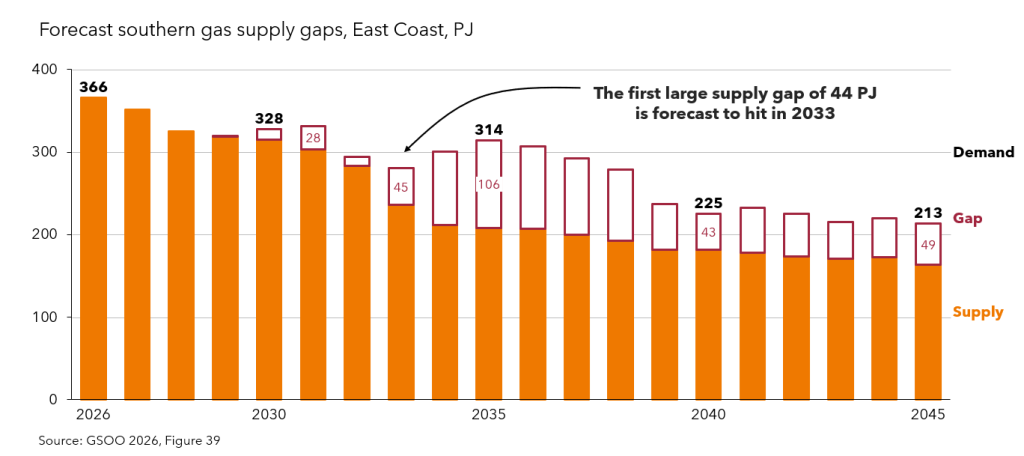
In practice, the east coast doesn’t have any meaningful supply gaps forecast until the mid-2030s. So for the first few years, the amount is likely to be set close to zero.
This basic approach is the right one – it means the amount of gas delivered can be ratcheted down over time to avoid flooding the domestic market, or as gas demand declines.
Three big flaws – the cap, the release valve, and the sweetheart deals
A major flaw in the government’s model is that in setting the obligation percentage, the minister could demand more than 20 per cent of exports.
Twenty per cent is neither a floor nor a ceiling – it’s a starting point. This is unworkable and unnecessary.
It’s unworkable because exporters need certainty that the government will not radically increase their obligations year-to-year. The reservation should not treat the exporters as a bottomless pit of gas to resolve all domestic shortfalls because it would drive out domestic producers and lead to a deeply regrettable east coast gas triopoly.
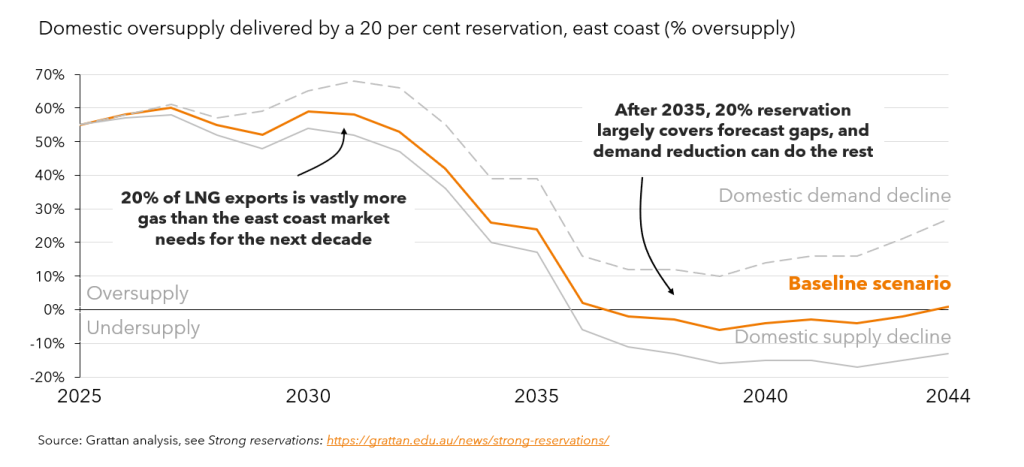
It is unnecessary because 20 per cent of exports is far more gas than we need and would flood the market for the next decade. Even a five per cent reservation would be sufficient for the foreseeable future.
The government needs to get real about how much gas it will actually demand of the exporters and put a hard cap on the percentage.
The release valve
If exporters find no domestic buyers for their reserved gas, they can apply for permission to export it through a so-called ‘release valve’.
This is a potentially fatal loophole. Ideally, the scheme would not have a release valve – the government would determine a volume of gas required, and exporters would be made to supply it.
In practice, a release valve simply functions as a backdoor to continued exports and undermines the ‘obligation to supply’ that was meant to be the basis of the scheme.
A release valve also retains the link between domestic and international prices, because exporters know that anything they don’t sell domestically, they can sell to Asia for sometimes twice the price.
The release valve should be removed. If the government keeps it, it must set the bar for accessing it extremely high. The model is vague on what the threshold for accessing the release valve will be. If it must exist, it should be a sluice, not a floodgate.
The sweetheart deals
The government’s model gives the minister huge discretion to vary the obligations of individual exporters in a way that opens the scheme to unfair treatment.
Exporters that want to reduce their obligations or access the release valve will need to apply to the minister for permission. In practice, this means some exporters will receive lower obligations than others.
One reason exporters can get their obligation reduced if they can prove there is insufficient infrastructure to get their gas to end customers.
This is a problem because getting gas from where it is produced (central Queensland, offshore WA) to where it is needed (Melbourne, Perth) is half the challenge.
The WA scheme has a similar infrastructure clause, and it fundamentally weakened the scheme. In a particularly egregious example, at its Pluto LNG facility, Woodside built about a third of the gas processing capacity that would be required to meet its domestic obligation. As a result, it gets a pass on its obligations.
An equivalent loophole in the national scheme would be a disaster.
The scheme should not contemplate giving special treatment to any individual exporter.
Instead, it should determine the volume of gas needed and levy that obligation as a single percentage of exports across all exporters. No special deals.
If some exporters can’t meet their obligation, they can pay others to meet it for them.
The path ahead
The gas industry is readying to challenge core parts of the proposed design. Some exporters have already rejected it. The states are fighting each other over possible carve outs. And the legislation will face a rocky road through a divided senate.
The government must stick firm on the fundamentals: deliver enough gas (and no more) and shed the escape clauses and the special deals (for states and companies alike).
Ensuring Australians are well-supplied by our own gas is a fair ask of the exporters making a motza selling it overseas. Get the details right, and this reservation just might make it happen.