It’s a career highlight for me to be here tonight sharing the stage with Alain Bertaud, someone whose work has shaped so much of my own thinking when it comes to housing and the design of our cities.
Within the field of urban planning and policy, Alain is a global rockstar.
And like any good show by an international band on tour in Australia, you need a local opening act.
It’s my privilege to play that role tonight, to set the scene about how housing in Australia’s cities has become so expensive, what that’s costing us, and to show why Alain’s ideas are so important in fixing the problem.
And on a personal note, this will be my last public-facing event while at Grattan Institute before I take on a role back in government in a few weeks’ time in the housing policy space.
Which is why tonight I’ll focus on the causes of Australia’s housing crisis, while leaving the solutions to Alain and the panel discussion to follow.
We haven’t built the homes we need
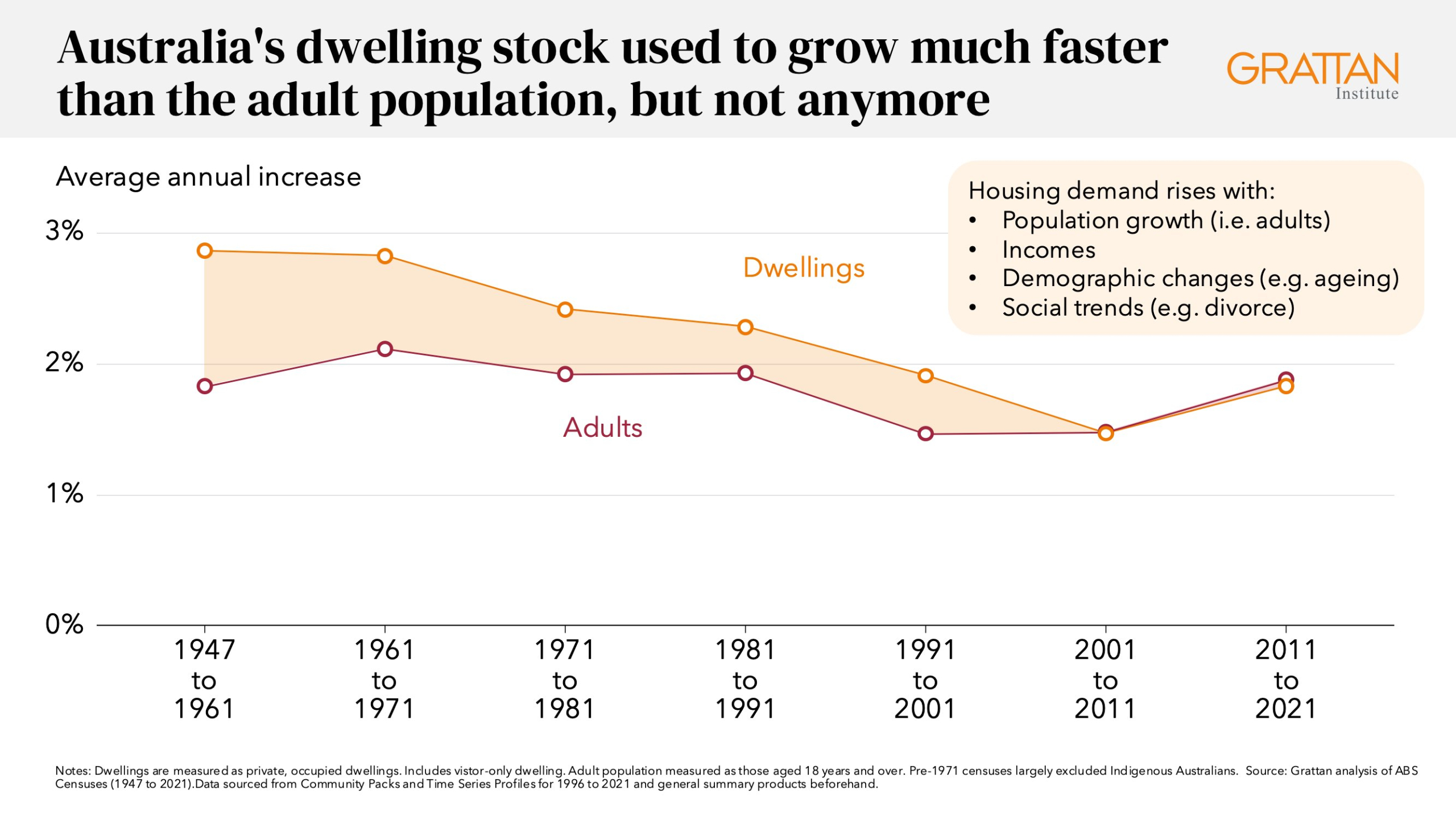
In the latter half of the 20th Century, we consistently built enough new homes to absorb our growing population. Since 2000, we haven’t.
For the first time in decades, Australia’s housing stock is growing more slowly than its population, and specifically, its adult population.
The problem runs deeper than simple population maths. Smaller households, rising incomes and wealth, and work-from-home patterns mean we need to build more homes than population growth alone suggests.
But we haven’t, with predictable consequences.
Australia’s housing crisis has gone national
Median home prices have increased from about four times median incomes in the early 2000s, to more than eight times today (and around 10 times in Sydney).
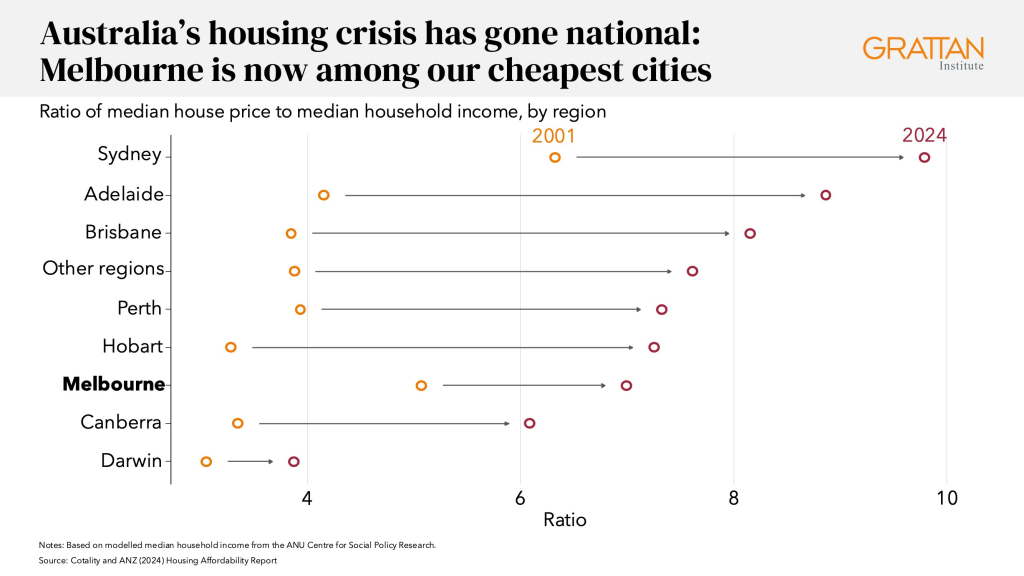
It’s long been a virtue of Australia that housing outside of Sydney and Melbourne has been more affordable than in our two largest cities. But no longer.
House prices in Brisbane, Perth, and Adelaide have nearly doubled since 2019, and those cities are now all listed among top handful of the least affordable cities globally.
Whereas Melbourne now stands out as Australia’s housing success story, with house prices only having risen from five to seven times median incomes.
In large part because Melbourne has built substantially more homes per extra resident than other Australian capital cities, including since the pandemic.
The shortfall is worst where it matters most
Not only do we have a housing shortage: we’re especially not building enough homes where people most want to live.
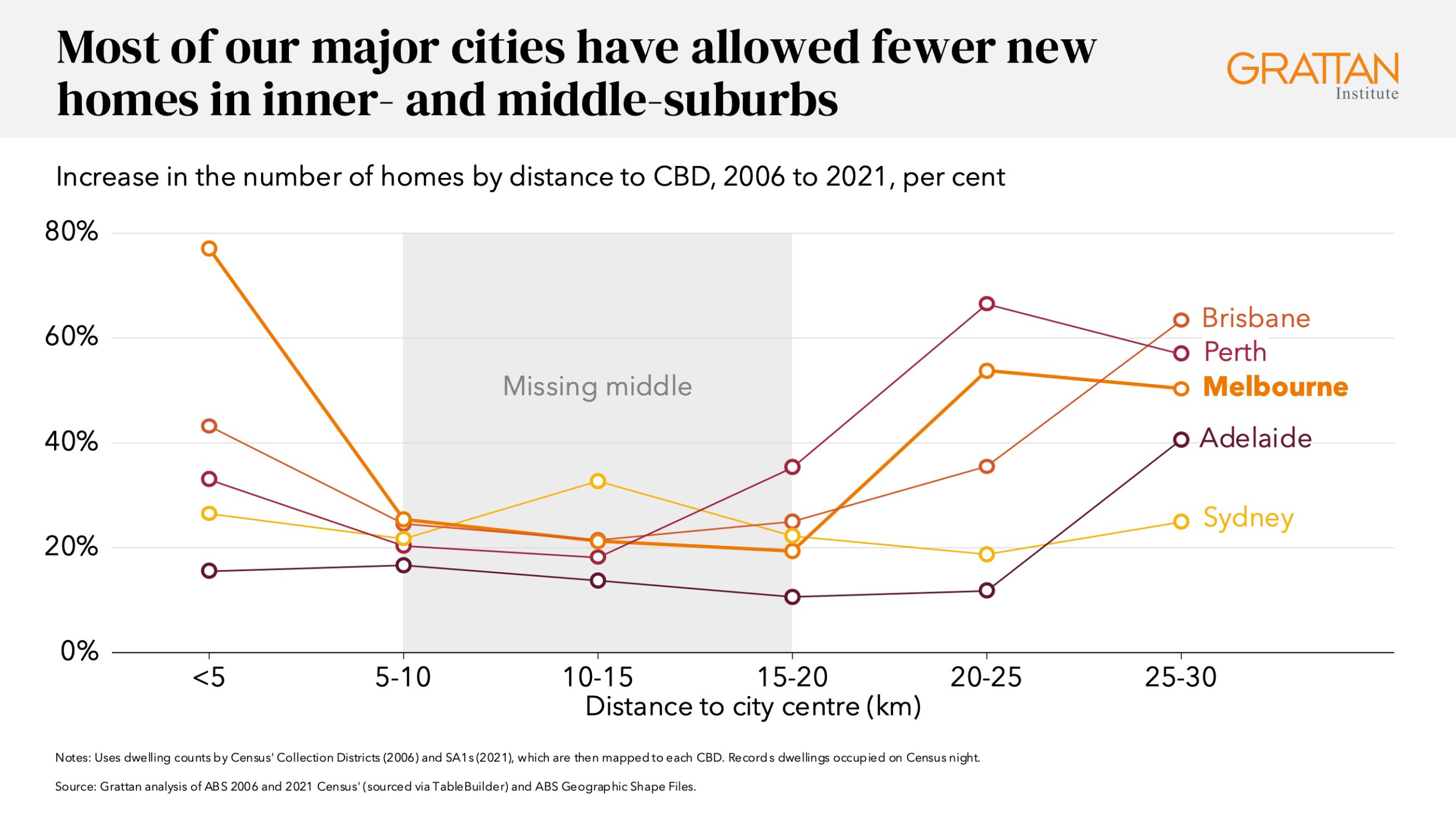
Between 2006 and 2021, most of our major cities added the fewest new homes in the desirable inner and middle-ring suburbs: precisely where housing is most expensive and demand is highest.
The exception being Melbourne, which added a lot of new apartments in and around the CBD, in addition to a lot of greenfield housing on the urban fringe.
We see this in surveys of what people want when we ask them to make real-world trade-offs on a given budget.
But we also see this in the prices that people are willing to pay to buy, or rent, these kinds of homes when they have been built in our biggest cities.
But instead of enabling more homes to meet that demand in established areas, we’ve pushed the bulk of our development to the urban fringe.
The result is that Australian cities are far less dense than comparable wealthy cities such as Toronto, Copenhagen, or Vienna — cities that match or exceed ours on quality-of-life measures, yet house far more people per square kilometre.
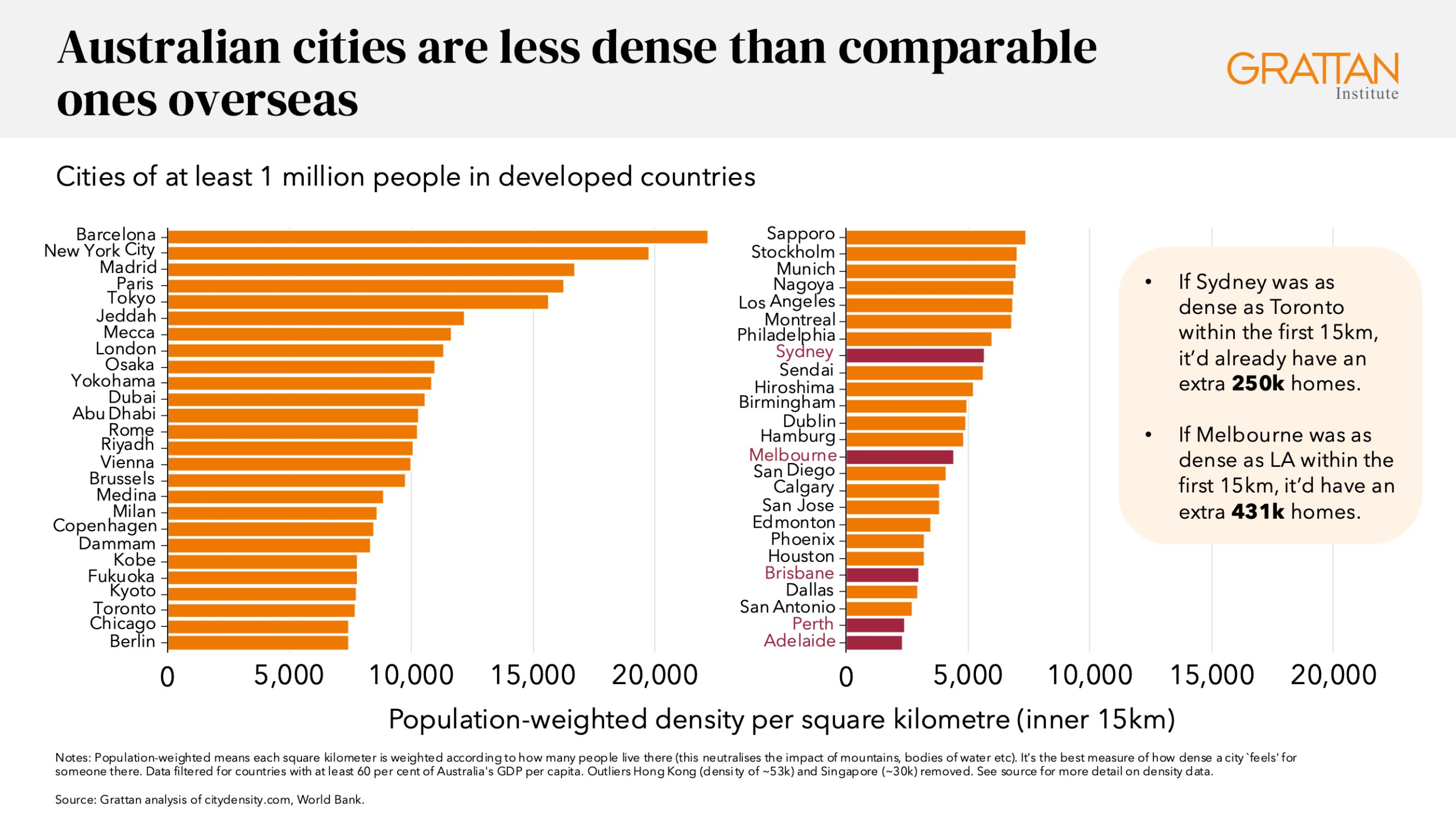
If the inner 15km of Melbourne matched Los Angeles – that globally-recognised example of dense, walkable, mixed-use urbanism – it would have 431,000 more homes.
If inner Sydney were as dense as Toronto, it would have 250,000 additional well-located homes.
And even that new housing that is being built on the greenfield fringe of all our biggest cities is typically on lots of 400sqm or less – not much larger than a typical new townhouse.
In other words, the Great Australian Dream of owning a quarter-acre block – or 1,000 square metres – within commuting distance of a capital city is already dead for most Australians, and has been for decades.
That is, unless you were lucky enough to buy one in an established suburb several decades ago.
We are undermining our own prosperity
Australian cities are our economic engines.
They allow people to access jobs and opportunities that best use their skills.
Cities generate productivity gains through the clustering of workers, firms and ideas, creating economies of scale that boost wages.
But scarce and expensive housing is pushing people away from these opportunities, particularly the young.
Those pushed to the outer suburbs face longer commutes and access to fewer jobs, making it harder for both parents to work, with women generally being the ones who end up working less.
Rising housing costs are turning our most productive cities from ladders of opportunity into barriers to entry.
Housing affordability is all about how we use land
Australia’s housing story is really one about the increasing value of scarce urban land.
After all, despite the vast size of our continent, Australia is one of the most urbanised countries on the planet.
When the demand for housing in a location increases, so does the price of land. Because it’s land — and well-located land in particular — that is in fixed supply.
In recent decades, the price of land has risen faster than the price of buildings. In 2024, land accounted for more than 70 per cent of the value of residential property, up from 50 per cent in 1990.
But the amount of housing that we can supply at a given location is not fixed.
First, we can build more intensively on the land we have: instead of a single house on a 1000sqm block, we can have four or five townhouses.
And second, because building upward is possible, via apartments.
In short, rising land values prompt developers to build more dwellings on each parcel of land, such as townhouses and apartment buildings.
That helps to keep housing affordable as land values rise as cities grow.
That is, unless we don’t allow that density to happen. And unfortunately, restrictive planning controls in our biggest cities are preventing much of the density we need.
Planning is the biggest problem
Of course, planning isn’t the only problem holding back more housing.
But it’s the biggest. And the good news is that it’s also the easiest to fix: it can largely be done without governments passing new legislation or spending more public money.
State and territory land-use planning systems have long managed the impacts of particular land uses and development on others.
Planners aim to manage the spillover effects, or ‘externalities’, arising from land uses —such as noise, pollution, or buildings overshadowing — on the neighbours.
Planning systems separate land uses that are clearly incompatible — such as putting a chemical refinery or an abattoir next to a school or housing.
And planners play a vital role in enhancing the public realm by coordinating the provision of infrastructure and green space.
In short, planning, when done well, can add enormous value to our cities.
But done poorly, it can also cause great harm.
And existing planning controls in Australia restrict new housing in ways that are hard to justify against these core objectives of planning. There are three problems.
Problem 1: Land-use planning controls say ‘no’ by default, and ‘yes’ by exception
The first, and by far the biggest, problem is that state and territory planning systems say ‘no’ to new housing by default, and ‘yes’ only by exception. Built form controls make it illegal to build more housing on a lot of scarce and valuable land across our capital cities.
About 80 per cent of residential land within 30km of the centre of Sydney, and 87 per cent in Melbourne, is restricted to housing of three storeys or fewer.
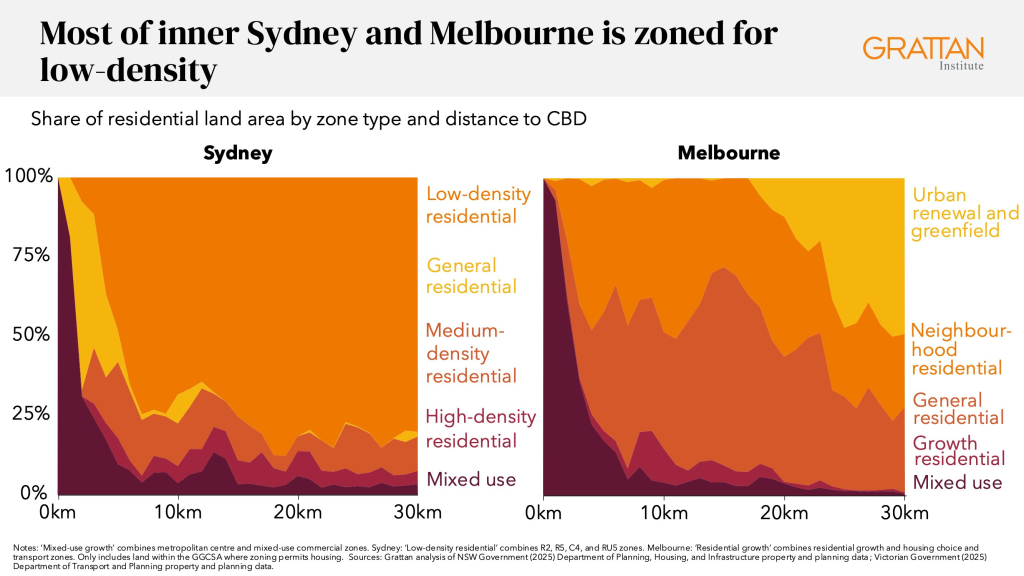
But this isn’t just a problem in our two biggest cities: three quarters or more of residential land in Brisbane, Perth, and Adelaide is zoned for two storeys or fewer.
Other prescriptive rules — such as minimum lot sizes, setbacks, and street frontages, as well as heritage — further limit what can be developed.
In fact, these other controls are often just as big a barrier to greater density as height limits, especially beyond Sydney and Melbourne.
The combined impact of these controls means development theoretically allowed is often practically infeasible, especially in the case of urban infill where the existing home must be bought and then demolished.
Problem 2: Planning approval processes are complicated, long, and uncertain
The second problem is that most new housing requires a planning approval, but approval processes for new housing — where it is even allowed in the first place — are slow, costly, and uncertain.
For example, a development application to build an apartment building in Sydney in the late-1960s was just 12 pages long. Today, a development application for planning approval for a similar apartment building runs to hundreds of pages and requires extensive environmental, traffic, and often heritage assessments.
The typical 10-dwelling development in Sydney and Melbourne also takes around 250 days to be approved. And each extra six months of permit processing time can add about $18,700 in developer costs per home.
Problem 3: The governance of land-use planning is biased against change
Third, the governance of land-use planning — who decides what gets built and where — is biased towards local residents who oppose change. People who might move to the area — were new housing to be built — don’t get a say.
In many other areas of policy, those proposing to restrict peoples’ choices in such a dramatic way would be required to reckon with the impact. But new land-use planning rules are not subject to any robust regulatory impact assessment process.
Land-use planning rules benefit existing residents by, for example, preserving views or preventing increased congestion. But studies conclude that the costs of restricting building the way that we do today are much larger.
The rules make housing scarcer and more expensive
By restricting the ability to build denser housing in desirable areas, planning rules drive a wedge between what housing costs to build, and what it sells for.
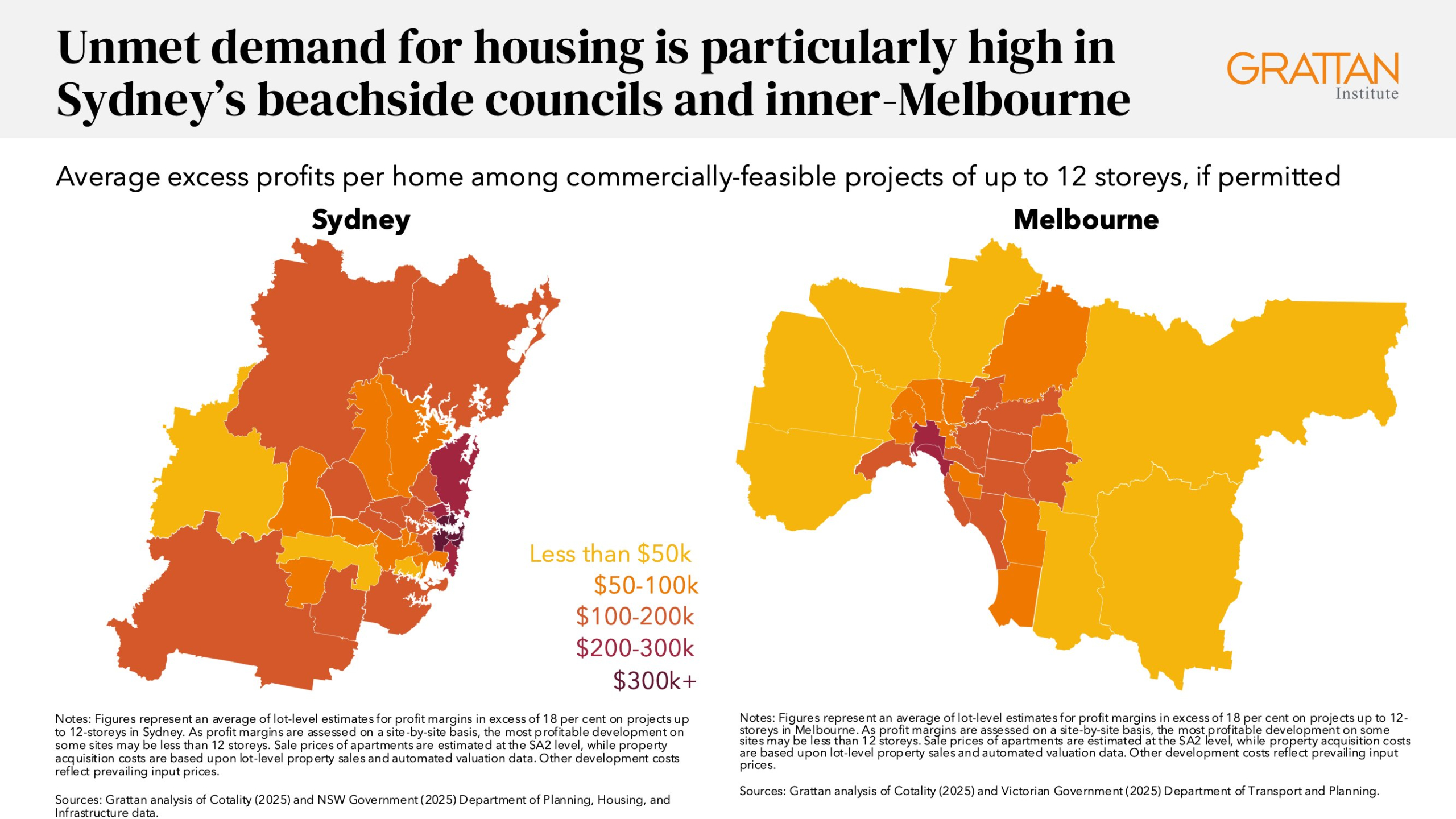
To estimate the impact of those controls, my colleagues and I at the Grattan Institute have calculated the gap between what housing sells for, and what it would cost if greater density was allowed across Sydney and Melbourne.
That gap between what homes cost to build, if allowed, and what similar homes currently sell for, approaches up to $500,000 in Sydney, and more than $250,000 in Melbourne.
That is, developers could currently sell these extra homes, if they were permitted on these sites, for substantially more than the cost of building them, even accounting for the costs of acquiring the land, all fees and charges, financing costs, and a developer profit margin.
In fact, relaxing planning controls means that housing supply can accelerate at the same time as house prices grow more slowly, or even fall.
By substantially increasing the number of sites where new housing is allowed, planning reform can reduce the cost of land for development by reducing the scarcity premium built into land values today.
Since developers would pay less for the land they need for each new home they build, they could sell homes for less and still make a commercial return.
The case of Auckland
This isn’t merely theory.
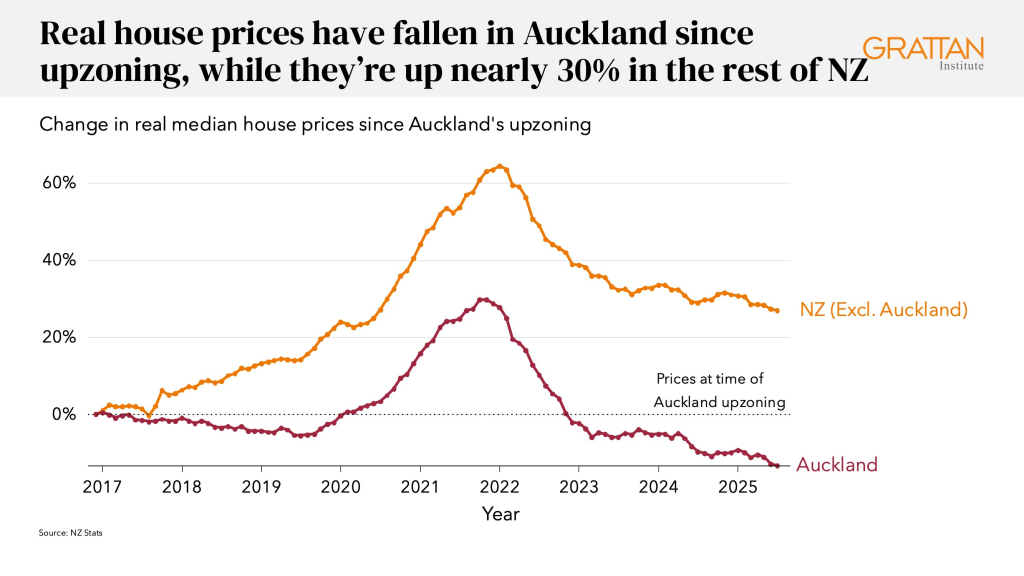
In 2016, about three-quarters of the residential land in Auckland, New Zealand, was up-zoned.
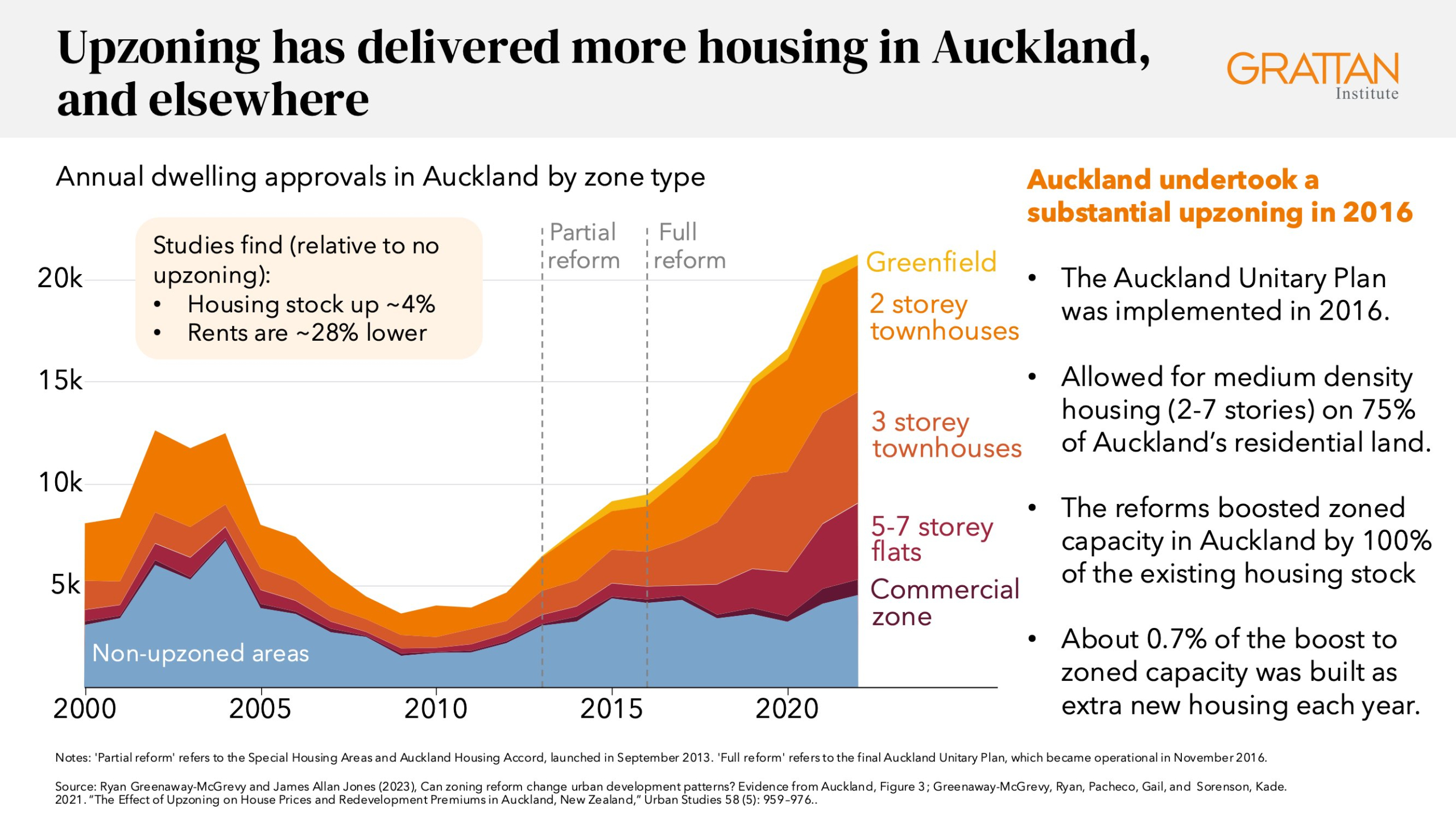
Researchers have found it led to an increase in housing supply of at least 4 per cent in just six years. Most of this new stock was extra townhouses and small apartment buildings.
That extra housing reduced rents for two- and three-bedroom dwellings by up to 28 per cent compared to where they would have been without the reform.
These gains have been sustained: today, house prices in Auckland are 15 per cent lower in real terms (i.e. after inflation) than in 2016, compared to a nearly 30 per cent rise across the rest of New Zealand.
The case for optimism
For too long one of our most important regulatory systems – that which regulates where people can live and in what types of housing, and where they can work – has received too little attention.
The result is a regulatory approach across Australia’s states and territories that has failed to properly examine the consequences of the restrictions that it imposes on the lives of Australians, including scarce and unaffordable housing, a less dynamic economy, and a less equal society.
The weight of evidence has become impossible to ignore.
Ultimately, reforming state and territory planning systems will be an endeavour of the same scale as dismantling trade protectionism in Australia over the second half of the last century. And the payoffs could be just as big.
Thankfully, the politics of planning are shifting.
Legacy planning shibboleths are being upended almost daily in Victoria and NSW as state governments override commonly held beliefs, and the vocal objections of local residents, to permit more housing.
The YIMBY movements in Melbourne, Sydney, Brisbane, and Canberra are a big part of that story.
And for those interested in solving this problem, I can think of no better guide than Alain Bertaud.
Thank you.