Overview
Too many Australians with psychosocial disability are missing out on the support they need. Some people living with the disabling effects of significant mental health challenges receive help through the NDIS. But most people with psychosocial disability receive no support from the NDIS or the mental health system – including about 130,000 adults with the greatest needs.
This gap is fuelling a growing problem. People without adequate support are more likely to experience homelessness, be admitted to hospital, or have their needs escalate – adding pressure to systems already under strain.
The NDIS has transformed funding for psychosocial supports. In the last year, it spent more than $5.8 billion supporting about 66,000 people with psychosocial disability. This investment is about one-third of all government spending on mental health. The NDIS should continue to support people with the most significant need, but more support is required for the people who do not meet its eligibility criteria.
Outside the NDIS, access to support is a postcode lottery. Services are patchy, underfunded, and inconsistent. A more balanced system – one that strengthens recovery-oriented supports inside and outside the NDIS – has the potential to transform the lives of people with psychosocial disability and make better use of existing funding.
Governments have recognised this gap and committed to building a more comprehensive system of psychosocial supports. But progress has stalled due to overlapping responsibilities, contested roles, and fiscal constraints.
A fairer, more effective, and better integrated system for people with psychosocial disability is possible. A clear-eyed review of pockets of good practice across Australia and evidence from current and previous programs shows the way.
The co-location of disability and mental health within one federal department also creates a new opportunity – to improve the experience of people with the most significant psychosocial disability by joining up these systems and better targeting resources to need.
This report outlines a plan to bridge the current gap in support by:
- Establishing a new National Psychosocial Disability Program, outside the NDIS but funded within existing contributions to the scheme, to provide support for a further 130,000 adults with the highest need.
- Delivering consistent services nationwide, expanding access to individual support facilitation and a broader range of recovery-oriented psychosocial supports.
- Enabling Primary Health Networks to lead regional planning, commissioning, and coordination, balancing national consistency with local flexibility.
- Making governments jointly responsible for design and delivery of the program, aligning incentives through new multilateral governance arrangements with clear lines of accountability.
Together, these reforms would create a more coherent, equitable, and sustainable system to better meet the needs of Australians with psychosocial disability, all within the current NDIS budget envelope.
Photo credit: Mindframe images
Recommendations
Recommendation 1
Establish a new National Psychosocial Disability Program outside the NDIS
- Provide recovery-oriented supports for adults with significant psychosocial disability who do not qualify for the NDIS.
- Fund the new program by re-purposing funds from within the current NDIS budget envelope.
- Enable people to step up or down between the NDIS and the new program as their needs change.
Recommendation 2
Deliver consistent services nationwide, tailored to regional needs
- Fund individual support facilitation, evidence-based psychosocial supports, and regional coordination, with a specific service response to meet the needs of First Nations people.
- Evolve state services to avoid duplication and enable tailoring of support to local needs and circumstances.
Recommendation 3
Make federal, state, and territory governments jointly responsible for the program
- Ensure oversight of the program through multilateral governance that aligns incentives across governments.
- Embed the voice of lived and living experience of psychosocial disability in program governance and commissioning processes.
Recommendation 4
Give Primary Health Networks responsibility for regional planning and commissioning
- Commission the program through regional consortia, with a lead role for PHNs, and make Aboriginal Community Controlled Organisations responsible for services for their communities.
1 Reform is urgent
Too many Australians with psychosocial disability are falling through the cracks and missing out on crucial support.
People with psychosocial disability that limits their ability to live independently or participate in community life often receive little or no support — from either the National Disability Insurance Scheme (NDIS) or the broader mental health and disability systems.
Psychosocial disability can be debilitating and, at its most significant, is eligible for NDIS support. But many people who need help do not qualify for the scheme, and there are few alternatives.
As a result, thousands of Australians are stranded below the NDIS’s eligibility threshold, without the supports they need. The personal, social, and economic costs of this gap are significant — including reduced quality of life, fewer opportunities for community participation, and lost productivity.
About 66,000 Australians with psychosocial disability receive services through the NDIS. But more than 130,000 people are left without any support, despite good evidence that recovery-oriented services can improve people’s functioning and well-being (see Figure 1.1).
This report outlines the steps governments should take to create a more balanced system – one that delivers fairer, more effective support for Australians living with psychosocial disability, regardless of whether they qualify for the NDIS.
Figure 1.1: Most people with significant psychosocial disability are missing out
People aged 25-64 with significant psychosocial disability and an unmet need for psychosocial supports, 2023
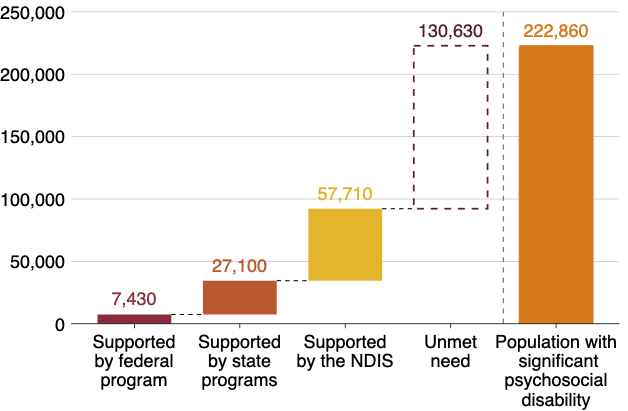
Notes: ‘Significant psychosocial disability’ refers to the population identified by Health Policy Analysis as experiencing severe mental health challenges that result in a high level of impairment. The 57,710 figure does not represent all NDIS participants with a psychosocial disability; it is from FY23 and only represents the population aged 25-64. The NDIS currently has a total of 66,000 participants with a primary psychosocial disability: NDIA (2025a).
Source: Grattan Institute analysis of Health Policy Analysis (2024).
Box 1: What is psychosocial disability?
Psychosocial disability refers to the functional impairment that people can face as a result of their mental health challenges. Not everyone with mental health challenges will have or develop a psychosocial disability – mental health challenges relate to a diagnosed condition, whereas psychosocial disability describes the disabling effects that some people may experience as a result.
It can affect how a person thinks, feels, communicates, or interacts with others. People with a psychosocial disability may find it difficult to secure and keep a job, make and maintain friendships and relationships, or manage finances and everyday responsibilities such as rent and utilities.
In this report, we focus on people with significant psychosocial disability – that is, people who experience high levels of functional impairment and have resultant high support needs.
Though widely used, the concept of psychosocial disability is not well-defined and is not universally accepted.aThe concept became increasingly prevalent in Australia in the early 2000s, supported by advocacy from The National Mental Health Consumers and Carers Forum: National Mental Health Consumer and Carer Forum (2011). There is no internationally agreed definition.
1.1 Mental health challenges are a major cause of disability
More than one in five Australians aged 16-85 experience mental health challenges each year, and 43 per cent have experienced one at some point in their lives.1These statistics capture people who met the diagnostic criteria for a mental illness at some point in the past 12 months, or in their lifetime: ABS (2023). In 2022, 4.3 million people in Australia experienced mental health challenges.2Ibid.
Many people with significant mental health challenges face long-term difficulties with day-to-day functioning.3People with mental health challenges and/or psychosocial disability have varied preferences about the language used to describe their experiences. Throughout this report, we follow the language guidance of the Mindframe media guidelines, Our words matter: Guidelines for language use, and try to avoid using medicalising language (such as ‘severe mental illness’) except where it is necessary for clarity. These individuals have a psychosocial disability (see Box 1).4Harvey et al (2023), and Productivity Commission (2020). Psychosocial disability can significantly limit capacity for self-care, communication, mobility, memory, and social interaction.
Of the 4.3 million Australians with mental health challenges, about 350,000 have a significant psychosocial disability for which they require support.5Health Policy Analysis (2024, Table 6). About 66,000 people with a significant psychosocial disability are in the NDIS.6NDIA (2025a, Table 1).
1.2 The toll of significant mental health challenges continues to rise
Spending on mental health services has grown steadily over the past decade. In 2023, total Australian expenditure amounted to $501 per person, which is $64 more per person than in 2014.7In real terms: AIHW (2025a, Table EXP.2). Public campaigns have encouraged Australians to seek help, and it shows: the share of adults who saw a health professional for their mental health rose from 12 per cent in 2007 to 17.4 per cent in 2020–22.8This comparison is based on the most recent two iterations of the Australian Bureau of Statistics National Study of Mental Health and Wellbeing: ABS (2023) and ABS (2008). The fieldwork for the most recent study was done over three years, between December 2020 and October 2022, and so represents a point-in-time measure for that period.
Yet higher spending and greater awareness have not reduced the impact or prevalence of mental health challenges. In 2023, mental health challenges were the leading cause of years lived with disability in the Australian population.9These trends are taken from ‘burden of disease’ reporting by the Australian Institute of Health and Welfare, which measures the impact of different health conditions in terms of disability-adjusted life years (DALYs), years lived with disability (YLDs), and years of life lost (YLLs). Between 2003 and 2024, the rate of DALYs for mental health conditions and substance-use disorders rose by 31 per cent, while the DALYs from all diseases fell by about 11 per cent. In 2024, mental health conditions and substance-use disorders were the second-largest contributor to the total disease burden and the leading cause of the non-fatal burden (measured in YLDs): AIHW (2024).
Gains from increased funding have not been even. Policy attention and enhanced supports have focused on more common conditions such as anxiety and depression, while people with the most significant mental health challenges too often remain left behind.10Harvey et al (2023, p. 2). Stigma, discrimination, and poor access to appropriate care are still widespread.11Behavioural Economics Team of the Australian Government (2022).
1.3 People with psychosocial disability experience significant disadvantages
For many Australians with psychosocial disability, daily life can be difficult. Beyond the challenges of managing their mental health, many face barriers to learning, working, connecting, and belonging, as a result of their mental health challenges and of discrimination.
The result is a cycle of disadvantage, where poverty, trauma, and poor health are intertwined causes and consequences of psychosocial disability.
People with psychosocial disability are less likely to be in the workforce, and more likely to rely on income support payments.12ABS (2025a, Table 10.3). Those who are employed tend to earn less than the general population; people with psychosocial disability had a median personal income of $450 per week in 2022, a fifth less than the median for all disabled people ($575) and less than half the median income for non-disabled people ($1,050).13Ibid (Table 10.1).
People with psychosocial disability are also less likely to have finished Year 12 and are less likely to go on to tertiary education.14Ibid (Table 8.3). About two in five do not have a year 12 or higher qualification, compared to one in five people without disability.15Ibid (Table 8.3).
Low and unstable income, and educational disadvantage, make it harder for many people with psychosocial disability to afford safe housing, transport, and healthcare, and to participate in the community.
In 2022, more than four in five people with psychosocial disability reported experiencing barriers to participating in social or community activities.16Ibid (Table 12.3). One in four reported having experienced discrimination in the past year on the basis of their disability.17Ibid (Table 11.3).
Beyond social exclusion and discrimination, many people living with psychosocial disability also face violence, abuse, neglect, and exploitation. Research for the 2019-23 Disability Royal Commission found that rates of interpersonal maltreatment are higher among this group than among other people with disability.18Fry (2023, p. 12).
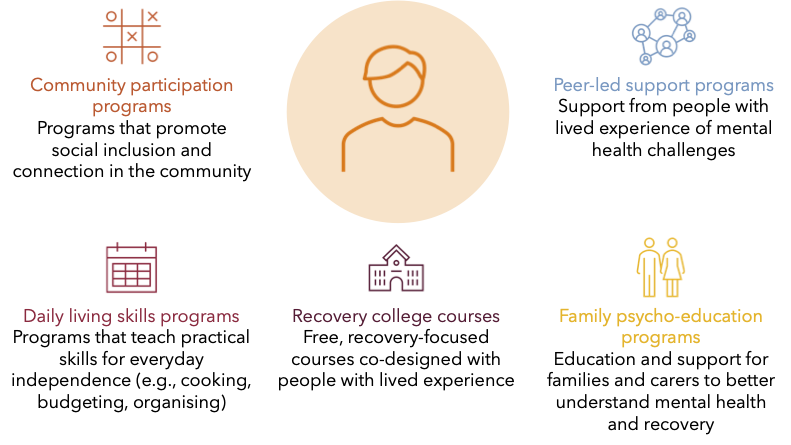
Figure 1.2: There are a range of psychosocial supports
Source: Grattan Institute analysis.
1.4 Psychosocial supports have a distinct and important role
People living with psychosocial disability can benefit from a range of supports in addition to clinical mental health treatment, medications, and specialist care from psychiatrists and psychologists.
Psychosocial supports are non-clinical, community-based supports that wrap around clinical care to provide vital assistance for people with functional limitations arising from mental health challenges (see Box 2).19Health Policy Analysis (2024, p. 5). They are delivered by a diverse workforce that includes people with lived experience in peer support roles.
Psychosocial supports deliver benefits not only for individuals – by improving recovery, participation, and quality of life – but also for the system, by reducing demand on hospitals and other government services.20Agency for Clinical Innovation (2025, p. 2).
A recent systematic evidence review focused on Australia and the UK found positive outcomes from recovery-oriented programs, including improved well-being, better management of mental and physical health, and increased independence, as well as positive system-level outcomes including reduced reliance on community mental health services and lower use of hospital and crisis-based services.21Ibid (p. 2).
Similarly, evaluations of the largest psychosocial programs in NSW found that rates of mental health-related hospital admissions were reduced by about three-quarters after people accessed services.22Purcal et al (2022, p. 5). The average length of inpatient stay also reduced by a similar proportion.23Ibid (p. 5). And the number of people with a new criminal charge or community corrections order fell to almost zero in the year after entering the program.24Ibid (p. 5). These reductions in service use translated into cost savings of about $86,000 per person over five years.25Ibid (p. 6).
Box 2: What are psychosocial supports?
Psychosocial supports are ‘non-clinical and recovery-oriented services, delivered in the community and tailored to individual needs, which support people experiencing mental illness to live independently and safely in the community’.aThis is the definition agreed to by all Australian governments, under the National Mental Health and Suicide Prevention Agreement: Psychosocial Project Group (2023).
They include services that assist people living with mental illness to:
– manage daily living skills
– obtain and maintain housing
– connect with and maintain engagement with other services, such as the NDIS, alcohol and other drug treatment services, and clinical care
– socialise, and build and maintain relationships
– engage, and maintain engagement, with appropriate education (including vocational skills) and employment opportunities.bHealth Policy Analysis (2024, pp. 5–6).
1.5 Too many people with significant psychosocial disability are missing out on support
A 2024 report prepared under the National Mental Health and Suicide Prevention Agreement found that about 650,000 Australians aged 12-64 had a moderate or severe need for psychosocial services – but less than a quarter were getting any support.26This report was prepared by Health Policy Analysis. We rely on Health Policy Analysis’s modelling throughout this report because it is the best available data on the need for and provision of psychosocial supports in Australia. For a more detailed analysis of the report’s data, see Appendix A: Health Policy Analysis (2024, Table 48).
The vast majority of hours of unmet need were for people with a ‘severe’ need for supports – or in other words, with a significant psychosocial disability.27Health Policy Analysis (ibid, Table 52). We identify this group as having a ‘significant psychosocial disability’, because the definition used in the modelling is ‘more closely related to role impacts and impairment in psychosocial functioning than clinical symptoms’: Health Policy Analysis (ibid, p. 4). Less than a third of the 335,800 people in this category got support from any existing program.28Ibid (Table 48).
These gaps persist despite the evidence that psychosocial support can improve quality of life, support people back into work, and reduce reliance on more expensive programs and acute mental health services.29NDIS Review (2023a, p. 84).
Many people can benefit from psychosocial supports,30Productivity Commission (2020, p. 831). but the group with significant psychosocial disability warrants priority because of the urgency of addressing the steep funding cliff at the edge of the NDIS.31People with primary psychosocial disability receive an average of $90,300 a year in the NDIS (NDIA (2025a, Table 18)), but many deemed ineligible for the NDIS receive nothing: Health Policy Analysis (2024, Table 48). This report focuses on that group.
1.6 Reform has been slow and insufficient
Psychosocial disability sits uneasily at the intersection of the mental health and disability systems, making its policy design inherently challenging.
The inclusion of psychosocial disability in the NDIS wasn’t inevitable. The Productivity Commission’s 2011 inquiry process, which ultimately recommended the creation of the NDIS, sought feedback on whether psychosocial disability should be included at all.32Productivity Commission (2011, p. 23). This uncertainty has persisted ever since.33For example, former Australian of the Year Patrick McGorry suggested that including psychosocial disability in the NDIS was a mistake: Rosenberg et al (2019).
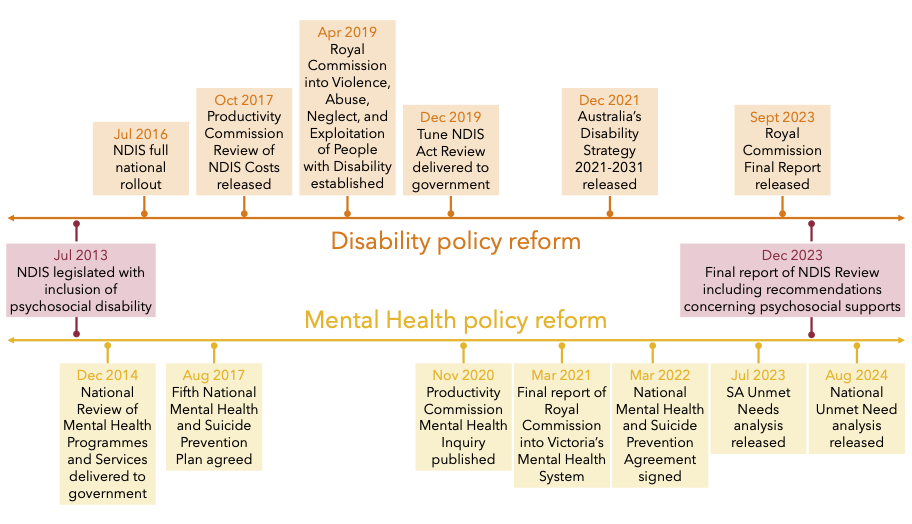
In recent years, reviews have recommended ways to improve support for people with psychosocial disability in the NDIS (see Figure 1.3).
Figure 1.3: Under the NDIS, the distinct policy reform paths of mental health and disability have intersected
Key disability and mental health public policy events, 2013 to 2025
Source: Grattan Institute analysis.
In 2022, all governments signed the National Mental Health and Suicide Prevention Agreement, and committed ‘to be jointly responsible for psychosocial support services for people who are not supported through the NDIS.’34Council on Federal Financial Relations (2022, Clause 47(g)).
And in 2023, National Cabinet agreed to jointly fund foundational supports – lower-level disability supports delivered outside the NDIS.35Department of the Prime Minister and Cabinet (2023). The 2023 NDIS Review made clear that these supports should include targeted supports for people with psychosocial disability.36NDIS Review (2023b, p. 4).
These commitments show that there is a shared awareness of a problem. But there has been little progress to address it. And these two commitments appear to exist separately — one in the mental health system, and one in the disability system, with little acknowledgement of their overlap or how it should be managed.
In practice, people needing these supports span both systems, and any solution that is located solely in one system will mean continued service fragmentation.
1.7 A fairer, more effective system is possible
Despite the slow pace of reform, there are reasons for optimism. Governments have already taken important steps that could lay the groundwork for a stronger and fairer system of psychosocial supports.
The co-location of disability and health into a single federal department creates an opportunity to tackle the longstanding disconnect between the two systems and to build a fairer, more effective system of support for people with psychosocial disability.
To seize this opportunity, Ministers should join up policymaking in the Department of Health, Disability, and Aging, and confirm that work to address unmet need identified under the National Mental Health and Suicide Prevention Agreement is the same as the targeted foundational psychosocial supports proposed by the NDIS Review.
In our previous report, Saving the NDIS, Grattan Institute identified how a small proportion of the NDIS budget could be redirected to fund an ambitious tier of targeted foundational supports for people outside the scheme who have psychosocial disability.37Bennett et al (2025).
Building on this previous work, this report will look more forensically at what supports should be commissioned, for who, and in what way. While these elements could be progressed by government regardless of the chosen funding mechanism, in this report we work within the scope of the commissioning budget we previously identified.
1.8 What this report does and does not do
This report focuses on the landscape of psychosocial supports outside the NDIS, and how to address unmet need for people with significant psychosocial disability. It does not set out a comprehensive plan for reforming how the NDIS should support people living with psychosocial disability.
There are broader reforms needed that fall outside the scope of this report, including changes to NDIS eligibility, assessment, and planning processes. Other areas – such as reforms to clinical mental health services, or broader social policy settings – are also outside the scope of this report.
This report explains how governments can build a strong and equitable tier of psychosocial supports outside the NDIS, creating a better experience for people with psychosocial disability without the need for new government investment.
Chapter 2 shows that government investment in psychosocial supports is out of balance, resulting in a postcode lottery where some people get high-quality supports but most get nothing.
Chapter 3 proposes a new National Psychosocial Disability Program that should provide support for adults living with significant psychosocial disability who do not qualify for the NDIS.
Chapter 4 describes how the program should be implemented at the regional level by Primary Health Networks, to ensure services are responsive to local needs.
Chapter 5 sets out how governments should come together to jointly fund and oversee the new program, to get the best results for its recipients.
2 Government spending is out of balance
The current psychosocial supports landscape is sparse. About 66,000 people with a primary psychosocial disability receive support from the NDIS. Outside of the NDIS, the federal government, and all state and territory governments, currently fund psychosocial support programs, some of which are longstanding.
But expenditure on psychosocial supports is too concentrated on the relatively small proportion of people who meet NDIS eligibility criteria. And the targeting and design of state and federal programs is hugely inconsistent.
This geographic inconsistency means regional inequity. But it also means there are many different existing programs that provide evidence for what works well and why. Against this backdrop, building a psychosocial support offering to address unmet need should be a process of learning from and expanding best practice.
This chapter analyses the current landscape of psychosocial supports and shows how the patchwork of services can be improved by re-balancing government spending so that more people with significant psychosocial disability receive the support they need.
2.1 Funding for psychosocial supports is poorly targeted to need
Funding for psychosocial supports in Australia is highly concentrated in the NDIS, leaving a significant funding cliff at the edge of the scheme.
NDIS spending on support for people with a primary psychosocial disability was in excess of $5.8 billion over the last year.38NDIA (2025a, Table 13). The NDIS now represents a very substantial, and quickly growing, proportion of all Australian governments’ expenditure on support for people with mental health challenges (see Figure 2.1).
Figure 2.1: The NDIS has rapidly emerged as a substantial component of all funding for supports for people with mental health challenges
Expenditure by Australian governments on mental health services and on NDIS payments to people with a primary psychosocial disability
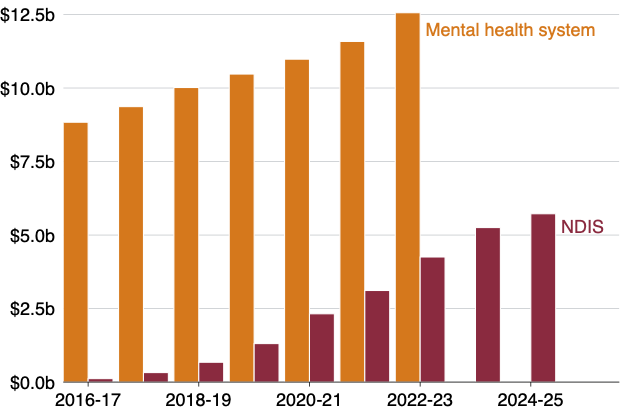
Notes: Mental health expenditure data are not available for 2023-24 and 2024-25. Mental health expenditure includes expenditure by the federal and state/territory governments on Medicare mental health services, mental health medications, state and territory specialised mental health services, and other smaller-scale services within the mental health system.
Sources: AIHW (2025b) and NDIA (2025b).
Total government expenditure on non-NDIS psychosocial supports is about $600 million per year: about $136 million for the Commonwealth Psychosocial Support Program (CPSP) and about $481 million for state- and territory-funded programs.39The CPSP received $272.1 million for a two-year extension in the 2024-25 Mid-Year Economic and Fiscal Outlook (about $136 million annually): Department of Health, Disability, and Ageing (2025a). Funding data on state and territory programs are limited. We have used the AIHW national state and territory recurrent expenditure on grants to non-government organisations as the closest proxy: AIHW (2025a).
This means that more than 90 per cent of total spending by Australian governments on psychosocial supports is through the NDIS, which allocates individualised packages to about 66,000 people with a primary psychosocial disability.40Grattan Institute analysis of Department of Health, Disability, and Ageing (2025a), AIHW (2025b), and NDIA (2025a, Table D.8).
This is similar to the total number of people who receive support from all other psychosocial services put together (estimated to be about 64,000 people).41Health Policy Analysis (2024, Table 48).
These non-NDIS psychosocial supports barely scratch the surface of current need (see Figure 1.1). In almost all instances, the federal and state offerings in each state serve fewer people than the NDIS (see Figure 2.2).42For simplicity, in this chapter we use ‘state’ to mean ‘state and territory’.
Figure 2.2: Service coverage for people with significant psychosocial disability is different in every state – but most need is unmet
Proportion of people aged 12-64 living with significant psychosocial disability receiving supports, by provider, 2022-23
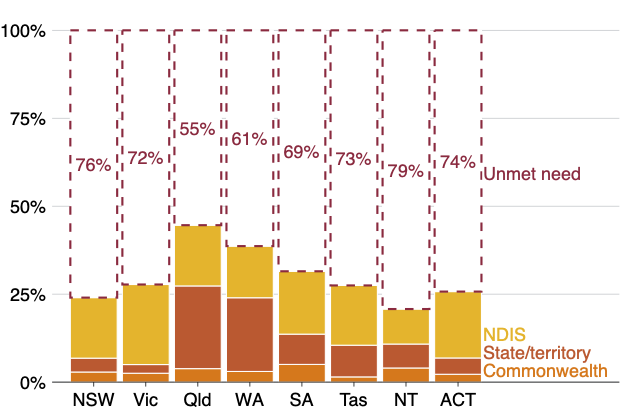
Note: ‘Significant psychosocial disability’ refers to the population identified by Health Policy Analysis as experiencing mental health challenges that result in a high level of impairment.
Source: Grattan Institute analysis of Health Policy Analysis (2024).
People with psychosocial disability are seeking help, but too often they are not getting either state-funded supports or a place in the NDIS. More adults with high support needs miss out altogether than receive support from any existing program.43Health Policy Analysis (2024, Table 48).
This is despite evidence that there is enough money in the system overall. One analysis concluded that overall expenditure on specialised mental health community support services in South Australia exceeded need by about $34 million.44McGrath (2023, Table 18). The distribution of this funding was overwhelmingly in the NDIS.45Ibid (p. 50). There was still substantial unmet need for mental health services, since virtually all other community mental health supports were substantially underfunded.46Ibid (p. 50).
2.2 The NDIS hasn’t closed long-standing gaps in psychosocial supports
The low number of people receiving psychosocial supports outside the NDIS is no coincidence. While there was large unmet need for psychosocial supports before the NDIS, the introduction of the NDIS from 2016 failed to substantially increase access and, in fact, brought about the end of many existing psychosocial support programs.47NDIS Review (2023a, pp. 82–83).
As the NDIS was rolled out, funding for federal psychosocial support programs and some state government programs was folded into the new scheme.48Rosenberg (2017, p. 2). This happened despite warnings that many people would be left with reduced access to services.49Meldrum (2014), and Quinlan (n.d.).
Four key federal programs for people with psychosocial support needs and their carers – Partners in Recovery, Personal Helpers and Mentors, Support for Day to Day Living in the Community, and Mental Health Respite Carer Support – were dismantled in the process.50Productivity Commission (2020, p. 843). In practice, only about half of their former participants chose to apply for the NDIS, and roughly a quarter of those applicants were deemed ineligible.51Hancock et al (2019, pp. 7, 8).
Transitional measures were put in place, which have since been consolidated into the Commonwealth Psychosocial Support Program, which now reaches about 22,000 people.52Health Policy Analysis (2024, Table 42). The CPSP primarily supports people with moderate support needs.53Ibid (p. 67).
Some state programs were also absorbed. The 2019-21 Royal Commission into Victoria’s Mental Health System records how, in 2015, the state – once a national leader in community psychosocial supports – decided to transition most of its psychosocial funding into the NDIS, leaving little available outside the national scheme.54State of Victoria (2021, Volume 1, 383).
Now, nowhere is well served. Australia’s psychosocial support dollars flow to the few, not the many.
The average package for someone in the NDIS with a psychosocial disability is about $70,000 per year, excluding people with the most intensive housing and support packages.55The small number of people with psychosocial disability who receive Supported Independent Living (SIL) have an average package size of $384,800. The overall average for people living with psychosocial disability in the NDIS is $89,700: NDIA (2025c, Table 111, Supplement E). This is higher than the average funding for all disabilities in the NDIS (excluding the same group), which is about $46,000.56NDIA (2025d, Table 106, Supplement E). Funding for people with psychosocial disability has grown at a faster rate than the scheme as a whole, predominantly driven by people’s plans growing over time (see Figure 2.3).57Grattan Institute analysis of NDIA (2017), NDIA (2018), NDIA (2019), NDIA (2020), NDIA (2021a), NDIA (2022a), NDIA (2023a), NDIA (2024a), NDIA (2025d), and AIHW (2025c).
Figure 2.3: Cost growth for psychosocial disability has largely been caused by plan growth
NDIS primary psychosocial disability cost growth decomposition, FY17-25
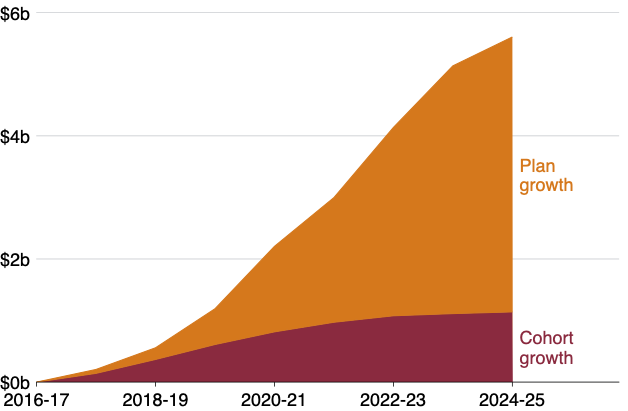
Notes: Growth decomposition determined using FY17 costs as baseline; participant growth represents the cost growth from participants if plans had been maintained at the baseline price. Plan growth represents all other growth; it will include actual inflation of wages and goods, and real growth in payments from interplan and intraplan inflation.
Source: Grattan Institute analysis of NDIA (2017), NDIA (2018), NDIA (2019), NDIA (2020), NDIA (2021a), NDIA (2022a), NDIA (2023a), NDIA (2024a), NDIA (2025d), and AIHW (2025c).
In contrast, in the Commonwealth Psychosocial Support Program – the federal government’s largest budgetary commitment to psychosocial disability support outside the NDIS – the average annual cost per person is about $6,000 per year.58NDIS Review (2023a, p. 84). Some states run programs of higher-intensity support, but funding is still less than NDIS-levels.59See for example NSW program CLS-HASI which provides an average of 333 hours of support to participants per year, with an average cost of $35,622 in 2018-19: Health Policy Analysis (2024, Table 18), Purcal et al (2022, p. 10).
It is appropriate that people in the NDIS receive the highest level of support, given that this group has been assessed to have the highest and most complex needs.60To access the NDIS, applicants with primary psychosocial disability typically have demonstrated that they have a permanent condition with substantially reduced functional capacity: NDIA (2024b). Previous Grattan Institute analysis estimated about 3 per cent of participants with primary psychosocial disability accessed the scheme via the early intervention pathway, which has a different set of criteria: Bennett et al (2025, p. 64). But the current balance appears off-kilter: the scale of investment for those within the scheme sits uneasily alongside the very limited supports available to the many who live with psychosocial disability outside it.
The disparity between haves and have-nots is also worsening, with NDIS eligibility rates for applicants who live with a psychosocial disability falling sharply – from 78-to-86 per cent in the scheme’s first three years to just 25 per cent in 2024-25 (see Figure 2.4).61NDIA (2019), and NDIA (2025b, Table 2). This decline is specific to psychosocial applicants: overall eligibility rates across the NDIS rose from 76 per cent in 2022-23 to 80 per cent in 2024-25.62NDIA (2023b, Table 2), and NDIA (2025b, Table 2). There have been no changes to NDIS eligibility criteria that can explain the reduction in access for people with psychosocial disability.63For further analysis of the challenges people with psychosocial disability face in getting access to the NDIS, see Threlfall et al (2025).
Figure 2.4: Fewer and fewer people with psychosocial disability are successful when applying to the NDIS
NDIS access rates for people with a primary psychosocial disability
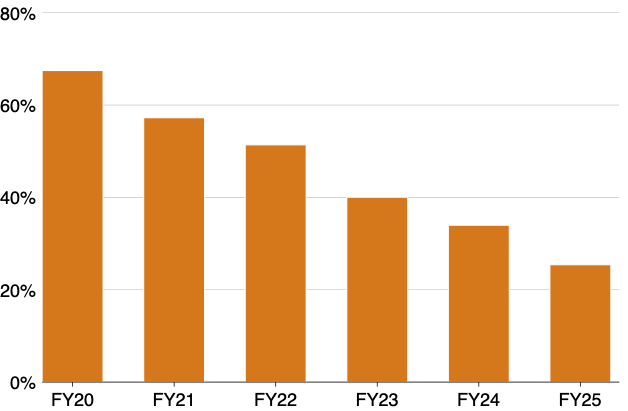
Note: Data based on Q4 access rates for each financial year.
Source: Grattan Institute analysis of NDIA (2021a), NDIA (2022b), NDIA (2023c), NDIA (2024c), and NDIA (2025e).
2.3 The mix of psychosocial supports available in each state is highly variable
Each state funds a variety of psychosocial support programs for adults. Most of the programs are small (see Figure 2.5).
Figure 2.5: There are a lot of state-run psychosocial support programs, most of them small
Size and intensity of state-funded psychosocial support programs in 2022-23
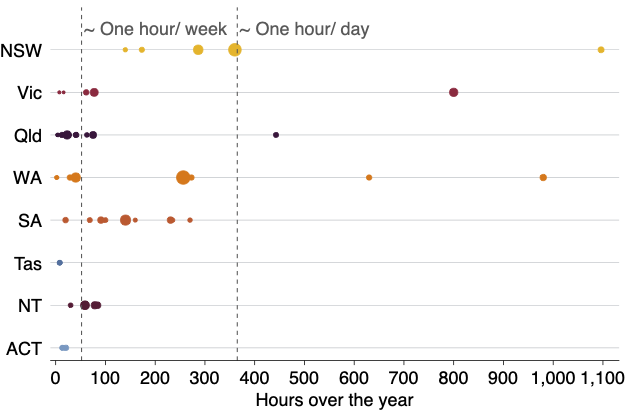
Notes: Each dot represents an individual program. The bigger the dot, the more people using the program. A dot’s placement on the x-axis indicates the average number of hours the program delivered per person. People don’t necessarily receive services for the full 12 months, and the frequency of service access could vary over the period.
Programs with less than 10 participants have been excluded. Data includes people aged 12-64.
Source: Grattan Institute analysis of Health Policy Analysis (2024).
While some services are delivered directly by governments, most are commissioned from non-government organisations.64Productivity Commission (2020, p. 828). Many of these organisations deliver programs funded by multiple jurisdictions, including Commonwealth programs commissioned through Primary Health Networks (PHNs).65PHNs are non-government organisations tasked by the federal government with planning and commissioning services for their region. See Chapter 4.
The range of programs available in each state varies, reflecting different histories of deinstitutionalisation, population needs, policy choices, and funding levels.
All states provide individual recovery supports, and most offer group activity and/or drop-in programs.66Grattan Institute analysis of Health Policy Analysis (2024). See Appendix A for more details. But only some states fund peer-led, clubhouse, or residential supports.67A clubhouse is a member-run organisation based in a physical space – a clubhouse. There is strong evidence that people with mental health challenges who participate in a clubhouse tend to have better social connections and quality of life: McKay et al (2018). Grattan Institute analysis of Health Policy Analysis (2024). Western Australia, Queensland, and South Australia provide the most comprehensive offering in terms of program types.68Grattan analysis of Health Policy Analysis (2024).
The ACT funds services for people from age 10, Tasmania from 12, and NSW and Victoria from 16.69Grattan Institute analysis of Health Policy Analysis (ibid). In the remaining states there are no services for people younger than 18.70Grattan Institute analysis of Health Policy Analysis (ibid).
Most states also fund programs for specific population groups – such as people experiencing homelessness, people with eating disorders, those exiting justice settings, or people from specific cultural groups.71Grattan Institute analysis of Health Policy Analysis (ibid). But these tailored supports are patchy. Every state has these population groups, yet none offer tailored programs for all of them.
2.4 State-funded psychosocial support offerings target different levels of need
The proportion of people using these psychosocial support services outside the NDIS varies greatly between states (see Figure 2.2).72Grattan Institute analysis of Health Policy Analysis (ibid).
Most psychosocial supports outside the NDIS are delivered through state programs, which in 2022-23 supported about 27,100 adults with a significant psychosocial disability.73Ibid (Table 48). But access varies widely across jurisdictions. In some states, fewer than 35 people with a significant psychosocial disability per 100,000 of the general population receive state-funded supports, while in others it’s nearly 300 people per 100,000 (see Figure 2.6).74Grattan Institute analysis of Health Policy Analysis (ibid).
Figure 2.6: The proportion of people receiving psychosocial supports varies greatly across Australia
People aged 12-64 with significant psychosocial disability who received non-NDIS psychosocial supports, per 100,000 population, by funder, 2022-23
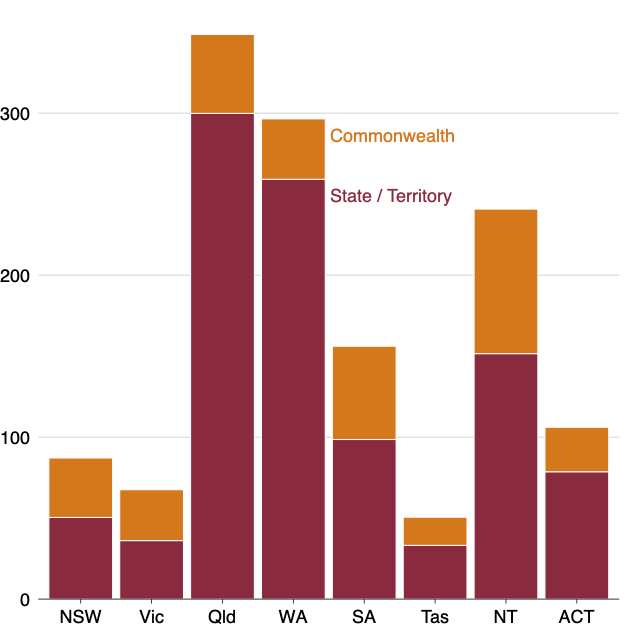
Note: Represents actual per capita service use among the general population, not adjusted for need.
Source: Grattan Institute analysis of Health Policy Analysis (2024).
The extent of support provided also varies substantially, from 3,400 hours of service per 100,000 people at the lowest end to more than 20,000 hours at the highest.75Grattan Institute analysis of Health Policy Analysis (2024, pp. 44–64).
Federally-funded services outside the NDIS are much smaller, reaching only about 28,000 people nationally.76Most of these people (22,000) receive support from the Commonwealth Psychosocial Support Program, with the remainder using a variety of small programs: Health Policy Analysis (ibid, Table 42). These services are too small to offset geographic inequities in access (see Figure 2.6), and there is no evidence they are targeted to fill gaps in state-funded services.
NSW and Queensland illustrate these differences. In NSW, a person with significant psychosocial disability receiving state-funded psychosocial support in 2022-23 received an average of 337 hours of support.77Ibid (Table 19). In Queensland, the equivalent figure was just 29 hours.78Ibid (Table 25).
The biggest programs in NSW – the Housing and Accommodation Support Initiative and Community Living Supports (HASI-CLS) – are high intensity, reflected in the high number of hours of support available per person.79NSW Health (2025) and Health Policy Analysis (2024, Table 18).
In contrast, Queensland’s main programs, including the Individual Recovery Support Program and the Group Based Peer Recovery Support Program, offer lower-intensity, time-limited support.80Grattan Institute analysis of Health Policy Analysis (2024, Table 24). Participants are expected to reduce service use over two years.81Rutherford et al (2022).
With limited funding, each state has made a trade-off. NSW concentrates resources on a smaller, more complex group, with little support available for people with less complex needs, whereas Queensland spreads support more thinly across a broader population.
2.5 Government investment should be better balanced
The concentration of funding in the NDIS is not only a problem for the people who miss out. Previous Grattan Institute research indicates that a large proportion of funded supports for successful applicants are not well aligned to the objective of enabling personal recovery.82Bennett et al (2025, p. 62).
A disproportionate amount of NDIS funding for people with a primary psychosocial disability – 80 per cent – goes on practical daily living supports, either inside or outside the home.83NDIA (2025a, Table 16). This can include cleaning, cooking, and transportation to get out and about.
While there is a role for these supports in the NDIS for people with psychosocial disability as part of a broader package of supports, particularly when in crisis or in their early months or years in the scheme, there is no evidence that funding daily living supports over the long term supports people’s recovery.84Bennett et al (2025, p. 62). Yet recovery is explicitly identified as the intended purpose of NDIS support for this group.85NDIA (2021b, p. 5). In practice, packages for people on the NDIS with a psychosocial disability tend to go up over time, rather than down.86NDIA (2022c, p. 34).
This funding mix magnifies the targeting problem: intensive day-to-day assistance for the few, alongside under-resourced recovery-oriented supports for the many.
In our Saving the NDIS report, we outlined how to optimise government expenditure on evidence-based supports, while more equitably meeting people’s needs.87Bennett et al (2025). We estimated that, through a carefully staged transition, about $2.2 billion per year could be redirected to fund an ambitious tier of recovery-oriented psychosocial supports for people outside the NDIS who are currently missing out.88Ibid. This would be equivalent to about one-quarter of total projected payments for people with a primary psychosocial disability, and can be done without undermining the important role the NDIS should continue to play for those who qualify for it.89This funding redirection would not affect any NDIS participants receiving Supported Independent Living funding: Bennett et al (ibid). We estimate that payments for people with a primary psychosocial disability will have grown to $8.8 billion by 2030-31, based on interpolating between the 2027-28 and 2033-34 projects in the 2023-24 Annual Financial Sustainability Report: NDIA (2024d, p. 174) Under our plan, $2.2 billion per year is redirected in 2030-31, which is equivalent to one-quarter of payments. See Appendix B for an explanation of the proposed funding transition.
3 Australia needs a new National Psychosocial Disability Program
Australia can build a truly national system of psychosocial supports within five years – but it will take clear vision, smart design choices, and strong commitment from all governments.
Governments should commit to a bold but practical plan that:
- prioritises people with the highest need – adults with significant psychosocial disability who are not in the NDIS;
- establishes a new National Psychosocial Disability Program (NPDP) which ensures sufficient psychosocial supports are available everywhere in Australia;
- increases funding for Social and Emotional Wellbeing supports, to support First Nations people with psychosocial disability; and
- tasks Primary Health Networks (PHNs) with commissioning the program (see Chapter 4).
In this chapter, we propose a model for a new National Psychosocial Disability Program. We outline the types of psychosocial support services that should be available in every region. None of these services are entirely new: all exist or have existed in Australia, and all are supported by evaluation evidence.
3.1 Target adults with significant needs
Many Australians would benefit from increased access to psychosocial supports, but governments should prioritise meeting the needs of adults with significant psychosocial disability.
There are two reasons for this prioritisation.
First, governments should prioritise people with significant psychosocial disability because this group faces the most profound quality-of-life consequences from their mental health challenges.90Modelling conducted under the National Mental Health and Suicide Prevention Agreement estimated that 255,000 people living with mental health challenges aged 25-64 have an unmet need for psychosocial supports, of whom 125,000 have a ‘moderate’ need for support and 130,000 have a ‘severe’ need for support. This model differentiates the two groups based on the level of functional impairment and support needs people experience as a result of their mental health challenges: Health Policy Analysis (2024, pp. 4, 78). See also: National Mental Health Commission (2024, p. 21) and Evans et al (2007).
The negative consequences, for individuals, families, communities, and taxpayers of not addressing this group’s needs are higher than for people with lesser mental health challenges. For some people with significant psychosocial disability, timely access to supports outside of the NDIS will also prevent, reduce, or delay their need for an individualised NDIS package in the future.91NDIS Review (2023a, pp. 83–84).
Second, government should focus specifically on adults because it is among adults that the largest gulf of unmet need lies, and because the psychosocial support needs of children are different to those of adults and therefore warrant a different policy response.
Of the estimated 17 million hours of psychosocial support required but not being provided in Australia each year, more than half – 10 million hours – are among people aged 25-64 with significant psychosocial disability.92Health Policy Analysis (2024, Table 52). This concentration of unmet need is reflected in the rate at which this group is attempting to get access to the NDIS: 94 per cent of successful applicants to the NDIS with a primary psychosocial disability in 2024-25 were people aged 25 and older.93NDIA (2025b, Table 3).
A one-size-fits-all approach to addressing the psychosocial support needs of all age groups would not be appropriate. Effective mental health services for children are distinct from adult services, designed to be developmentally-appropriate and well integrated with sectors such as education and child protection.94World Health Organisation (2024). Any reform in psychosocial supports for young people should consider its integration with existing youth mental health initiatives.95For example, this would include consideration of how reforms integrate with the recent announcement of 30 new headspace Plus centres, designed to better meet the needs of young people with mental health challenges: McBride (2025).
Our proposed National Psychosocial Disability Program therefore should focus on how governments can meet the needs of the 130,000 adults with significant psychosocial disability and an unmet need for psychosocial support. Future policy work could consider how to better meet the needs of other groups, including whether it would be appropriate to use other funding sources to expand the remit of the proposed program to address more of this unmet need.
3.2 What a new national program should look like
The new program we propose should build on what we know works to support adults with psychosocial disability, through the provision of non-clinical, evidence-based and recovery-oriented psychosocial support (see Figure 3.1).
Figure 3.1: Grattan Institute’s proposed National Psychosocial Disability Program comprises three types of services
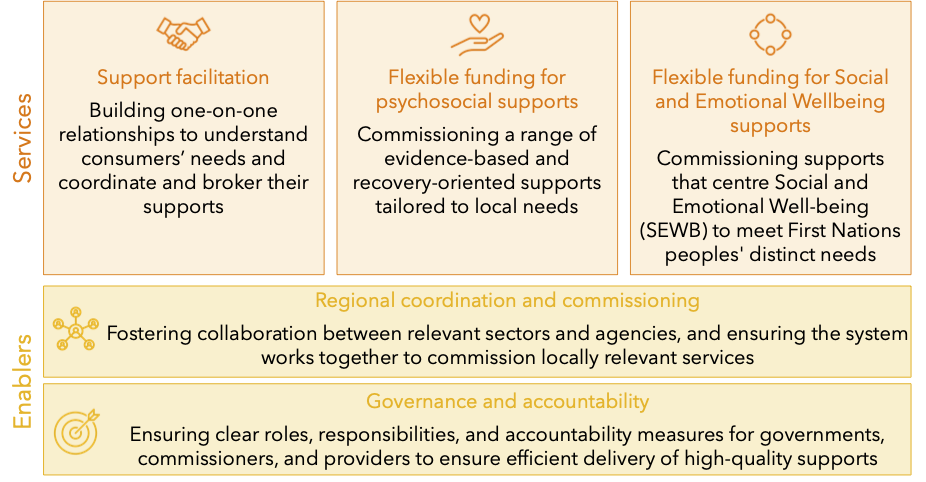
Note: Enablers are explained in Chapter 4.
Source: Grattan Institute analysis.
The program’s purpose should be to enhance personal recovery and well-being and to prevent, reduce, or delay people’s requirement for more intensive disability supports through the NDIS.
The program should ensure that all adults with significant psychosocial disability can get the following services, no matter where they live in Australia:
Specific supports for First Nations peoples: supports that centre Social and Emotional Wellbeing (SEWB) to meet First Nations peoples’ distinct needs.
- A Support Facilitator: one-on-one support for people with psychosocial disability to understand their needs, develop recovery plans, and connect to appropriate supports. Facilitators should support people with significant psychosocial disability, whether or not they are in the NDIS.
- Local psychosocial support services: a range of evidence-based and recovery-oriented supports that have been commissioned to meet local needs.
- Specific supports for First Nations peoples: supports that centre Social and Emotional Wellbeing (SEWB) to meet First Nations peoples’ distinct needs.
3.2.1 Support Facilitators should provide a bridge between the mental health and disability systems
Helping a person with psychosocial disability with their recovery requires a supporter with an understanding of that person, and an ability to help them ‘picture a way of things being different’.96Jones et al (2016, p. 39).
Many people with psychosocial disability have limited informal support. Without targeted help, many people fall through the cracks, face long delays, or disengage from support.
It is widely recognised that a specific support role that enables someone’s personal recovery through partnering on goals and coordinating services is valuable.97Rattray and Shelby-James (2025, p. 9), and Department of Health (2022, p. 2). People with psychosocial disability want this form of support.98Chang et al (2025, p. 24).
The Support Facilitation role includes developing a supportive one-on-one relationship with a person with psychosocial disability, assisting them to develop a recovery plan, and then brokering access to health, housing, income support, and community services.99Smith-Merry and Hollier (2025). This role is similar to Local Area Coordination (LAC), which began in Western Australia as a support for people with intellectual disabilities and has subsequently been introduced in the UK for a broader range of groups, including people with mental health challenges: Lunt et al (2021). The evidence from LAC shows that support facilitation, done well, can produce many benefits: Bainbridge and Lunt (2021) and Thiery et al (2023). The relationship building and recovery support offered by this role goes beyond the role of a traditional ‘navigator’ and forms an integral part of the support offering (see Box 3 for an illustrative case study showing how this support would work).
The main responsibilities of the Support Facilitator role we recommend are:100Smith-Merry and Hollier (2025).
- building trusted relationships;
- working to identify recovery goals and support needs;
- making connections to appropriate services inside and outside of the National Psychosocial Disability Program;
- administering brokerage funding as needed;
- supporting applications to the NDIS where appropriate; and
- reaching out to people who may be in the target population.
Support Facilitators should not be responsible for intake and screening. PHNs have existing intake systems that can support this process.
Support Facilitators should help about 20 people at a time.101This reflects the midpoint of the caseload recommended by the NDIS Review for Specialist Navigators for people in the NDIS of 1:12 and the maximum load under Partners in Recovery for Support Facilitators of 1:30: Smith-Merry et al (2015, p. 3), NDIS Review (2023a, p. 326). Some people will require more intense support than others from time to time. For people receiving support, the system should be seamless: whichever service they approach, they should be directed quickly to the right support for their needs.
Implemented well, the Support Facilitator function will help overcome some of the most persistent criticisms of mental health and disability systems: complexity that deters engagement, lack of personalisation, and a weak orientation to recovery.102Smith-Merry and Hollier (2025, p. 1).
Brokerage funding
Support Facilitators should be empowered to distribute brokerage funding to the people they are supporting, where needed. We propose that up to $3,000 per person be available to meet short-term needs of program participants where those needs can’t be met with an existing service.
A similar pool of funds was available under Partners in Recovery and was considered effective.103Smith-Merry and Gillespie (2017, p. 2). Partners in Recovery was a national psychosocial support program which operated between 2013 and 2019. It ceased as part of the transition to the NDIS, with PIR participants expected to either transfer to the NDIS or transitional programs which would later become the Commonwealth Psychosocial Support Program: Hayes et al (2018). The Commonwealth Psychosocial Support Program also offers brokerage funding.104Department of Health, Disability, and Ageing (2025b, p. 15). Examples of short-term needs that these funds could support are specialist medical assessments for program referrals, one-off cleaning services in hoarding situations, or assistance for First Nations peoples in meeting cultural responsibilities.
Integration with other coordination roles
Given the current patchwork of coordination supports for people with disability, reforms should be designed to avoid unnecessary duplication. To that end, our proposed Support Facilitator role should be seen as synonymous with the Psychosocial Recovery Navigator role recommended by the 2023 NDIS Review, rather than additional.105NDIS Review (2023a, p. 507).
This would smooth transitions between support systems for people accessing services, and promote knowledge sharing and a community of practice across a single unified workforce.
People in the NDIS with a psychosocial disability have access to two supports with similar purposes: Psychosocial Recovery Coaches and Support Coordinators. But there is ambiguity about the intended functions of the two roles.106Ibid (p. 516).
To streamline and strengthen support, both roles should be folded into the Support Facilitator function available to all participants of our proposed NPDP, and anyone in the NDIS with a primary psychosocial disability.107Consistent with our previous research, people in the NDIS who need intensive housing and support services, including those with a primary psychosocial disability, should also have access to specialised housing and living navigators: Bennett and Orban (2024, p. 36).
Box 3: Illustrative case study: Support Facilitation
Eliza is a 54-year-old living in Melbourne. Since her late teens she has had periodic bouts of major depression, during which she struggles to complete self-care tasks or leave the house.
Eliza has lived alone in the same social housing apartment since 2012. During a recent depressive episode, she struggled to keep on top of the clutter around her home, including in the corridor outside her apartment. Homes Victoria issued her with a notice to vacate on the grounds that the clutter endangered her neighbours.
Soon after, Eliza went to hospital with suicidal ideation. A psychiatrist adjusted her medication dose and, after hearing her history of unmet complex psychosocial support needs, referred her to the National Psychosocial Disability Program.
Her Support Facilitator, Mandy, visited Eliza at home the next day. They talked about what was going on in Eliza’s life, with her housing, relationships, and mental health. Mandy contacted Tenants Victoria, and sat with Eliza as she explained her situation to them on the phone. Mandy also used brokerage funding to organise a one-off cleaning service to come to Eliza’s home.
With the help of Tenants Victoria, Eliza was able to challenge the notice to vacate at the Victorian Civil and Administrative Tribunal and remain in her home.
Mandy and Eliza continue to meet regularly, and have devised a longer-term recovery plan. Mandy has supported Eliza to attend the gardening program at her housing complex, to meet her neighbours, and to re-engage with clinical supports. Eventually, one of Eliza’s recovery goals is to reconnect with her son.
This is a fictional case study, for illustrative purposes.
3.2.2 Flexible funding for psychosocial supports
Greater support facilitation alone will not be enough to address the unmet need. The quantity of services available also needs to be improved. Under our proposed National Psychosocial Disability Program, there must be more psychosocial supports. Current commissioning by governments falls well short of community demand.108Health Policy Analysis (2024, Table 48).
Each Primary Health Network should receive a flexible commissioning budget, alongside nationally consistent service model guidelines. The guidelines should set the minimum requirements for service design, while allowing PHNs discretion to commission services that best fit local needs (see Box 4 for an illustrative case study showing how these services could look).
The national guidelines should specify:
- Intended outcomes from services, linked to accountability and evaluation (see Section 4.3);
- Core expectations for support duration and intensity; and
- Minimum requirements for service mix.
Beyond these requirements, PHNs should have flexibility to tailor the mix, scale, and delivery model of services according to regional needs identified through local planning processes (for more detail on this aspect, see Chapter 4).
Support intensity and duration
Support intensity and duration must be flexible and respond to changes in people’s needs over time.109Smith-Merry et al (2025, p. 5).
There should not be a set number of hours prescribed for people accessing the program. Instead, support intensity should fluctuate, increasing when needs are higher and stepping down when needs are lower. Supports should generally be offered for up to three years, with PHNs able to extend support where necessary. People needing more intensive and ongoing support should be assisted to apply for the NDIS.
Service mix
Regions should offer a mix of evidence-based supports that reflect people’s different needs and preferences. To be eligible for funding, a program must:
- Be culturally safe and responsive to the needs of First Nations peoples.
- Demonstrate evidence of effectiveness (e.g. through prior evaluations or a published evidence base);
- Include both individual and group-based support options; and
Services with evidence of positive outcomes include:
- Community participation programs, such as clubhouses and social/activity-based groups, which can offer a sense of belonging and support improved confidence and the development of social skills;110Killaspy et al (2022) and McKay et al (2018).
- Recovery colleges, which combine education and peer mentoring to improve wellbeing and confidence, and reduce social isolation;111Killaspy et al (2022).
- Family psychosocial education, which helps families build skills and knowledge to support their loved ones;112Harvey (2018), and Killaspy et al (2022).
- Peer-led supports, which help people build confidence and advocacy skills, improve understanding of mental health, deepen community connections, and strengthen engagement with services (the federal government’s recent investment in the peer workforce should be leveraged to expand these models);113Killaspy et al (2022), and Department of the Treasury (2025). and
- Daily living skills development, to help people manage their tenancies, manage their physical health needs, develop cooking skills, and learn to use public transport.114Purcal et al (2022).
Given the scale of the National Psychosocial Disability Program, the program could help foster service innovation. A small portion of each PHNs funding pool should be quarantined for supporting pilots or tests of newer service offerings. Findings from evaluations should be disseminated across PHNs to avoid duplication, accelerate learning, and ensure that successful models are adopted efficiently and widely.
Some well-evaluated supports, including supported accommodation and supported employment, are best delivered elsewhere in the system.115For evidence on effectiveness of supported accommodation and supported employment see: Kavanangh et al (2021) and Killaspy et al (2022). Long-term housing assistance should remain a state or NDIS responsibility.116When we refer to supported accommodation, we are referring to supports that include provision of social housing in a wraparound package, such as Housing First. This does not include programs such as HASI-CLS in NSW, which provides recovery-oriented psychosocial supports that may include tenancy skill development but does not provide social housing.
We have previously recommended that general foundational supports should include individual capacity-building programs that develop skills needed to obtain and keep a job.117Bennett et al (2025, p. 51). Support Facilitators should connect people with psychosocial disability to these programs where they exist, as well as to other employment supports, such as those provided through the new Inclusive Employment Australia program.118Department of Social Services (2025a).
Box 4: Illustrative case study: Psychosocial programs
Kai is a 36-year-old living in Brisbane. They live with borderline personality disorder, which means they struggle with impulse control and have a hard time forming and maintaining relationships. They currently work casually at a café, but have changed jobs frequently because they find it hard to consistently attend work and maintain co-worker relationships when they are unwell.
Kai has a 13-year-old daughter who lives full-time with their ex-partner. They all spend time together, but Kai often argues with their ex-partner, which leads to feelings of shame because it upsets their daughter.
Kai has been able to get long-term Medicare mental health support, including Dialectical Behavioural Therapy and medication, from a care team including a GP, psychologist, and psychiatrist. This team links Kai with the National Psychosocial Disability Program, where they are paired with a Support Facilitator working for a local LGBTQIA+ organisation.
Through the Support Facilitator, Kai develops a recovery plan which involves better understanding their symptoms and improving their relationship with their ex-partner, so they can be a more stable parent in their daughter’s life.
They begin attending a recovery college, taking a course about distress tolerance. Their daughter is also able to attend a support group for teenagers whose parents have complex mental health challenges. These supports help Kai to start talking to their daughter more about their mental health and what it has meant for their family.
This is a fictional case study, for illustrative purposes.
3.2.3 Specific supports should be commissioned to meet the needs of First Nations peoples
First Nations people experience psychosocial disability in ways that are influenced by the ongoing impacts of colonisation, dispossession, and intergenerational trauma, as well as by the distinct knowledge systems and rich cultural continuity that sustain wellbeing. A 2022 national survey found that First Nations peoples were about 1.6 times more likely to report a psychosocial disability than the Australian population overall.119Grattan Institute analysis of ABS (2025b) and ABS (2025a).
Mainstream health services have often failed to engage and appropriately support First Nations peoples, resulting in significant inequities in access and outcomes.120AIHW (2022, p. 57). This is reflected in the declining progress against the Closing the Gap measure related to Aboriginal and Torres Strait Islander peoples’ Social and Emotional wellbeing.121Productivity Commission (2025a).
Barriers include a lack of cultural safety, experiences of systemic racism, and service models that are misaligned with Indigenous worldviews of health and spiritual and emotional well-being.122Murrup-Stewart et al (2025, pp. 4–5).
Mainstream supports offered under the National Psychosocial Disability Program should be culturally appropriate and safe for First Nations peoples. But this is not enough. Specific supports should be commissioned that respond to the cultural priorities and needs of Aboriginal and Torres Strait Islander peoples.
Dedicated supports should centre Social and Emotional Wellbeing (SEWB), a multidimensional model for Aboriginal and Torres Strait Islander health.123Gee et al (2014, p. 55). SEWB emphasises that well-being is collective and holistic: health and mental health being inseparable from other dimensions of life and extending beyond the individual to family, kinship, community, culture, spirituality, and Country.124Ibid (pp. 57–61). Delivering services consistent with SEWB requires engagement across all of these domains.
Although SEWB is embedded in national policy frameworks, progress in translating it into practice has been uneven and under-resourced.125Dudgeon et al (2025a, p. 19). Promising examples are emerging from Aboriginal-led organisations. In Western Australia, the Aboriginal Health Council of Western Australia’s Aboriginal Community Controlled Health Services has piloted a SEWB Model of Service built on four pillars: psychosocial support, culturally secure community development, targeted interventions, and coordinated care.126Dudgeon et al (2025b, p. 2). An interim evaluation found the pilot had made strong contributions to strengthening social and emotional wellbeing.127Ibid (p. 1).
In regions with service gaps, new services should be commissioned by the National Psychosocial Disability Program. Where effective models already exist, the NPDP should support the expansion of these programs.
Box 5: Illustrative case study: Support applying for the NDIS
Nathan is a 28-year-old living in Dubbo, NSW. When he was 17, he began experiencing paranoia and behaving erratically. He stopped showing up to school, travelled to Sydney, and after couch-surfing for a period eventually began living in his car.
Contact with police led to him eventually being detained in a secure mental health facility, where he received a diagnosis of schizophrenia. After leaving hospital, Nathan moved back to Dubbo to live with his parents.
Since then, Nathan has had stable housing and rebuilt his relationship with his parents, but he has become socially isolated. He tried to move out of home to a sharehouse close by, but his difficulties with memory and self-insight meant he struggled to navigate housemate relationships, manage chores, and remember to pay rent. His mental health quickly deteriorated.
Nathan’s GP suggested he engage with the National Psychosocial Disability Program. With his Support Facilitator, Nathan developed an individual recovery plan, with goals of meeting people his age he could play sport or go to the pub with, and eventually moving out of home.
Nathan decided to apply for the NDIS, because he will need a lot of support to learn the skills to live independently. His Support Facilitator helped him collect evidence for his application and then, once he was found eligible, to plan and coordinate his supports.
Nathan’s Support Facilitator also linked him with a peer-led social soccer group, specifically for young people living with psychosocial disability, where he is able to meet and socialise with people his own age.
This is a fictional case study, for illustrative purposes.
3.3 The continuing role of the NDIS
The NDIS should remain a crucial support for people with the most significant psychosocial disabilities. While the scheme needs improvement to ensure more effective use of funds, it has delivered real benefits for many and must continue to do so.128NDIS Review (2023a, p. 510), and Threlfall et al (2025).
This report does not focus on supports within the NDIS. However, the way NDIS services interact with non-NDIS psychosocial and mental health services has a big impact on the coherence and efficacy of government investment in these programs. Better coordination between systems is essential.
Our previous work highlighted several ways the NDIS can better meet the needs of people with psychosocial disability, including clearer access criteria, a stronger focus on recovery, and greater use of evidence-based supports.129Bennett et al (2025).
NDIS eligibility should be more predictable. The scheme should focus on people with the highest needs for psychosocial support. But access decisions must also reflect the episodic nature of mental health conditions.
We previously recommended that the NDIA work with clinical experts and people with lived experience to provide clear guidance for health professionals. This guidance should help ensure consistent decisions about what counts as a ‘permanent’ psychosocial disability when determining NDIS eligibility, based on severity, frequency, and duration.130Ibid.
At the same time, the boundary around the NDIS should not be rigid. People’s needs can change, and the system should allow for that. Supports should be able to ramp up or down over time.
Some people may no longer need NDIS-funded supports – temporarily or even permanently. In these cases, we previously proposed the use of zero-dollar plans.131Ibid. This would enable supports to be paused without affecting the person’s ongoing NDIS eligibility status, meaning they could resume supports at a later stage should their needs increase without the need to reapply.
A key feature of a more flexible system should be the ability for people to ‘step down’ from the NDIS to lower-intensity psychosocial supports outside the scheme – and to step back up if their needs increase again. Zero-dollar plans would smooth the way for this feature. The NDIA should develop an approach to operationalise this concept within the existing legislative framework.
The integrated design of our proposed Support Facilitator role should support a more flexible system. Facilitators should help people move between NDIS and non-NDIS services based on their changing needs, without severing or compromising their support relationship (see Box 5 for an illustrative case study showing how this could work).
Ultimately, our proposal for an integrated system of psychosocial support would see the NDIS continue to operate as a high-intensity, individualised program for people with the greatest need. The NDIS should sit alongside the lower-intensity ‘targeted foundational supports’ provided by our proposed National Psychosocial Disability Program – with a consistent approach to service navigation and integration with clinical services in place across both levels of coverage (see Figure 3.2).
Figure 3.2: The National Psychosocial Disability Program will complement the NDIS by establishing a broader continuum of supports for people with significant psychosocial disability
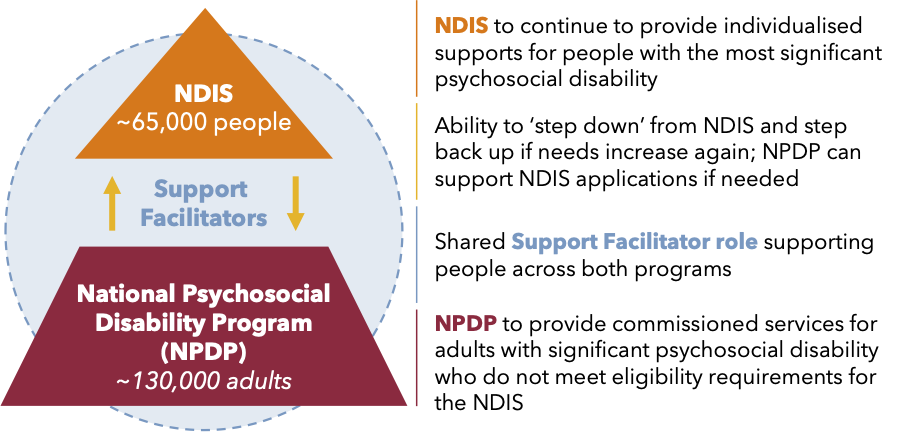
Source: Grattan Institute analysis.
All governments should also maintain their existing investment in psychosocial supports outside the NDIS, though over time it may be appropriate to reshape and differently target some programs to better complement the expanded service coverage provided by the NPDP.
4 Primary Health Networks should commission the program
To set up the new National Psychosocial Disability Program (NPDP) for success, its implementation must be responsive to regional needs.
A balance must be struck. On the one hand, national consistency is important to avoid perpetuating the patchwork of supports that currently exist. On the other hand, the program must reflect regional differences. Getting this balance right will require careful calibration.
The national guidelines outlined in Chapter 3 should determine who the program is for, how the support facilitation function works, how flexible funding can be used, and the intended outcomes of the program. But coordination between service systems, service planning, and commissioning should be delegated regionally.
Primary Health Networks are in the best position to carry out these functions. Each PHN should form a regional consortium with other local non-government and community organisations, including the voices of lived experience, to deliver the National Psychosocial Disability Program in their region.
This chapter explains the importance of regional coordination and commissioning, why Primary Health Networks are best placed to lead these functions, and how they can be set up for success.
4.1 Regional coordination and commissioning
Regional coordination should not just be a guiding principle – it must be a built-in function of any national model of psychosocial support, with clearly defined roles and lines of accountability. It is a critical enabler to delivering the support facilitation and psychosocial support services outlined in Chapter 3.132An evaluation of national psychosocial support programs in 2021 identified that strong, collaborative relationships between PHNs and service providers, including people with lived experience in service integration initiatives, and ‘a dedicated individual or group who generates shared motivation across stakeholders to overcome challenges to integrating and delivering accessible psychosocial supports’, were enablers of integration between psychosocial supports and other services used by people with psychosocial disability: Nous Group (2021, p. 95).
At the individual level, Support Facilitators will help people accessing psychosocial supports to coordinate the right mix of services to meet their needs. But regional coordination is about making sure that it isn’t left to individuals to bridge gaps between incongruent systems.133See Smith-Merry et al (2015) for a discussion of the importance of regional coordination as an enabler of effective individual support facilitation. This means fostering collaboration between sectors and agencies, and ensuring the system works together – not in silos.
These roles, which UK researchers have called ‘boundary spanners’, connect different parts of fragmented systems of health and care.134Williams (2002). These roles are critical in complex service environments, helping to build trust, bridge gaps, and enable more joined-up approaches to care.135Brophy et al (2014, p. 399).
The key components of regional coordination required to better connect psychosocial and other supports should include:
- hosting inter-agency coordinating committees to bring together decision-makers from different parts of the system;
- mapping services and identifying and addressing service gaps with flexible funding – or providing this intelligence to governments;
- conducting regional needs assessments building on existing joint regional mental health plans, to collate and update information about the extent of need for psychosocial supports in their region;
- organising regional engagement and co-design activities to embed lived experience expertise and local First Nations communities into commissioning processes;
- communicating and managing referral pathways;
- providing training, support, mentoring, and communities of practice for Support Facilitators; and
- resolving issues and ensuring integration strategies are implemented as planned.
Regional coordination should span the interface with mainstream services, beyond just psychosocial support.136To be clear, this doesn’t mean that Primary Health Networks should become responsible for providing or planning these services. Rather, they should build relationships with relevant providers and state government agencies, including identifying opportunities for joint planning, streamlined referral pathways, and information sharing. These systems include:
- mainstream community services;
- specialist housing, homelessness, employment, and drug and alcohol services;
- public health services – including public mental health services and clinical and psychosocial supports, as well as physical health services;137The 2024 federal Budget provided funding for Primary Health Networks to develop models of multidisciplinary care for people with complex mental health care needs, including integrating peer workers, mental health nurses, and social workers into general practices: Commonwealth of Australia (2024a, p. 116). One aspect of their regional coordination role should be considering the link between these teams and the National Psychosocial Disability Program.
- information, advice, and other general foundational supports;138See Grattan Institute’s Saving the NDIS report for further discussion of how people with significant psychosocial disability might benefit from general foundational supports: Bennett et al (2025). and
- support from the NDIS.
4.1.1 Regional commissioning
Commissioning is a strategic process involving a cycle of activities – from assessing a population’s needs, to designing, purchasing and evaluating the services required to meet them.139Australian Council of Social Service (2018).
Effective commissioning of disability and health services requires a strong understanding of community needs and the existing service ecosystem.140Ibid. Commissioning to meet regional need should also involve putting in place strong engagement mechanisms to ensure people with psychosocial disability, and their families, can shape and inform the process.141See Loeffler and Bovaird (2019) for a discussion on the importance of elevating the voice of intended service-users in the strategic commissioning cycle.
4.2 Regional consortia led by PHNs
Primary Health Networks are the right mechanism to coordinate and commission foundational supports for psychosocial disability.142Primary Health Networks (PHNs) are independent non-government organisations tasked by the federal government with planning and commissioning primary health services for their region: Australian National Audit Office (2024).
PHNs already have experience commissioning psychosocial supports, through the Commonwealth Psychosocial Support Program and its predecessors, and already hold responsibility for regional planning and commissioning of other services for people with mental health issues, including Medicare Mental Health Centres.143Productivity Commission (2025b, p. 196). Half of all funding for PHNs is for the mental health and suicide prevention program.144Department of Health and Aged Care (2024).
PHNs were explicitly set up to fill a need for enhanced regional coordination and commissioning in primary healthcare.145Australian National Audit Office (2024, p. 7). Even where PHN boundaries match the boundaries of a state or territory, as is the case in Tasmania, the ACT, and the NT, their distinctive role and structure gives them a responsibility to build and maintain the close community connections required to understand regional needs. State and territory governments have established local hospital networks, their own regional organisations, to manage and coordinate state-funded health services.146University of New South Wales et al (2018, p. 9).
Psychosocial supports are not in themselves a primary health service and should not be delivered under a clinical mental health paradigm. This is compatible with the role of PHNs – whose remit already includes a range of programs that are not strictly concerned with the delivery of primary healthcare, such as supporting a systems-based approach to suicide prevention, in addition to psychosocial supports.147Department of Health (2019).
For psychosocial supports to be effective, they must be coordinated with other health and social services that people with psychosocial disability use. PHNs are well positioned to provide this coordination because they were explicitly set-up with the goal of providing system-level regional coordination and are already tasked with doing regional needs assessments, service mapping, and planning.148Duckett and Swerissen (2017, p. 21).
Each PHN should be tasked with bringing together a consortium of organisations to deliver the National Psychosocial Disability Program in their region.149Smith-Merry et al (2025, pp. 5–6). Consortia would likely consist of the PHN, non-government organisations with a history of delivering community mental health services, and specialist organisations with expertise and staff representing people with lived experience of psychosocial disability and/or target populations in the region, such as specific migrant populations or First Nations communities.150Ibid.
The consortium model will enable providers to build collaborative, rather than competitive, relationships, taking collective responsibility for meeting the region’s needs.151These consortia should be stood up through a formal procurement process, similar to the process whereby the Department of Health and Ageing solicited bids for regional consortia under Partners in Recovery: Department of Health and Ageing (2012). This procurement process will be important to manage probity risks around allocating funding to consortia that include service providers.
The governance structure of these consortia should be flexible from region to region, within the following parameters:
- The Primary Health Network should be responsible for holding and allocating the program funding. This includes funding for regional coordination, support facilitation, flexible funding for service delivery, and individual brokerage funding.152There could be limited exceptions to this, where the PHN is not yet capable of being the lead partner. This would mean an arrangement similar to in some Partners in Recovery regions, where the Medicare Local was a consortia member, but a different organisation such as Anglicare Tasmania or Schizophrenia Fellowship of NSW was the lead partner: Department of Health (2013). We would expect this to be a time-limited arrangement, while the PHN built up its capability with support from the Department of Health, Disability, and Ageing.
- Decisions about what services to fund should be made collaboratively, with all consortia partners formally included in the process. If the local hospital network is not a formal consortia partner, it should still be consulted in this process.153Decisions about what services to fund should be made collaboratively, with all consortia partners formally included in the process. If the local hospital network is not a formal consortia partner, it should still be consulted in this process.
- Support Facilitators should be employed by consortia partners, excluding the PHN. Multiple organisations in a region might employ Support Facilitators, to maximise population coverage.
- Support Facilitators should have the financial delegation to directly use brokerage funding up to a certain limit.
- PHNs should be responsible for performance reporting to the Department of Health, Disability, and Ageing, and for ensuring that data collected by other consortia partners is of high enough quality to support this process.
Box 6: Productivity Commission recommendations
The Productivity Commission recently released its final report of its review of the National Mental Health and Suicide Prevention Agreement.aProductivity Commission (2025b). The report highlights the urgency of addressing the unmet need for psychosocial supports, as also highlighted in Chapter 1 of this report.
But the Productivity Commission’s recommendations differ from Grattan’s plan because they recommend that state governments should be solely responsible for commissioning psychosocial supports outside the NDIS, under a joint funding arrangement with the federal government.bIbid (p. 22).
While Grattan considered this option, we do not agree that this is the best approach to improve equity of service availability across the country. The inconsistency of existing psychosocial supports between states, as outlined in Chapter 2, demonstrates the risk that a state-led commissioning approach would perpetuate a postcode lottery for people with psychosocial disability. Our alternative, PHN-led, joint commissioning approach provides a clearer pathway to the national consistency that is needed.
State governments are also not in a good position to find new money to fund these supports; in our plan, they would not need to, because the supports would be funded out of existing joint contributions to the NDIS. This would ensure that all governments have a shared, ongoing commitment to achieving a balanced, nationally consistent, and sustainable system.cSee Grattan Institute’s report, Saving the NDIS, for further detail on how this funding arrangement would ensure risk is shared between governments: Bennett et al (2025).
4.3 Setting PHNs up for success
Since PHNs were established in 2015, reviews of the PHN program have highlighted weaknesses in program specification and performance measurement, and variable commissioning capability among the 31 PHNs.154These reviews include a 2024 audit of the Department of Health and Aged Care’s performance management of the PHN program: Australian National Audit Office (2024); the 2018 Evaluation of the PHN program by the University of NSW, Monash University, and EY: University of New South Wales et al (2018); and Productivity Commission analysis of the effectiveness of PHNs in the context of mental health and suicide prevention services, in reports between 2020 and 2025: Productivity Commission (2020) and Productivity Commission (2025b). These are serious issues – but not insurmountable ones, particularly for a program that is still maturing.
In tasking PHNs with commissioning the National Psychosocial Disability Program, the federal government should seize the opportunity to learn from experience and improve the program’s specifications, commissioning guidance, and performance measurement.
To date, PHNs have had a small budget and span of influence relative to the whole primary healthcare and primary mental healthcare systems.155Bates et al (2023, pp. 475–476), and Breadon et al (2022, p. 61). For example, PHNs are required to commission primary mental health services to target service gaps in their region, but the scale of services they are responsible for is very small compared with Medicare-subsidised mental health services (see Figure 4.1). And PHNs don’t have sufficient resources to overcome inequities in access, or materially improve mental health outcomes for people in their region.
Figure 4.1: PHN-commissioned mental health services are much smaller than Medicare-subsidised mental health services
Proportion of population accessing mental health services through different service systems
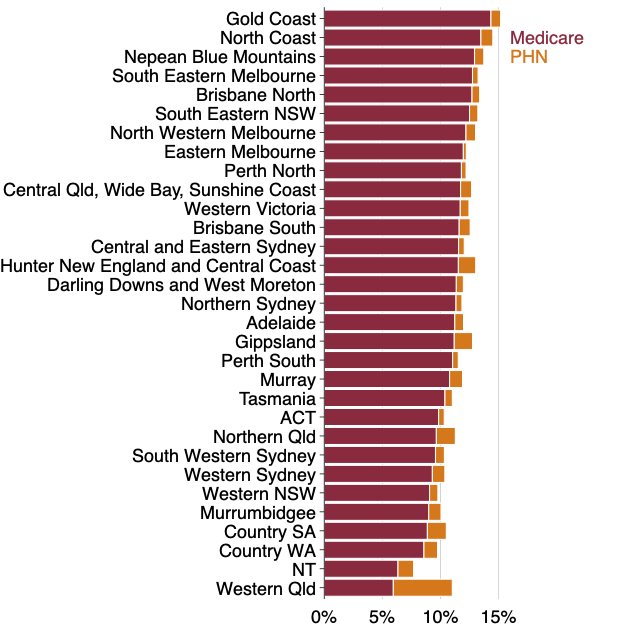
Notes: Proportions represent the number of people receiving services in each system, based on patient location, as a proportion of the region’s population. Medicare numbers include the number of people who accessed specific Medicare Benefits Schedule item numbers. For a list of item numbers included in this category, see AIHW (2025d). The figures for PHN services here represent the number of ‘active clients’ captured in the Primary Mental Health Care Minimum Data Set.
Sources: Mental Health Australia and University of Canberra (2024).
This disconnect between the scale of ambition for PHNs and their funding has undermined confidence. Giving PHNs responsibility for the National Psychosocial Disability Program will put them in a very different position with regards to psychosocial supports – with a meaningful budget and system-wide responsibility in their region.
Under the National Psychosocial Disability Program, PHNs should be given more flexibility to commission psychosocial supports that respond to local need. Longer-term funding arrangements, with grants of at least five years, should also be used, to avoid workforce retention and service continuity issues that result from short-term funding cycles.156Bates et al (2023, p. 478), and Productivity Commission (2025b, p. 199).
4.4 Measuring and improving PHN performance
Primary Health Network capability and commissioning performance varies considerably across the country (see Figure 4.2). Improving poor performers will require increasing accountability.
Figure 4.2: Primary Health Networks have different strengths and weaknesses
Results for each of the 31 PHNs, each represented by a dot, against selected Key Performance Indicators in 2020-21
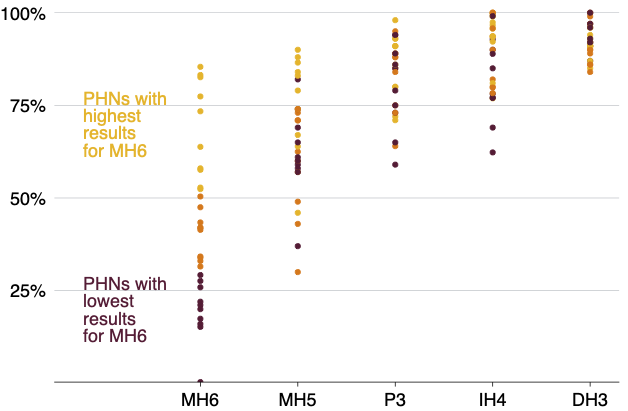
Note: DH3 = Rate of accredited general practices sharing data with PHN. IH4 = Proportion of PHN-commissioned mental health services delivered to the regional Aboriginal and Torres Strait Islander population that were culturally appropriate. P3
= Rate of general practice accreditation. MH5 = Proportion of people referred to PHN-commissioned services due to a recent suicide attempt or because they were at risk of suicide followed up within seven days of referral. MH6 = Outcomes Readiness completion rates for clinical outcome measures.
Source: Australian National Audit Office (2024, pp. 113–123).
In 2024, the Australian National Audit Office examined how the then Department of Health and Aged Care managed Primary Health Network performance. It found that performance management was only partly effective, and that the department was unable to demonstrate that the PHN program was achieving its objectives.157Australian National Audit Office (2024).
To date, Primary Health Network accountability has focused too much on detailed reporting of inputs and outputs, and too little on outcomes. And little action has been taken in response to poor performance.158Rosenberg (2017, p. 4).
If Primary Health Networks are to be given responsibility for the National Psychosocial Disability Program, the department must improve its performance management.
Governments should work with people with lived experience of psychosocial disability to design and agree on a performance framework for the National Psychosocial Disability Program, with measurable, achievable, and ambitious performance indicators. This framework should be focused on the most important outcomes, and not weighed down by too many indicators, which could create unwieldy reporting and dilute accountability.159Duckett and Ward (2008, p. 7).
Performance measures should go beyond just measures of output (e.g. service volumes or rates of access) or experience (e.g. satisfaction among people with psychosocial disability), to also consider results for people accessing the NPDP. These might include measures of social connectedness, life satisfaction, participation in employment or education, or reduced hospitalisations.
4.5 Commissioning tailored services for First Nations peoples
A distinct approach is required for commissioning services for First Nations peoples; one that prioritises the decision-making authority of Aboriginal and Torres Strait Islander communities.
In Section 3.2.3, we recommended greater availability of Social and Emotional Wellbeing (SEWB) supports, funded through the National Psychosocial Disability Program.
In 2024, the federal government commissioned an independent review of sector funding arrangements for Aboriginal and Torres Strait Islander mental health and suicide prevention services, including Social and Emotional Wellbeing services. This review considered how sector funding arrangements could be reformed to best align with the commitments of all Australian governments under the National Agreement on Closing the Gap.160Ninti One (2025).
In line with the sector funding review’s recommendations, the federal government should channel the funding we propose is set aside under the NPDP for Social and Emotional Wellbeing to an Aboriginal and/or Torres Strait Islander Community Controlled body in each region.
This body should work with other Aboriginal and Torres Strait Islander organisations to agree on funding allocations for the region. This would enable self-determined planning, accountability, and service design at the local level, with commissioning occuring either regionally or at the state/territory level, depending on the scale, structure, and readiness of Aboriginal Community Controlled Health Organisations (ACCHOs).161ACCHOs are the preferred organisations to deliver Social and Emotional Wellbeing services, followed by other Indigenous organisations as required: Ninti One (ibid).
While PHNs should not be responsible for commissioning First Nations-specific supports, they should continue to have a role in ensuring mainstream services are culturally safe and responsive.
5 A new funding and governance model
A national program will only succeed if governments build strong governance and commissioning arrangements that create trust, align incentives, and promote collaboration around shared goals. It won’t succeed if either level of government ‘goes it alone’.
Improving Australia’s current patchwork of psychosocial services means strengthening the mechanisms required to bring coherence. New psychosocial supports must be deeply connected to state-run clinical services and interface sensibly with the NDIS to be effective.
The priority must be to expand access quickly, using the simplest available mechanisms, even if the long-term service configuration in each jurisdiction is not fully settled or will take time to achieve.
Creating the right conditions means joining up policy agendas that have previously been progressing in parallel – the work on unmet need for psychosocial support under the National Mental Health and Suicide Prevention Agreement and the commitment to foundational psychosocial supports made by National Cabinet in response to the 2023 NDIS Review.
This chapter explains how the funding, governance, and oversight arrangements should operate for our proposed National Psychosocial Disability Program.
5.1 Governments should use their existing NDIS contributions to extend psychosocial supports
Grattan Institute’s proposal is simple: fund an ambitious tier of psychosocial supports for people outside the NDIS from within governments’ existing contributions to the scheme.
We showed in our Saving the NDIS report that the amount of money in the system is not the problem; rather, the problem is how the money is currently used and allocated.162Bennett et al (2025). By managing future funding commitments more carefully and redirecting some NDIS funding that is currently spent on supports that are not evidence-based, governments could establish these services without exceeding current NDIS budget forecasts and achieve a more equitable distribution of resources.163Ibid.
The federal government’s current plan does the opposite. It asks states to sign up to new funding obligations – 50:50 with the federal government.164Department of the Prime Minister and Cabinet (2023), and State of Victoria (2025).
This is unnecessary. A smarter approach is to fund wider access to psychosocial supports under the NDIS budget – creating a multi-tiered system that offers a range of services, funded from the same source, rather than as a bolt-on program. This better aligns incentives and avoids the fragmentation that would come from funding these services separately.
Our previous research showed how this re-balancing of existing funding could be achieved through a carefully managed transition and reshaping of NDIS plans to build up a commissioning budget of about $2.2 billion by 2031 for use outside the NDIS – ensuring more Australians with a psychosocial disability get support from within the same funding envelope.165Bennett et al (2025, pp. 64–67). This proposed funding transition is outlined in more detail in Appendix B.
Delivering these supports through the NDIS budget would provide stability to funding, reduce duplication, and give all governments a stake in building a more balanced system. Success here would reduce pressure on the NDIS – if psychosocial supports outside the NDIS help people live well without needing an individualised package, the growth in NDIS liabilities will slow.
The case for budgetary alignment will only strengthen as the cap on states’ contributions to the NDIS rises from 4 per cent to 8 per cent from mid-2028.166Department of the Prime Minister and Cabinet (2023). With greater exposure to the scheme’s growth, states share the incentive to deliver effective psychosocial supports that can moderate future costs. Any slowdown in spending growth will benefit both levels of government.
Using existing NDIS funding would also allow governments to set performance metrics that reflect their respective priorities. For the federal government, success means improving NDIS sustainability and delivering better results for disabled Australians both inside and outside the NDIS. For the states, it also means reducing demand on inpatient and community mental health services, emergency departments, and homelessness services.167The 2023 NDIS Review recommended an expansion in non-NDIS psychosocial supports with the rationale that ‘early access to psychosocial supports (combined with mental health treatment) may reduce the likelihood of [people with psychosocial disability] requiring the NDIS in the future, as well as relieving pressure on hospitals and other services’: NDIS Review (2023a, pp. 83–4). All of these outcomes matter.
Governments should pivot from the current plan. Requiring new funding has led to unnecessary delay. A more practical approach is to use existing NDIS contributions and update intergovernmental agreements to support faster progress through better coordination, governance, and accountability (see Appendix C).168A new program funded from governments’ combined NDIS contributions should be reflected in amendments to NDIS bilateral agreements – which provides the funding mechanism – and the new National Mental Health and Suicide Prevention Agreement – which clarifies accountability for delivery.
5.2 Governance arrangements should support joint oversight
The recent co-location of disability with health and aged care in one federal department creates an opportunity to better align incentives across disability and mental health.169Department of the Prime Minister and Cabinet (2025).
To realise this opportunity, the Department of Health, Disability, and Ageing must join up policy agendas that have previously been progressing separately. It is not tenable for reforms to address unmet need for psychosocial support under the current National Mental Health and Suicide Prevention Agreement to be progressed on a different track to the establishment of foundational psychosocial supports as agreed by National Cabinet in response to the 2023 NDIS Review.
Retaining separation between these policy areas will perpetuate long-standing confusion, undermine the potential to improve service access for those most in need, and do nothing to facilitate the integrated eco-system of psychosocial supports that is so clearly needed.
These reform pathways should be brought together, with the establishment of the National Psychosocial Disability Program as the initial priority. This will require joined-up governance and oversight, to ensure collaboration between governments and across portfolios, with clear lines of accountability.
The Productivity Commission recently proposed a new governance approach as part of its review of the Mental Health and Suicide Prevention Agreement to better facilitate whole-of-government action under the next agreement.170Productivity Commission (2025b). This includes establishing a Special Purpose Mental Health Council reporting to National Cabinet, bringing together Ministers from both levels of government and other social policy portfolios to address cross-system challenges.171Ibid (p. 14).
If this council were established, it would work well to progress our reform proposals, so long as disability ministers are included in the new council and it had a strong connection back to the Disability Reform Ministerial Council.
The Productivity Commission’s interim proposal for immediate work to address unmet need for psychosocial supports to advance through the Psychosocial Project Group, established under the current agreement, with reporting to Health Ministers every six months, also has merit.172Ibid (p. 20). But the group’s membership should be urgently refreshed for this purpose, to include disability officials and the NDIA, to expedite cross-portfolio collaboration. Reporting should additionally be to the Disability Reform Ministerial Council, to ensure full visibility.
In the long run, it will be important for government to consider the most appropriate connection between governance arrangements for disability and mental health reforms, so that established mechanisms for decision making or advisory input are streamlined to enable coordinated action.
Grattan Institute has previously recommended new multilateral governance for foundational supports: a national Commissioning Authority to set direction and focus decision making, and state Commissioning Boards to provide a state-level view of the funding transition and total service mix.173Bennett et al (2025). These arrangements, tailored for our National Psychosocial Disability Program, proposals are illustrated in Figure 5.1.
Figure 5.1: Governance arrangements for our proposed National Psychosocial Disability Program should support joint oversight
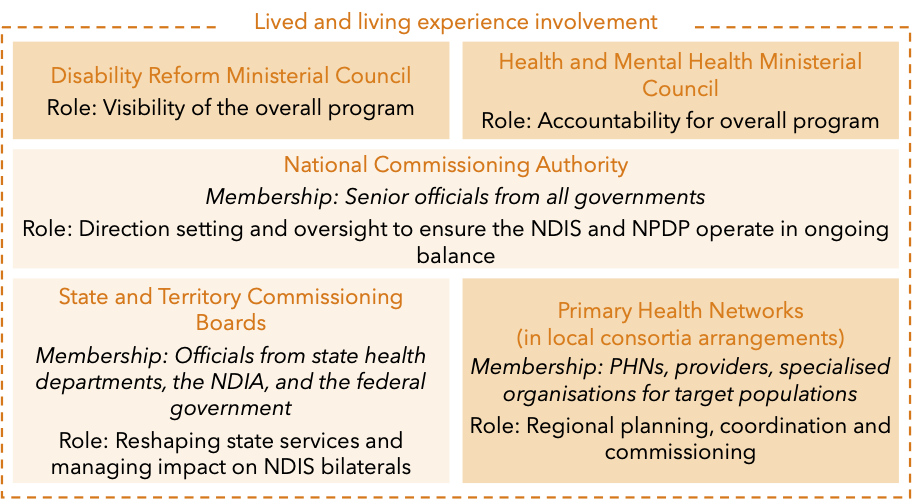
Notes: Darker colours indicate existing bodies. Lighter colours indicate new bodies recommended by Grattan Institute.
Source: Grattan Institute analysis.
The Commissioning Authority should bring together senior officials from all governments to agree on a national framework and roadmap for these reforms, with the main responsibility for ensuring that the NDIS and the National Psychosocial Disability Program operate in balance.
The authority should conduct a six-monthly policy review and provide this to the Disability and Health and Mental Health Ministerial Councils, identifying policy and operational settings that need adjustment to keep the two programs in balance and deliver the best results for Australians with psychosocial disability. The review should allocate actions to the CEO of the NDIA and/or the Secretary of the Department of Health, Disability, and Ageing as the two responsible senior officials working under the same ministerial portfolio.
Overall progress with the National Psychosocial Disability Program should be reported to the Health and Mental Health Ministers Council and noted by Disability Ministers, avoiding duplication and maintaining clear lines of communication and accountability.
State and territory Commissioning Boards should include officials from state health departments, the NDIA, and the federal government. Their role would be to oversee the redirection of NDIS funding to the National Psychosocial Disability Program and to take a state-level view of the totality of psychosocial supports, and how existing services may evolve to complement the national program.174For example, where existing state services are low-intensity and might duplicate offerings under the National Psychosocial Disability Program, these might be transferred to the Primary Health Network commissioning stream, freeing up state funding to plug other gaps.
Primary Health Networks should lead the commissioning of services regionally as part of their consortia, leveraging existing planning mechanisms and connecting the National Psychosocial Disability Program with existing joint regional plans. This process should closely involve Local Health Networks, which should be the conduit to ensure statewide priorities are cascaded through regional planning.
Because National Psychosocial Disability Program funding will flow directly from the federal government to PHNs or consortia, state Commissioning Boards should identify opportunities to spread services across regions, advise on the viability of consortia bids in the early stages of the program, track how the program’s implementation affects other state services, and monitor how the transition affects NDIS delivery.
5.2.1 Embedding the voice of lived experience
Governance arrangements should be supported by strong engagement to ensure that the voices of people with lived experience of psychosocial disability and their families are incorporated in decision-making about the national program at all levels.
The intended beneficiaries of our proposed new program are in a unique position to articulate their needs and help design services to meet them.175Penny and Slay (2014, p. 43). Incorporating the perspectives of people with lived experience of psychosocial disability into program governance will help ensure the program design and implementation approach is effective and carries the trust of the people it is designed to help.176Sartor (2023) and Lumby (2024). To make timely progress, governments should use existing co-design mechanisms for this purpose wherever possible.
That should mean ensuring a lead role for the two national lived experience peak bodies recently established and funded by government: the National Mental Health Consumer Alliance and Mental Health Carers Australia.177These peak bodies have identified the Lived Experience Governance Framework, co-designed by the National Mental Health Consumer Carer Forum and the Mental Health Lived Experience Engagement Network, as a suitable framework to embed within the new national Mental Health and Suicide Prevention Agreement. This same approach could be applied to the specific needs of the National Psychosocial Disability Program: Productivity Commission (2025b, p. 172). The Aboriginal and Torres Strait Islander Lived and Living Experience Centre should also be engaged to ensure the voices of First Nations people are heard.178Black Dog Insitute (n.d.).
At a national level, government should also leverage the NDIS Reform Advisory Committee, which was established in 2025 to oversee implementation of NDIS reforms as a result of the 2023 NDIS Review.179Department of Social Services (2025b). Membership of the group should be reviewed to ensure sufficient representation of people with lived experience of psychosocial disability.
5.3 How to transition to the National Psychosocial Disability Program
The transition to the National Psychosocial Disability Program must be carefully managed. Under our proposal, funds directed to PHNs would triple (see Figure 5.2). Such rapid expansion would challenge even the most established PHNs. To manage this risk, a staged approach is essential, with PHNs receiving support to build commissioning capacity and capability.
Figure 5.2: The National Psychosocial Disability Program would triple PHN program funding in less than a decade
Primary Health Network program funding projected increase in total funding under the NPDP
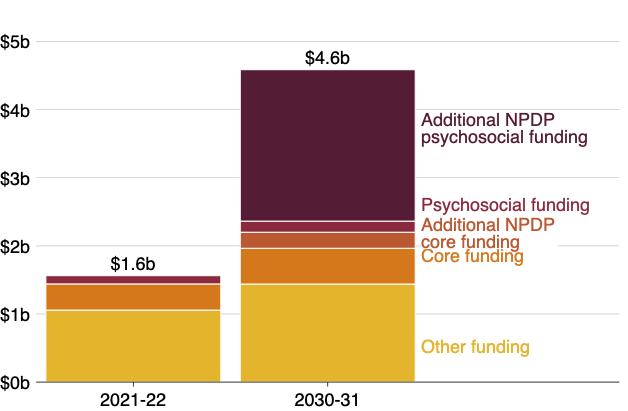
Notes: Figures are nominal values. Most recent data available were from 2021-22; accordingly, this does not reflect more recent government investments through PHNs, for example for Medicare urgent care clinics. Assumes no increases to other PHN program funding (other than inflation). Other funding includes primary mental health care, drug and alcohol treatment programs, First Nations Integrated Care, after hours, aged care, community health and hospitals, and other targeted mental health interventions.
Source: Grattan Institute analysis of Department of Health and Aged Care (2025).
To ensure quality commissioning and regional coordination, funding for the new program should be built up gradually. We have previously identified a viable pace to transition funding from the NDIS to the National Psychosocial Disability Program over four years:180Bennett et al (2025). $139 million in 2027-28, $877 million in 2028-29, $1.7 billion in 2029-30, reaching full scale at $2.6 billion in 2030-31 (see Figure 5.3, and Appendix D for further detail about our costings).
Figure 5.3: Transition plan for establishing the National Psychosocial Disability Program
Proposed commissioning budget, 2027-28 to 2030-31
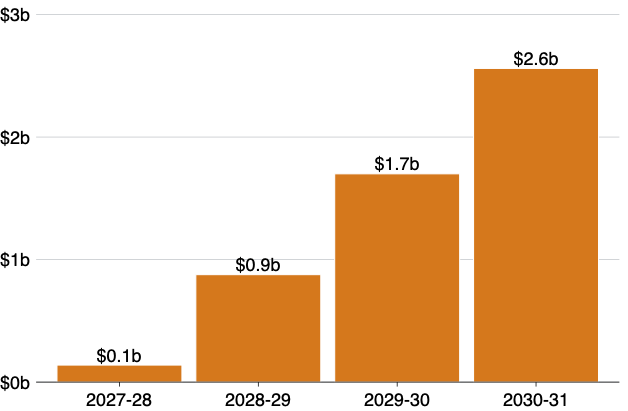
Source: Grattan Institute analysis.
This transition is ambitious, with substantial year-on-year funding increases. This scale of investment will create challenges for the sector, but it is warranted given the depth of unmet need.
Once mature, the program should:
allocate 30 per cent to flexible funding for PHN commissioning of additional psychosocial support services; and
- commit about 54 per cent of the total budget to the Support Facilitation function, with a further 3 per cent to be available as individual brokerage funding to be administered by Support Facilitators;181Support Facilitation accounts for just over half of total program costs, reflecting the labour-intensive nature of one-on-one support as outlined in Section 3.2.1. Our costings include people with a primary psychosocial disability who are in the NDIS transitioning to the Support Facilitation model by 2030-31.
- allocate 9 per cent to cover enabling costs including an expanded regional coordination and commissioning role for PHNs;
- allocate 30 per cent to flexible funding for PHN commissioning of additional psychosocial support services; and
- earmark a further 4 per cent specifically for commissioning of additional Social and Emotional Well-being (SEWB) supports.
5.3.1 The rollout should be staged
A staged rollout will be essential to ensure regional readiness and build capability over time. While funding won’t become available until 2027-28 under our proposal, implementation planning must begin earlier.
As set out in Section 5.2, getting the right governance arrangements in place will be critical to success. Such arrangements should be finalised by 2026-27 to enable smooth implementation of the program.
The allocation of funding between Primary Health Networks should be based on a model that takes into account each region’s population, indicators of the level of need for psychosocial support, and the higher costs of delivering services in remote areas. This model should be agreed between governments by the end of 2026-27.
The Department of Health, Disability, and Ageing should begin program and service model design in partnership with people with lived experience, and with input from the national Commissioning Authority, over the same period (as discussed in Section 5.2).
Once the design is agreed on, the department should seek bids from regional consortia. Bids should be assessed and grouped into rollout tranches based on readiness, including workforce capacity, commissioning maturity, local sector capacity, and the strength of regional governance and collaboration.182Given the immaturity of current PHN key performance indicators, as discussed in Section 4.4, other information about performance should be used to support assessment of these bids. This should include information gathered as part of the PHN business review (Department of Health, Disability, and Ageing (2024)) and other data held by the Department of Health, Disability, and Ageing.
Best-placed regions should form the first tranche in 2027-28, receiving early funding to build workforce and service capacity. A second tranche, covering most regions, should follow in 2028-29. A final tranche – regions needing more help to prepare – should receive targeted support to build readiness to join the program in 2029-30.
This sequenced approach will allow the program to build gradually while maintaining quality and continuity. It recognises that regional capacity will differ, and that some areas will require longer to establish strong commissioning systems and workforce development plans.
5.3.2 Commissioning the future workforce
Increased funding for psychosocial supports will require an expanded workforce to deliver them. Current capacity is inadequate to support the full scale of our proposed program.183Department of Health and Aged Care (2023).
In its Mental Health Inquiry, the Productivity Commission highlighted how the transition to the NDIS created major disruption.184Productivity Commission (2020, p. 827). Short-term stop-gaps such as the National Psychosocial Support measure were under-resourced, leaving long waiting lists and fuelling staff attrition.185Ibid (p. 847). Many skilled workers who left the sector because providers could not guarantee ongoing employment were deemed unlikely to return.186The Productivity Commission also pointed to deeper structural drivers of workforce constraint. Over-reliance on insecure, short-term contracts, combined with the absence of clear long-term funding arrangements, discouraged retention and undermined professional pathways: Productivity Commission (ibid, p. 847). A repeat scenario must be avoided.
We might never have a ‘perfect’ workforce, but this should not delay progress. Commissioning needs to proceed while simultaneously investing in building workforce depth and capability.
The design we propose for the National Psychosocial Disability Program will help address structural workforce challenges. Increased funding, together with supporting PHNs to adopt best-practice commissioning, will give the sector greater certainty and create longer-term opportunities for staff.
But further dedicated effort is required to increase the supply of specialised skills and competencies needed to deliver psychosocial supports.187NDIS Review (2023a, p. 527).
The National Mental Health Workforce Strategy 2022–2032 sets out a 10-year plan to build a workforce that is skilled, well-distributed, and supported to meet population needs.188Department of Health and Aged Care (2023). This strategy sets out targeted actions to expand the peer workforce, which should be leveraged by the NPDP.
Yet, the strategy does not adequately address the broader community mental health workforce that delivers psychosocial supports.189Mental Health Australia (2025). Expanding the Strategy to include specific actions to monitor, grow, and retain the community-managed mental health workforce would help ensure the sector can meet future demand.
Figure 5.4: Support facilitation will account for more than half of total National Psychosocial Disability Program costs
Proportion of NPDP expenditure by component at full program scale, 2030-31
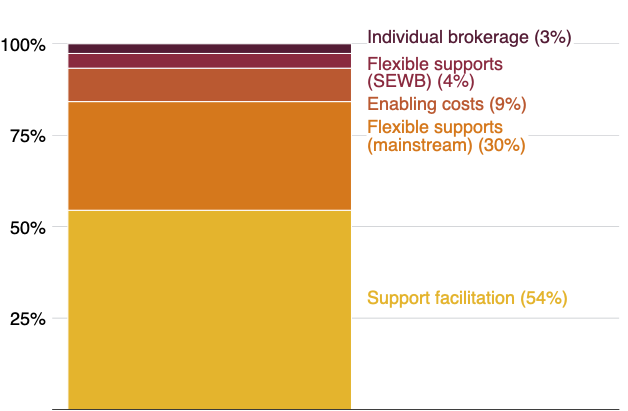
Note: SEWB = Social and Emotional Wellbeing.
Source: Grattan Institute analysis.
5.4 Supporting improvement through data and evaluation
The National Psychosocial Disability Program will represent a substantial uplift in funding and scope for the psychosocial supports sector. But it won’t be perfect straight away – and so the design must build in feedback loops to ensure all stakeholders learn from experience as the program grows.
Data collection and evaluation, prioritising outcomes for people with psychosocial disability, must be embedded from the outset.
Up until now, a lack of suitable outcomes data and the inability to link data between systems has often undermined the evaluation of psychosocial supports programs and constrained the evidence base.190See, for example, Nous Group (2021, p. 103). The NPDP represents an opportunity to develop a stronger evidence base, by generating novel data, enabling academic research, and directly funding evaluations of innovative service models.
In our Saving the NDIS report, we called for the establishment of a national minimum dataset that captures all disability-specific services delivered outside of individualised NDIS plans.191Bennett et al (2025, p. 77). Service activity under the National Psychosocial Disability Program should be included in this dataset, alongside appropriate outcome measures. Outcome measures should focus on the specific intended outcomes of psychosocial supports for personal recovery, rather than clinical outcomes such as alleviation of symptoms.192Nous Group (2021, p. 50).
To ensure the data collection is comprehensive and comparable, governments should also agree to transition reporting of any other continuing psychosocial support services to the national minimum dataset by 2027-28.193For example, reporting on the Commonwealth Psychosocial Support Program should be transitioned to this dataset, away from the Primary Mental Health Care Minimum Data Set. Reporting for continuing state-funded programs should similarly be transitioned.
Comprehensive, nationally consistent data capturing the whole system is a crucial enabler for effective system monitoring, evaluation, and accountability. Governments should work with service providers and PHNs to minimise the reporting burden in this transition.
This dataset should be designed to enable linkage with other data assets, such as the National Disability Data Asset. This will ensure that it is possible to analyse program recipients’ use of other services, such as NDIS supports, Medicare services, pharmaceuticals, hospital services, and income support payments.
The design of the dataset and any future linkages should conform with the principles of Indigenous Data Governance, in collaboration with Aboriginal and Torres Strait Islander people and the Social and Emotional Wellbeing sector.194Commonwealth of Australia (2024b).
This data will be a crucial enabler for monitoring PHN performance (as outlined in Chapter 4) and for evaluation.
The federal government should also commit to funding an evaluation of the National Psychosocial Disability Program as a whole. This evaluation should commence alongside the gradual establishment of the program, and include consideration of:
- how well services are targeted to need;
- referral pathways and flows between different service types;
- whether the funding level is appropriately calibrated to need in practice; and
- cost-effectiveness of different service offerings, including quantifying benefits for individuals and systems.
Acknowledgements
This report was written by Sam Bennett, Mia Jessurun, and Reilly Polaschek. Alastair McEwin also made a substantial contribution. It was edited by Paul Austin.
We would like to thank the members of Grattan Institute’s Disability Program Reference Group for their helpful comments, as well as numerous people with lived and living experience of psychosocial disability, government and industry participants and officials for their input.
The opinions in this report are those of the authors and do not necessarily represent the views of Grattan Institute’s founding members, affiliates, individual board members, reference group members, or reviewers. The authors are responsible for any errors or omissions.
Grattan Institute is an independent think tank focused on Australian public policy. Our work is independent, practical, and rigorous. We aim to improve policy by engaging with decision makers and the broader community.
We acknowledge and celebrate the First Nations people on whose traditional lands we meet and work, and whose cultures are among the oldest in human history.