Overview
Australia’s disability employment system is not delivering for those who need it most. Despite sustained policy attention and more than $1.3 billion in annual public investment, outcomes remain persistently weak – particularly for people with high support needs.
Employment rates are only 34 per cent for Australians with profound or severe disability, compared to 82 per cent for non-disabled people. When these Australians are in work, many are paid under the Sup-ported Wage System, which permits pay rates well below the national minimum wage – and as low as $3.31 per hour.
Too many disabled Australians with high needs remain excluded from the workforce altogether, diverted into day programs that substitute for work, or confined to sheltered work at low pay, with little prospect of progression.
The employment support system is fragmented and poorly aligned with contemporary policy objectives. Inclusive Employment Australia (IEA) and the NDIS – the two main government programs focused on helping disabled Australians into work – still operate in silos, with weak incentives to prioritise open employment or improve earnings. Disconnects between services mean people fall through the gaps.
The NDIS was supposed to drive improvement in disability employment rates, but progress has been slow and uneven and few people with high support needs have been assisted into mainstream jobs.
Yet the evidence on what works is clear. In Australia and internationally, better results are achieved when systems prioritise open employment, regardless of level of need. This requires tailored job matching, ‘place and train’ approaches, job customisation, and dedicated pathways from education. The federal government should systematically embed these features across the Australian system.
But improved services alone will not be sufficient. Demand-side barriers remain significant: too few employers recruit, accommodate, and retain people with disability. Shifting employer behaviour requires more deliberate policy action – government should build capability, increase transparency and accountability, and leverage its role as a major employer to create stronger incentives for inclusive hiring.
Reform must also address the role of disability employment-focused social enterprises. While specialist employers provide important work opportunities and are a valid choice for some people, the current model is commercially fragile, entrenches systemically low wages, is built on last century’s work practices, and is out of step with community expect-ations. Government should play an active role in lifting expectations for Disability Social Enterprises, encouraging a model that is commercially sustainable and has the capacity to pay fair wages.
Transitioning the sector to this preferred model cannot happen overnight. But international experience shows that with the right policy settings in place, changes are possible that can lift wages and increase employment rates. The consequences of inaction are profound: continued low participation, suppressed wages, and structural fragility that leaves enterprises – and the jobs they provide – at risk.
Targeted upfront investment can deliver reform that is budget-positive within 10 years, with better resource allocation, reduced welfare payments, and higher tax revenue more than offsetting the cost.
A more effective disability employment system is within reach. With clearer policy direction from government, stronger alignment of funding and incentives, and the ambition to reform how employment
is supported, structured, and remunerated, Australia can deliver better results while ensuring no disabled Australian is left behind.
Recommendations
Recommendation 1
Prioritise open employment for disabled people with high support needs
- Diversify the scope of the Inclusive Employment Australia (IEA) program to include a specific stream focused on enabling open employment for disabled people with high support needs.
- Re-purpose a portion of employment assistance funding from the NDIS to support establishment of this new IEA program stream.
- Task the new Centre for Inclusive Employment with defining best-practice employment support for disabled people with high support needs, and invest in training and support to enable providers to meet this standard.
Recommendation 2
Expand mainstream employment opportunities for disabled people
- Require large employers to report publicly on the number of disabled employees they have, the disability disclosure rates, the number of referrals from the new IEA stream, and the number receiving sub-minimum wages.
- Reform the Disability Support Pension by abolishing the 30-hours-a-week rule for access, and allow an indefinite suspension period, during which a person can keep their Pensioner Concession Card.
Recommendation 3
Preference sustainable jobs in commercially viable Disability Social Enterprises paying fair wages
- Set new certification standards for Disability Social Enterprises that raise the bar for good specialist disability employment, requir-ing fair wages, open and inclusive workplaces, worker autonomy, progression opportunities, and commercial sustainability.
- Give financial and practical support to new providers and existing Australian Disability Enterprises that choose to transition to becoming certified Disability Social Enterprises.
Recommendation 4
Move away from sub-minimum wages and disability-only employment
- By 2034, make an application to the Fair Work Commission to review whether sub-minimum wages under the Supported
- Employment Services Award and Supported Wage System remain necessary.
- Set up a dedicated fund to maintain support for disabled workers who do not transition from an Australian Disability Enterprises to open employment, to ensure no one is left behind.
1 Australia’s disability employment system fails those who need it most
Many disabled Australians with the highest support needs are shut out of real work and the opportunity of fair wages.
Australia’s disability employment system has persistently failed them, despite decades of substantial investment by the federal government. Employment rates remain far below those of non-disabled Australians, wages are significantly lower, and too many people are either excluded from the labour market entirely or confined to ‘sheltered’ jobs with low pay.
The current system is fragmented and misaligned with contemporary policy objectives of enhanced inclusion and economic participation. Too often, it substitutes care for employment, sustains work settings that should be consigned to a previous era, and fails to provide clear pathways to inclusive jobs and better wages.
There is a better way. This report identifies the changes needed to improve employment results for disabled Australians with the highest support needs through fundamental reforms to core elements of the current model, including how work is supported, structured, and paid.
1.1 Disability employment rates and wages lag behind those of non-disabled Australians
Employment is a pathway to social and economic integration, independence, and personal fulfilment for disabled people,1Thies et al (2021, p. 5). including those with high support needs.2Taylor (2022, p. 7) and Meltzer et al (2019, pp. 89–90). In this report, we refer to people with ‘high support needs’ to mean people with disability who require substantial and ongoing support to obtain and/or maintain paid employment: Department of Social Services (2026a), Fair Work Commission (2020, Item 4.3), and NDIA (2025a, p. 69). This includes people currently working in supported employment, and others who could be directed toward supported employment. Work fosters a sense of purpose, opportunities for personal development, and meaningful social connection within the broader community.3Royal Commission into Violence, Abuse, Neglect and Exploitation of People with Disability (2023, p. 376). For disabled people, employment has been shown to contribute to a positive sense of identity and self-worth, and improved health and wellbeing.4Thies et al (2021, p. 5). The opportunity for employment has been recognised as a human right.5Article 27 of the Convention on the Rights of Persons with Disabilities recognises ‘the right of persons with disabilities to work, on an equal basis with others; this includes the right to the opportunity to gain a living by work freely chosen or accepted in a labour market and work environment that is open, inclusive, and accessible to persons with disabilities’: United Nations (2007).
But Australians with disability face persistent labour market disadvantage. They are less likely to be in paid work, and they earn much less when they are.
In 2022, the employment rate for working-age Australians with disability was about 56 per cent, compared to 82 per cent for people without disability.6ABS (2024). That 26 percentage-point gap has barely shifted in decades (Figure 1.1 on the following page).7There was a notable uptick in disability employment rates in the post-pandemic period. In the US this has been attributed to an increase in ‘teleworkable’ jobs as more people took up opportunities to work from home: Ne’eman and Maestas (2023). Australian research suggests improvements resulted from the macroeconomic effects of tighter labour markets drawing additional people into employment and making employers more willing to hire disabled workers: Mollross (2026). Employment rates are lower still for people with profound or severe disability (34 per cent in 2022),8ABS (2024, Table 8.1). with people with intellectual disability (32 per cent in 2018) and psychosocial disability (26 per cent in 2018) also faring badly.9ABS (2020, Table 4.3).
Figure 1.1: The disability gap in employment has been steady, and large, for decades
Percentage of people aged 15 to 64 who are employed
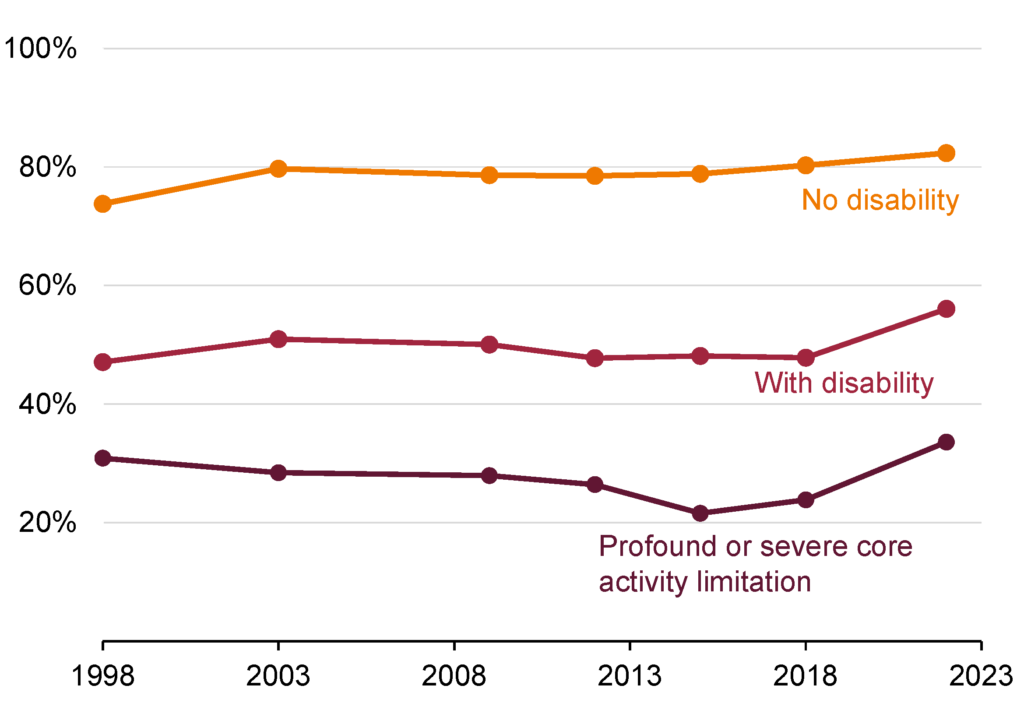
Note: 2003 figures exclude the Northern Territory. Sources: ABS (2024, Table 8.1) and previous releases.
Disabled Australians face significant barriers to finding and keeping work, including the impact of ill health or disability,10AIHW (2024a). employer perceptions, inaccessible workplaces, and discrimination.11Royal Commission into Violence, Abuse, Neglect and Exploitation of People with Disability (2023, pp. 381–386). In 2022, about one in eight working-age people with disability reported experiencing discrimination in the previous year, with more than one in four identifying their employer as the source of that discrimination.12Grattan analysis of ABS (2024, Table 8.1 and Table 20.1). This has knock-on effects – only 34 per cent of people with disability who experienced discrimination are employed, compared to 53 per cent who did not.13AIHW (2024b, p. 180).
When disabled Australians do find paid work, their earnings are generally lower, reflecting higher underemployment rates, fewer hours worked, and a greater likelihood of working part-time.14Ibid (p. 10). On average, weekly earnings for a disabled person are just over half those of non-disabled people. For Australians with profound impairments, median weekly earnings drop to $374 – just over one-third of the figure for non-disabled Australians.15ABS (2024, Table 7.1).
The National Disability Insurance Scheme (NDIS), introduced in 2013, was intended to bring a sharper focus to disability employment.16The 2011 Productivity Commission report into the NDIS identified economic benefits from the proposed new federal program that would substantially offset the investment in it and add significantly to Australia’s GDP: Productivity Commission (2011, p. 941). But results so far have been mixed.
In the second quarter of 2025–26, about 25 per cent of people in the NDIS aged 15–64 in the labour force were in open employment at full award wages, up about 5 percentage points since 2021.17AIHW (2026a). In this report, we use the term ‘open employment’ to mean employment in the mainstream labour market. Open employment can still involve ongoing workplace supports. We use the term to distinguish these jobs from what is often called ‘supported employment’ in Australia: jobs available only or primarily to people with disability, where wages are commonly set through the Supported Employment Services Award (SESA) and/or the Supported Wage System (SWS). We use the term ‘award wages’ to mean a full award rate that a non-disabled person would receive. This does not include sub-minimum wages legally payable to disabled people under the SESA and/or SWS. Only about 12 per cent of people in the NDIS aged 15–64 in the labour force with intellectual disability, 11 per cent with a psychosocial disability, and 7 per cent of those with Down syndrome, were in open employment at full award wages.18Ibid.
When disabled Australians with high support needs are employed, they remain concentrated in ‘disabled-only’ work settings. About 70 per cent of people aged 25 or older with an intellectual disability in the NDIS who have a paid job, work in Australian Disability Enterprises (Figure 1.2), where wages are typically well below the minimum award rate – a pattern that has persisted for decades.
Figure 1.2: Australian Disability Enterprises are the main employer for people with intellectual disability and Down syndrome
Share of employed people in the NDIS aged 25+, by primary disability
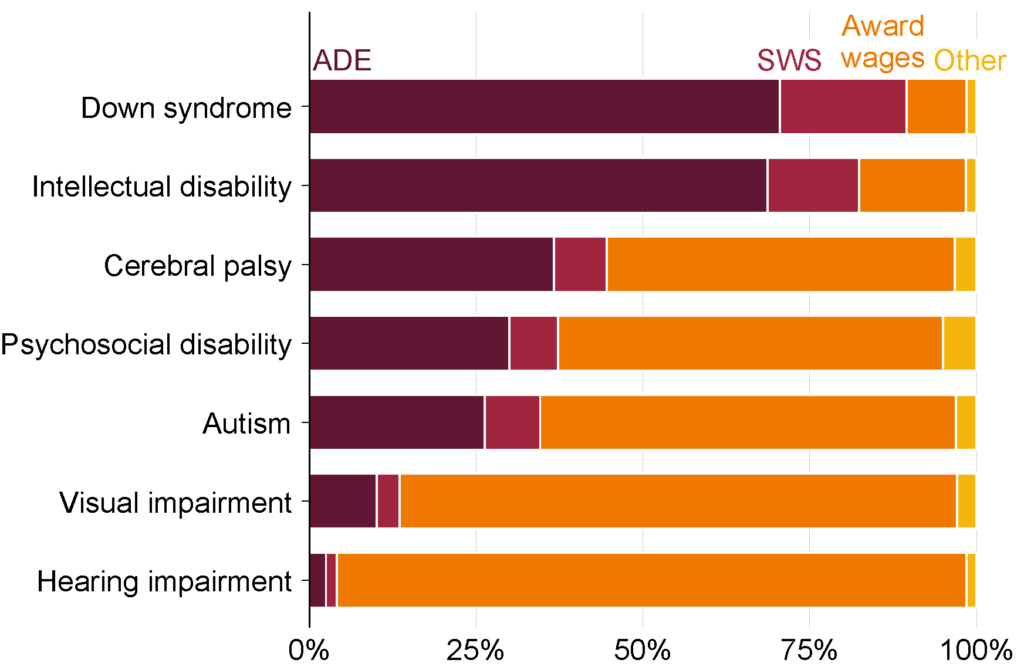
Notes: ADE = Australian Disability Enterprise. SWS = Supported Wage System. Based on employment status at time of entering the NDIS. Includes all NDIS entrants up to 31 December 2022.
Source: NDIA (2023, p. 61).
1.1.1 Open employment remains out of reach for most people with high support needs
Open employment – through jobs in the mainstream labour market – generally provides the strongest opportunities to enable disabled people’s economic and social participation.19Meltzer et al (2019, p. 90), and Thies et al (2021, p. 6). People with intellectual disability who work in open employment tend to have more control over their lives and higher wellbeing and self-esteem than people working in sheltered settings.20Meltzer et al (2019, p. 90).
Many disabled people who don’t have mainstream jobs want opportunities to work in open employment and to participate more fully in community life, even if their families may be hesitant about the transition.21Fulk (2018, p. 114).
A study of people leaving sheltered employment settings in Maine in the US found that those who got work in the open market reported improvements in their social and verbal skills and interactions.22Phoenix and Bysshe (2015, p. 28). Co-workers and employers also benefited from the experience of working with intellectually disabled colleagues.23Ibid (p. 28).
But in Australia, barriers to open employment are greatest for disabled people with the highest needs. Employers regard the workplace adjustments required to employ people needing intensive support as daunting. Even where funding and supports exist, practical challenges, from transport availability to inaccessible workplaces, continue to limit opportunities. Some Australian and international programs that combine personalised job matching, ongoing workplace support, and tailored support to employers have shown that with the right approach, employees with intellectual disability or multiple impairments can sustain productive and fulfilling work (Chapter 2).
But these examples remain the exception rather than the norm in Australia. Sheltered work, or no work at all, is far more common.
1.1.4 Day programs often substitute for work
Many people with intellectual disability in the NDIS who are not in paid work spend their weekdays in day programs. These programs are funded to support social and community participation – a core objective of the NDIS. But in practice, the daytime activities outside of the home that these programs provide often function as a substitute for employment.
Day programs vary widely. Some are centre-based, with structured, in-house activities. Others take groups of disabled people into the community – to parks, libraries, leisure centres, and other venues. About 82,800 people accessed group-based day services through the NDIS last year.24Grattan analysis of ABS (2026a). Almost 30,000 (36 per cent) were people with intellectual disability or Down syndrome.2529,077 people with a primary disability of intellectual disability or Down syndrome claimed the ‘Group Activities – Weekday Daytime’ line item as at December 2025. This is the largest Group Activities (day program) line item but not the only one, so this figure could slightly understate the total number of people from these disability groups: NDIA (2026a).
These programs are valued by many of the people who use them, and by their families. They provide routine, companionship, and a perceived ‘safe’ environment. They also offer important respite for carers, which can support family workforce participation.
But the model has limits. Group-based programs can isolate the people they support from the broader community and reinforce low expectations about employment.26Cole and Williams (2007, p. 6). There is little evidence in Australia or overseas that day services function as effective pathways into paid work.27Cocks and Harvey (2008, pp. vii–viii), and Wilkins et al (2012, p. 12).
NDIS data show that people in day programs do not, on average, have substantially higher support needs than those in employment (Figure 1.3). This suggests that many people currently in day programs could work, at least to some degree, with the right support.28This is consistent with a 2018 study in Oregon, US, which found that most people who genuinely wanted to work were able to achieve that goal, and that the likelihood of someone finding work was not significantly affected by the level of their disability, their education level, age, gender, or location: Fulk (2018, p. 124). But today only about 15 per cent of people accessing day program supports through the NDIS are also accessing a specialised supported employment support.29Day program supports have been identified by the line item for Group Activities. Specialised supported employment supports have been identified by the line item for Specialised Supported Employment: Grattan analysis of ABS (2026a).
The system rarely treats day programs as a pathway to employment. In most cases, they are an endpoint, often providing lifetime support.
Figure 1.3: People in day programs have a similar distribution of disability severity as those in supported employment
Share of cohort accessing NDIS line items at each NDIS severity score, 2025
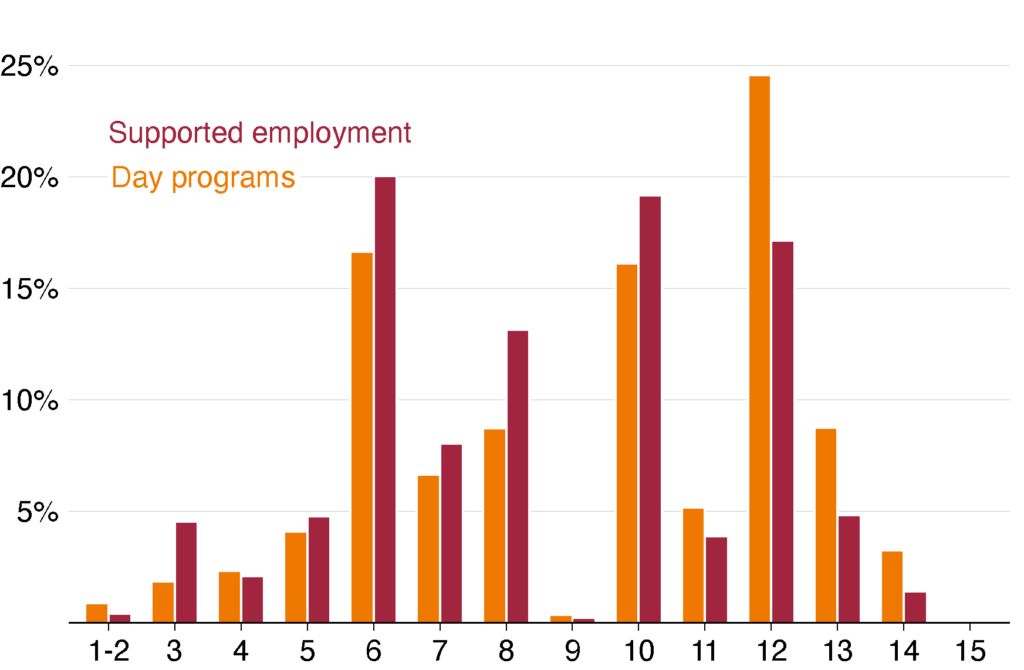
Notes: Day program supports have been identified by the line item for Group Activities. ‘Supported employment’ has been identified as anyone who claimed at least one NDIS line item related to the ‘0133’ ‘Specialised Supported Employment’ registration group. The NDIS severity score indicates the impact of a person’s disability on their ability to perform tasks and actions in a life area: AIHW (2024b, p. 134). A lower severity score indicates a higher level of function and lower support requirements. People with no recorded severity score excluded. Scores 01 and 02 are combined.
Source: Grattan analysis of ABS (2026a).
1.2 Supported employment through the NDIS
When disabled people with high support needs are employed, they are most likely to be in ‘supported employment’. Supported employment refers to jobs where disabled employees receive additional help in the workplace to undertake their work.30We have defined supported employees as anyone who claimed at least one NDIS line item related to the ‘0133’ ‘Specialised Supported Employment’ registration group in a given financial year. These items are used by people needing significant support in the workplace. This support can be used at any employer, but the majority (more than 70 per cent) of people accessing them work in Australian Disability Enterprises.
Originally, supported employment was synonymous with sheltered workshops that provided both a place of work and the support required within that setting. This model was codified in the Disability Services Act in 1986 as distinct from open employment, providing work for people deemed unlikely to obtain a job at or above the award wage in the mainstream labour market. More recently, following the full transition of funding and responsibility for supported employment to the NDIS from 2021, the workplace supports someone may need have been separated from the job to open up more employment options. While this shift has yet to achieve its policy intent at scale, it has broadened the forms that supported employment can take: sheltered jobs or jobs in the open labour market, paying either award or sub-minimum wages. Today, supported employment only meaningfully signals when someone is receiving specific NDIS supports in the workplace – not the nature of the job or the wages earned.
Figure 1.4: The number of supported employees has increased over the past decade
Number of supported employees
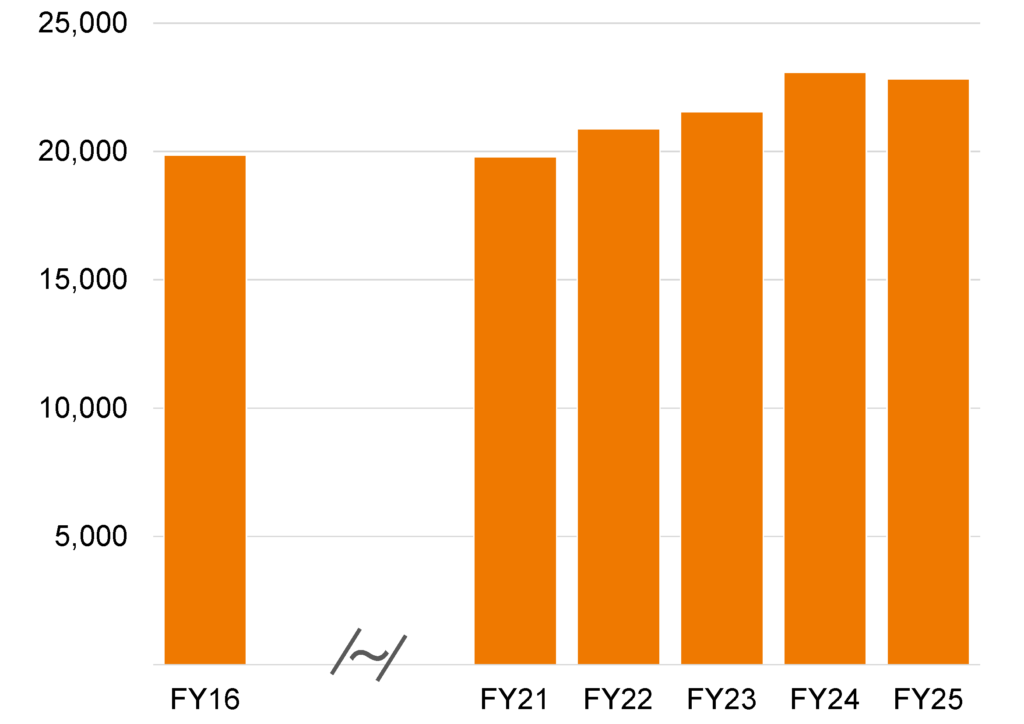
Notes: For FY16, ‘Supported employees’ is defined as people in the Department of Social Services’ ‘Supported program’. From FY21 onwards, ‘Supported employees’ is defined as anyone who claimed at least one NDIS line item related to the ‘0133’ ‘Specialised Supported Employment’ registration group. Data for FY17 to FY20 could not accurately be determined due to the transition from the Department of Social Services to the NDIS.
Source: Grattan analysis of ABS (2026a) and Productivity Commission (2020, Table 15A.63).
About 23,000 disabled people in the NDIS accessed these supports in 2024-25 (Figure 1.4).31Of these, only about 14,000 used the line item at least 12 times during the financial year: Grattan analysis of ABS (2026a). Most people who use these supports have intellectual disability (46 per cent) or autism (23 per cent), with smaller shares of people with psychosocial disability (10 per cent) and Down syndrome (6 per cent) (Figure 1.5).32Grattan analysis of ABS (ibid). Most supported employees are male (65 per cent).33Grattan analysis of ABS (ibid). And on average, supported employees are slightly younger than the general workforce (Figure 1.6). Less than half have completed high school, with 69 per cent having attained at least Year 9.
Figure 1.5: Intellectual disability is the primary disability of nearly half of people in Supported Employment
Share of people in Supported Employment, FY25
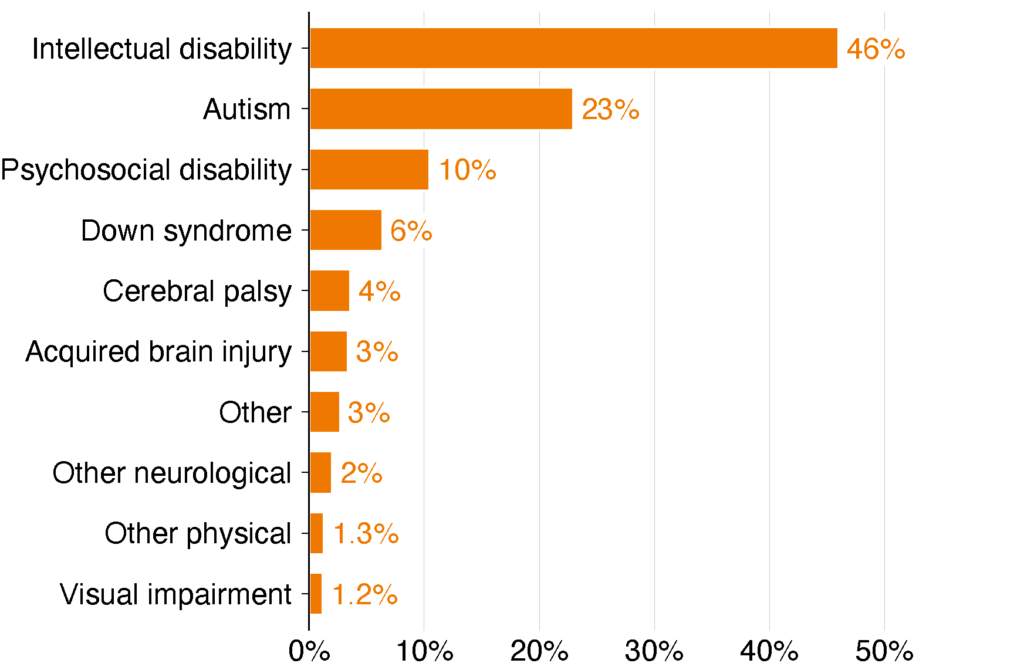
Note: ‘People in Supported Employment’ is defined as anyone who claimed at least one NDIS line item related to the ‘0133’ ‘Specialised Supported Employment’ registration group.
Source: Grattan analysis of ABS (2026a).
Figure 1.6: The supported employment workforce is younger than the general Australian workforce
Age distribution of supported employment cohort by age group compared to general Australian workforce, FY25
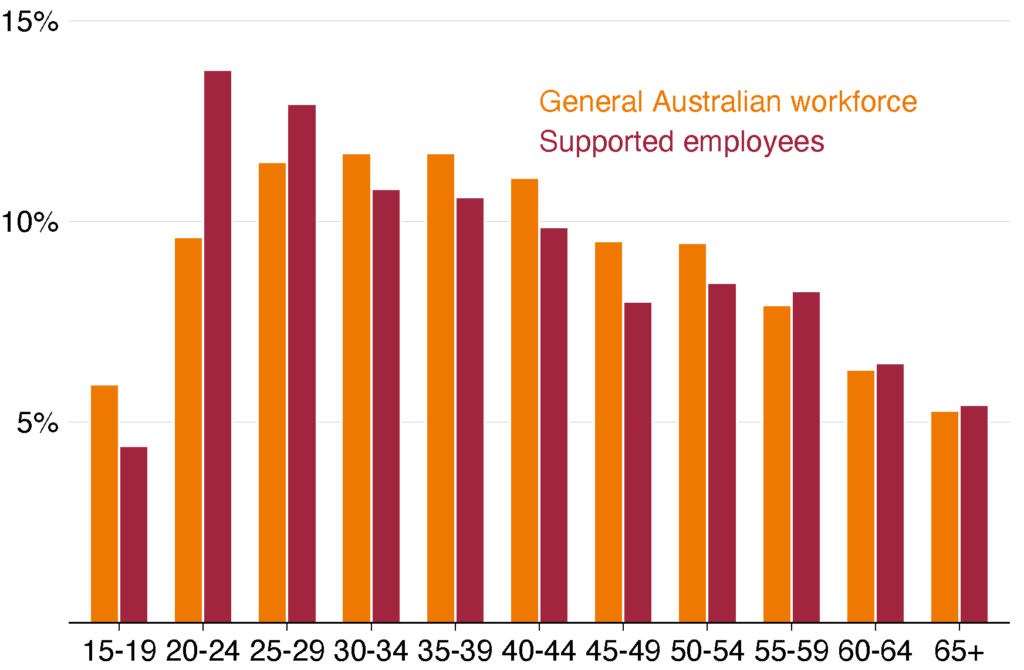
Notes: ‘Supported employees’ is defined as anyone who claimed at least one NDIS line item related to the ‘0133’ ‘Specialised Supported Employment’ registration group. Proportions reflect the share of employed people within each group. National workforce data sourced from the ABS Labour Force Survey, which covers civilians aged 15+.
Source: Grattan analysis of ABS (2026a) and ABS (2026b, Table LM1).
Supported employees have high support needs. Almost half of people in the NDIS aged 25 who are interested in paid work and are living in Specialist Disability Accommodation or with Supported Independent Living funding – services confined to people with high support needs or requiring specialised housing – work in Australian Disability Enterprises, which remain the most common settings offering supported employment (Figure 1.7).34There are strong links between accommodation and supported employment services, with many disability service providers operating both SIL homes and ADEs: Buyability (2026). The potential for people to have the same provider for both services is therefore relatively high, with ADEs conceivably meeting a rostering need, by providing support at times when the home is not staffed.
Figure 1.7: People with high support needs are more likely to work in Australian Disability Enterprises
Share of people in the NDIS interested in paid work aged 25+, by housing type
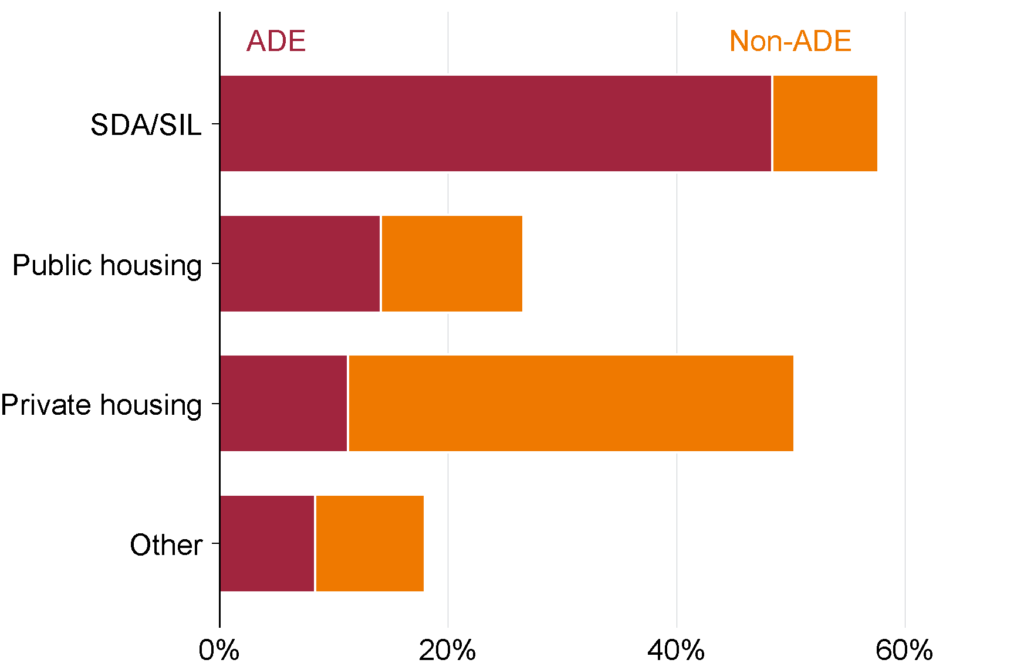
Notes: SDA = Specialist Disability Accommodation. SIL = Supported Independent Living. Based on employment status and living arrangement at time of entering the NDIS. Includes all NDIS entrants up to 31 December 2022. ‘Other’ includes boarding houses, hostels, shelters, crisis accommodation, nursing homes, and non-SDA/SIL supported accommodation.
Source: NDIA (2023, p. 56).
1.3 Sheltered work remains common
Australian Disability Enterprises (ADEs) are specialist, not-for-profit businesses that provide supported employment services to about 17,000 people with significant disability.35Mitra (2022). In 2022, about 150 registered providers operated nearly 500 sites across Australia.36Wilson et al (2022, p. 8).
ADEs operate across a range of industries but are concentrated in service sectors, including manufacturing, retail, administration, and property and gardening services.37Ibid (pp. 14–15). Many also run mobile work crews delivering services such as cleaning, waste management, and laundry, or operate customer-facing enterprises such as cafés and plant nurseries.38Ibid (pp. 14–15).
While ADEs generate revenue, many exist primarily to fulfil a stated social mission of job creation for people with significant disabilities. Financial performance varies widely, but sector data show that about half of providers operate at or below break-even (see more detail in Chapter 4). Cross subsidisation of loss-making trading operations with profits from wider disability service provision is common to balance the books.
However, several major providers have nevertheless experienced severe financial difficulties in recent years. Activ Support in Western Australia received a government rescue package in 2022,39Rishworth et al (2022). while Bedford Group in South Australia received multi-million dollar support from federal and state governments in 2025.40Simmons (2025).
Most ADEs are small-medium businesses, with more than half (57 per cent) employing fewer than 200 people in total,41NDIA (2025b, p. 12). and a median of 158 supported employees.42Ability Roundtable (2025, p. 25). Most supported employees work part time. About 70 per cent work less than 23 hours a week.43Ibid (p. 35).
Similar to day programs, many employees and families value what ADEs provide. Workers often report strong social connections and a sense of belonging, while families value the structure and perceived safety these environments provide. Many sheltered workplaces have longstanding community connections.
South Australia has the highest number of supported employees per population, with 0.13 per cent of South Australians accessing supported employment. This is more than three times as high as the ACT, where only 0.04 per cent of the population accesses supported employment. (Figure 1.8). These significant differences imply that there are factors other than need that are driving the number of supported employees. South Australia is home to the largest supported employer in the country, Bedford Group, which employs about 63 per cent of the supported employment workforce in the state.44Determined using Buyability’s publicly listed social enterprise directory and self-reported supported employee counts: Buyability (2026). While the ownership of Bedford transferred to The Disability Trust in 2026, supported employment
continues under the Bedford name.
Figure 1.8: South Australia has the highest number of supported employees per population
Supported employees per 10,000 population, FY25
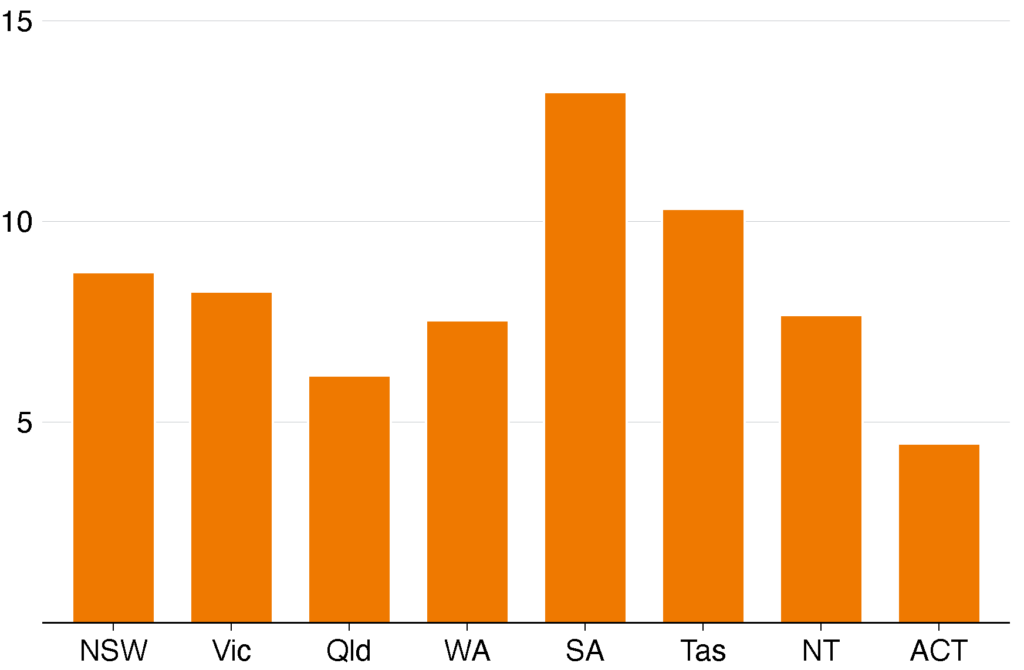
Notes: ‘Supported employees’ is defined as anyone who claimed at least one NDIS line item related to the ‘0133’ ‘Specialised Supported Employment’ registration group. Population denominators are ABS Estimated Resident Populations for each state and territory as at December 2024.
Source: Grattan analysis of ABS (2026a) and ABS (2025a).
Employment in ADEs is typically long-term, and transitions to open employment are rare. Between 2017 and 2024, only 1 per cent of ADE employees aged 25 and older, and 3.1 per cent aged 15-24, transitioned from an ADE to open employment.45NDIA (2024, p. 9). ADE workers are far more likely to transition out of employment altogether than to open employment (see more detail in Section 2.3).
Concerns about working conditions in ADEs are longstanding. Reviews dating back decades have identified issues with safety, job quality, and limited opportunities for progression.46The report from a government review of ‘Handicapped Programs’ in 1985 raised ‘major concern’ about ‘challenging and inappropriate work’ frequently found in sheltered workshops: Handicapped Programs Review (1985, p. 34). A report from government consultations on the future of supported employment in 2018 raised many of the same issues, including the lack of progression opportunities from sheltered work into open employment: Department of Social Services (2018, pp. 26–31). More recently, the Disability Royal Commission highlighted restricted choice and control, limited pathways to open employment, and elevated risks of violence, abuse, neglect, and exploitation compared to open employment settings.47Royal Commission into Violence, Abuse, Neglect and Exploitation of People with Disability (2023, pp. 461–531).
International scrutiny has reinforced these concerns. The United Nations Committee on the Rights of Persons with Disabilities has called for Australia to transition away from segregated employment models and expand pathways into open employment.48United Nations (2019, p. 13).
More recently, after a visit to Australia, the UN Special Rapporteur on contemporary forms of slavery raised concerns about ‘segregated employment’ in ADEs, describing the prospect of a worker being paid as little as $3.12 per hour in ADEs as ‘disturbing’.49Obokata (2025, pp. 11–12). The Special Rapporteur’s comments referred to the minimum wage rate for 2025-26. The minimum wage rate under the Supported Employment Services Award has been increased to $3.31 per hour in 2026-27: Fair Work Commission (2020). He called for a clear and time-bound national plan to phase out segregated employment and sub-minimum wages, and to promote employment for people with disability in the open labour market.50Obokata (2025, p. 18).
A central and unresolved issue is wages: many ADE employees are paid well below the national minimum wage under Australia’s supported wage arrangements.
1.4 The Supported Wage System entrenches low pay
The Supported Wage System (SWS) in Australia allows employers to pay workers with disability a proportion of the relevant award wage, based on an assessment of their productivity. It is used in both open and supported employment settings.
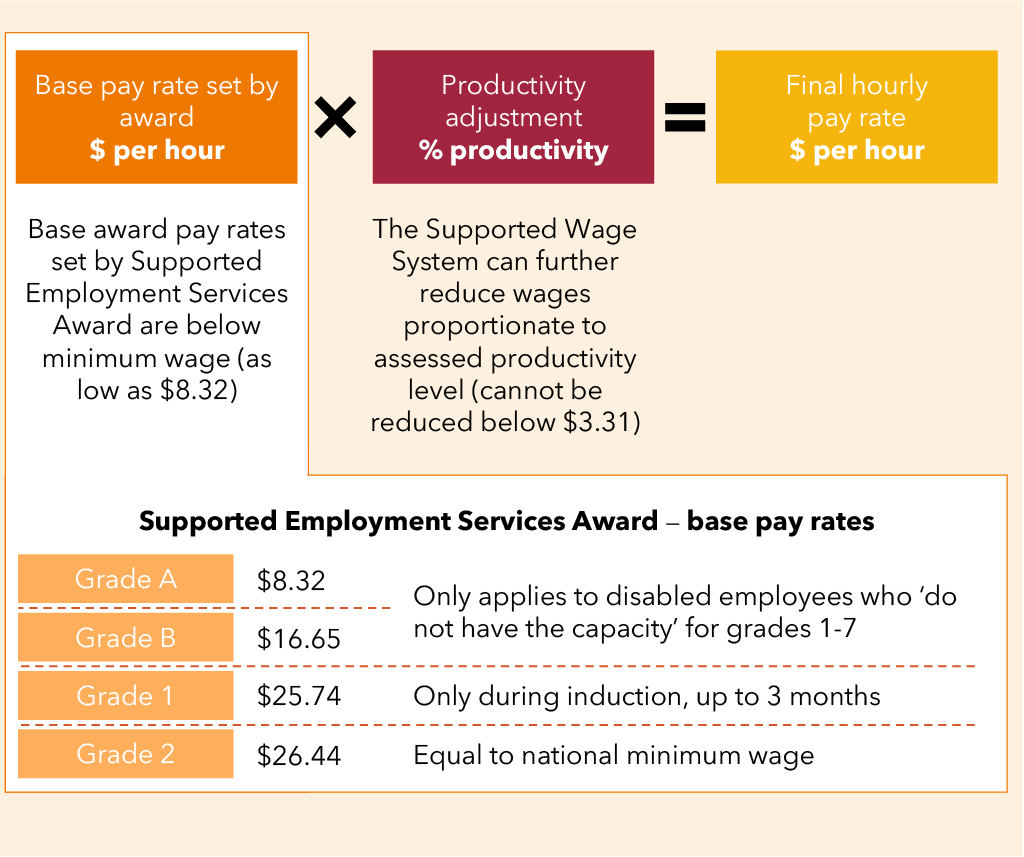
Alongside the Supported Wage System, the Supported Employment Services Award provides the sector-specific industrial framework for ADEs. The Award establishes a series of low base pay classifications for supported employment, which can then be further reduced through productivity-based wage assessments.
Evidence to the Disability Royal Commission indicated that average wages in supported employment were about $7 per hour.51Eastman (2022, p. 7). At the lowest point, the Award permits pay as low as $3.31 per hour, compared to a national minimum wage of $26.44 in 2026-27 (see Box 1).52Fair Work Commission (2020, Item D.4.1), and Fair Work Ombudsman (2026).
Most ADE employees are on SES Award grade levels set at sub-minimum pay rates, even before any further productivity-based reductions have been made (Figure 1.9). Most ADE employees also have assessed productivity levels of less than 100 per cent, meaning their pay is further reduced.53Ability Roundtable (2025, p. 32).
Figure 1.9: More than half of supported employees are on sub-minimum wage grades, even before reductions based on assessed productivity
Distribution of staff award levels and assessed productivity levels from a sample of Supported Employment Services, FY25
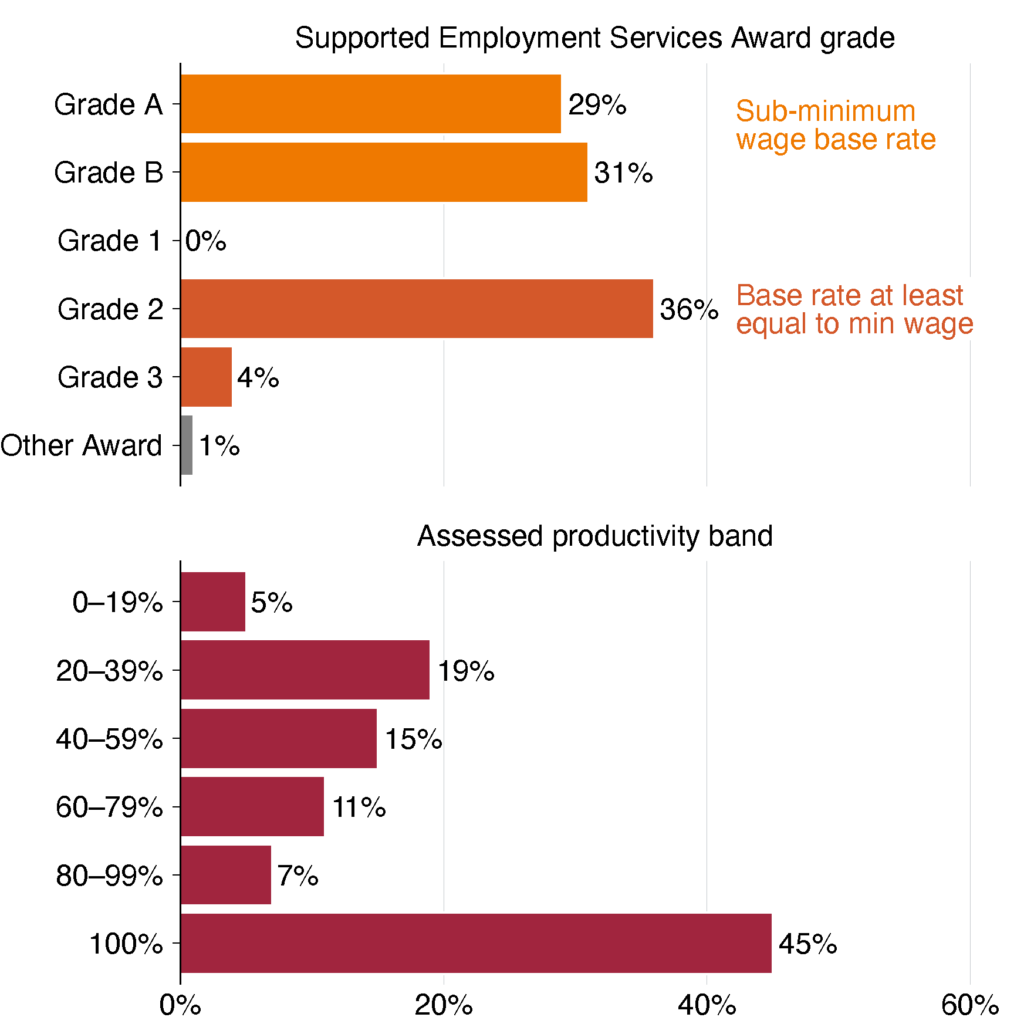
Notes: : Grades A, B, and 1 of the Supported Employment Services Award are below the national minimum wage of $26.44 per hour, at $8.32, $16.65, and $25.74 respectively (2026-27). Grade 2 is equal to the national minimum wage and Grades 3-7 of the Award are above the minimum wage. Survey included 33 Supported Employment Services, employing 8,024 supported employees.
Source: Ability Roundtable (2025).
The procedure for productivity assessments disadvantages ADE employees. 50 per cent of an ADE employee’s assessment is determined by their employer, which has a vested interest in a lower productivity rating, with the other 50 per cent determined by an independent assessor.54Department of Social Services (2023, p. 15). Supported Wage System employees at open employers are subject to productivity assessments determined wholely by an independent assessor.55Department of Social Services (2025a).
About 21,000 people were earning less than minimum wage in Australia in 2021 under these arrangements – about 17,000 ADE employees and 4,000 people in open employment whose pay was reduced based on productivity.56Mitra (2022), and Taylor Fry (2024).
While almost all disabled employees earning sub-minimum wage also receive the Disability Support Pension, which has a maximum rate of $600.45 per week, or $31,331 per year,57This is the maximum rate for a single person over 21, including Pension Supplement and Energy Supplement: Services Australia (2025). The amount is reduced by 50 cents for every dollar earned over $113 per week: Services Australia (2026a). combined income still lags considerably behind average incomes of non-disabled Australians. More than 80 per cent of supported employees had total earnings (including wage and salary earnings, and Disability Support Pension) under $40,000 in 2023-24.58Grattan analysis of ABS (2026a). Average weekly earnings for supported employees were $681, compared to $1,457 for all Australian workers (see Figure 1.10).59ABS (2025b).
Figure 1.10: Supported workers’ incomes are low, and most of their income is from the Disability Support Pension
Total annual income distribution of supported employees, and average total annual income by income type, FY24
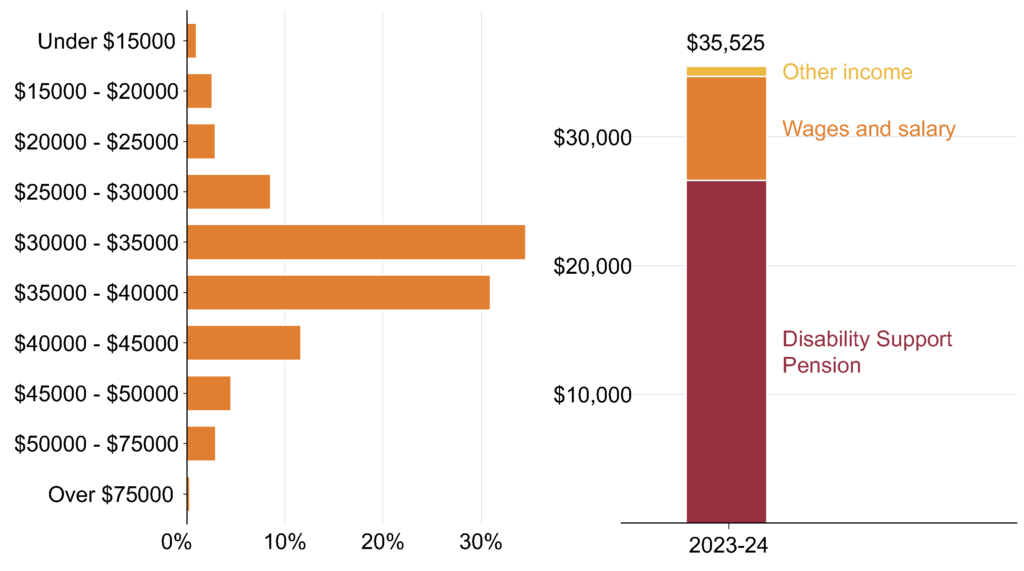
Note: ‘Supported employees’ is defined as anyone who claimed at least one NDIS line item related to the ‘0133’ ‘Specialised Supported Employment’ registration group.
Source: Grattan analysis of ABS (2026a).
While the Supported Wage System is intended to promote inclusion by addressing barriers to employment in the open workforce faced by people with disability, it does so by singling out disabled workers as the only group in Australia whose pay can be reduced linked to their assessed productivity.60Department of Social Services (2025b).
In its periodic review of the SES Award in 2020, the Fair Work Commission consolidated the ongoing use of the Supported Wage System in Australia, citing the need to ensure that ‘the capacity of ADEs to continue to employ disabled persons is not prejudiced’. The commission said that, in its view, open employment is ‘desirable’, but is not ‘practicable’ for people with more severe disability.61Steele (2022, p. 15). This despite decades of reviews and legal challenges questioning both the reliability of productivity-based wage assessments and the equity of paying workers a fraction of the award rate.62See for example Nojin v Commonwealth of Australia (2012), Duval-Comrie, Tyson and Commonwealth of Australia (2016), and Fair Work Commission (2019).
This system needs reform, but it cannot be done overnight. The risk of job losses resulting from enforced wage increases should not be taken lightly.
The goal of fair wages is the right one. In the long term, ‘fair wages’ should mean the full award wage that a non-disabled person would receive under the relevant industry award, not the Supported Employment Services Award. In the short term, use of productivity-based wage adjustments under the Supported Wage System may need to continue, in order to protect the jobs of some people with significant disability. But use of the Supported Employment Services Award to pay sub-minimum wages to workers in Australian Disability Enterprises, even before any reduction from a productivity assessment, is clearly unfair.
International experience shows that with the right policy settings in place, changes are possible that can lift wages while also increasing rates of economic participation. The key is building a system where sustainable jobs are no longer dependent on low rates of pay.
Box 1: Two mechanisms allow wages for employees with disability to be below the national minimum wage
The Supported Employment Services Award (SESA) sets the minimum wage rates for employees of Supported Employment Services (ADEs). The award permits disabled employees to be paid wages below the national minimum wage in two ways, which can compound:
1. A lower starting rate
Three of the nine grades in the SESA have base rates below the national minimum wage level ($26.44 per hour in 2026-27), with the lowest grade set at $8.32 per hour.aFair Work Commission (2020, Item 15.2), and Fair Work Ombudsman (2026).
2. A further cut based on productivity
On top of the base rate, employers can use the Supported Wage System, which involves a ‘productivity assessment’ that can reduce pay further.bFair Work Commission (2020, Item D.5). For example, a worker assessed at 20 per cent productivity can be paid 20 per cent of the relevant grade rate, down to a floor of $3.31 per hour.cIbid (Item D.4.1).
Productivity assessments can also be applied to other awards – disabled employees do not have to be working at a Supported Employ-ment Service to have their wages reduced based on their assessed productivity.
Example: Grade B packaging job at an ADE
An employee has a Grade B job on the packaging line collecting product components, inserting the product into the packaging, sealing the pack, and putting the pack in a carton (four steps). Their productivity is assessed at 30 per cent. Their hourly wage would be $16.65 x 30% = $5.00 per hour.
1.5 Employment supports are fragmented and ineffective
Governments invest heavily in specialist employment programs for Australians with disability, and dedicated Commonwealth funding has grown by about 48 per cent since the introduction of the NDIS (Figure 2.1). Despite this, gaps in coverage and variable service quality mean that improvements in employment results have been modest and uneven, with people with high support needs the least well served.
Disability Employment Services (DES), the government’s largest specialist program, has recently been reformed after years of systemic poor performance. In 2024-25, DES made fewer than 20,000 52-week employment placements from a caseload of more than 250,000 at the beginning of the year.63AIHW (2026b, pp. 11, 13) and Department of Social Services (2025c, p. 82). Among people with intellectual disability, who make up about 5 per cent of the caseload, the 52-week outcome rate was about 29 per cent. For people with psychosocial disability, who make up 41 per cent of the caseload, the rate was less than 19 per cent: Department of Social Services (2025d).
The Inclusive Employment Australia program, launched in November 2025 to replace DES, aims to improve results, but is unlikely to completely remove duplications and gaps in services (see more detail in Section 2.1).
NDIS supports, including those that target younger people transitioning from school and broader capacity building supports to help build people’s confidence and skills in preparation for paid work, are disconnected from Inclusive Employment Australia. This fragments responsibility for employment outcomes. It means many people receive support to build skills without support to secure a job.
The NDIS also channels significant funding to supports with limited evidence of effectiveness and few levers for government to control quality. A better balance between individualised funding and directly commissioned, evidence-based programs could improve employment outcomes for people with disability, particularly those with high support needs, and better align investment with the objectives of Australia’s Disability Strategy
1.6 Reform has been slow and insufficient
The history of reform in supported employment goes back decades. Successive governments since the mid-1980s have responded to program reviews and Federal Court decisions, trying to improve working conditions, pay, and the commercial viability of providers.
Despite these efforts, several program rebrands, and the periodic injection of transformation funding, only modest progress has been made in transforming Australian Disability Enterprises or improving rates of open employment. While some providers have succeeded in offering work in more integrated industry and community settings, many supported employment workplaces remain substantially unchanged (see Figure 1.11).
Figure 1.11: Sheltered workshops have been subject to many reforms since they were established in the 1950s
Key supported employment public policy events, 1950 to 2025
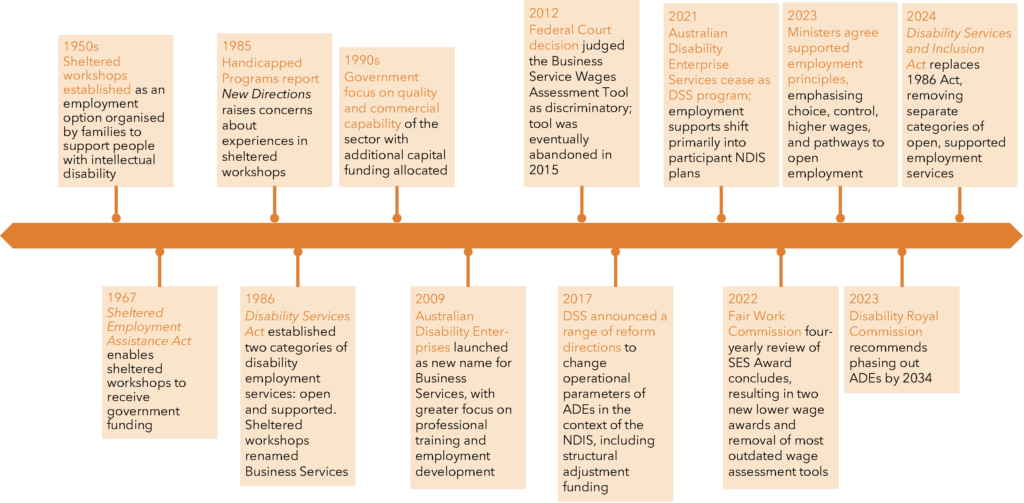
Notes: SES = Supported Employment Services. ADEs = Australian Disability Enterprises. Source: Grattan analysis.
More recently, the 2023 Disability Royal Commission and the 2024 Independent Review of the NDIS have helped to create a platform for change. They shone a light on persistent safety concerns in closed employment settings and drew attention to the inadequacy of supports to help get disabled people with high needs into mainstream employment.
The Royal Commission set the expectation of a sector transition to enabling more inclusive employment and full award-wage jobs by 2034. But progress in the past two years has been slow, and insufficient to give confidence that such a transition will be realised.
There have been welcome government commitments: $23.3 million over four years in the 2024 Budget to establish the Centre for Inclusive Employment to build an evidence base for what works in disability employment and build sector capability; and a further $227.6 million over five years to expand access to the Inclusive Employment Australia program.64Department of the Treasury (2024, p. 168).
But the government’s formal response to Royal Commission recommendations around Australian Disability Enterprises transformation and wage increases remains ‘subject to further consideration’,65Department of Health, Disability and Ageing (2025, Recommendation 7.32). and only a modest $57 million over four years has so far been committed to the specific task of supporting the ‘evolution’ of ADEs.66Department of Social Services (2024, p. 32), and Department of the Treasury (2023, p. 204).
1.7 Change is possible and desirable
Australia needs an ambitious reform agenda for the disability employment system. Overseas experience suggests that reform is possible without adverse impacts on people’s jobs, so long as the right policy settings are in place.
There is some indication that the number of new entrants to ADEs is slowing – there was a 4 per cent increase in the proportion of people in the NDIS working in open employment at full award wages between 2022 and 2025.67AIHW (2026b, Fig 2.3). Momentum is also discernible in various sector-led or philanthropically-led reform initiatives which are currently testing new ways to deliver supported employment or to transition existing delivery models.
These are positive indications that suggest there is a growing appetite for change that government would do well to shape and harness.
A generational shift may be slowly occurring, but without decisive government action, change will happen incrementally towards an uncertain destination, rather than as part of a planned and deliberate journey to greater inclusion.
The Department of Social Services should reset its reform agenda to ensure that increasing open employment is understood as the primary goal for all disabled Australians of working age, regardless of their level of need. The separate policy treatment of open and supported employment that has characterised reform efforts to date does not reflect contemporary expectations or realities of the work opportunities available or possible for people with high support needs.
The following chapters set out what government must do to improve pathways into open employment, expand mainstream employment opportunities, raise the bar for specialist disability employment, and support the sector to successfully transition. These policy settings will open doors to real work and deliver better jobs and fairer wages for disabled workers.
2 Improve pathways into open employment
The federal government spends more than $1.3 billion each year on employment supports for disabled people. But this spending is not delivering the best result: it is not supporting disabled people with high support needs to move to open employment and to earn fair pay for their efforts.
Employment supports are fragmented and poorly coordinated. And individually-funded payments through the NDIS have not sufficiently incentivised providers to adopt best practice.
We know what good looks like. International experience indicates the importance of a multi-pronged approach to help people with high support needs into mainstream jobs. This involves getting to know the person’s strengths, interests, and support needs; using ‘place and train’ approaches; job customisation; and establishing clearer pathways from education to work. None of these are widely or sufficiently available in Australia today.
Australia should redirect some of its employment support spending towards embedding these practices. A more concerted focus on making these supports available to people with high support needs, including workers in Australian Disability Enterprises, would deliver improved results.
2.1 Current supports are fragmented despite spending increases
Employment supports for people with disability are fragmented and often poorly coordinated. Different agencies operate with similar aims and unclear separation of responsibilities, creating risks of gaps, duplication, inefficiency, and inconsistency in the services available.
Before 2017, the Department of Social Services was the main source of government-provided employment support for disabled people in both open and supported employment. Between 2017 and 2021, supported employment services for people with high support needs transitioned to the NDIS.
NDIS supports are individually funded via a disabled person’s NDIS plan. NDIS supports focus on:
- Capacity building and preparing people to work.68NDIA (2026b).
- Day-to-day assistance in the workplace to maintain employment, mostly delivered in Australian Disability Enterprises.69NDIA (2021, p. 3).
Open employment services remained with the Department of Social Services, funded through the previous Disability Employment Services (DES) program. NDIS and DES supports were intended to be complementary, but in practice they did not integrate well and rarely worked in tandem.70Royal Commission into Violence, Abuse, Neglect and Exploitation of People with Disability (2023, p. 496).
Many people with high support needs, particularly those with intellectual disability, have historically received little or no support from the DES program. This includes those below the DES work-capacity threshold71To be eligible for DES services, someone needed to be assessed as being able to work at least 8 hours per week: Disability Employment Services (2025, p. 14). – who are often attending NDIS-funded day programs – and those in supported employment, largely in Australian Disability Enterprises. The DES program tended to focus on ‘job-ready’ applicants entirely separate to the NDIS, leaving no clear pathway into open employment for many, and very little movement between systems.
The Disability Royal Commission recommended greater collaboration between the NDIS and DES to improve cohesion, and that the federal government clarify the responsibilities of each system.72Royal Commission into Violence, Abuse, Neglect and Exploitation of People with Disability (2023, pp. 496–498).
DES was redesigned and relaunched as Inclusive Employment Australia in November 2025. This relaunch aims to improve results, including by extending eligibility to people previously considered below the eight-hour work-capacity threshold, offering longer-term support, and tailoring services more closely to individual needs.73Department of Social Services (2026b). While this could bring more people with high needs into the service, there is no explicit focus on NDIS day program attendees or supported employees, meaning structural gaps are likely to persist.
Inclusive Employment Australia supports are similar in purpose to those provided by the NDIS:
- Support to prepare for work, such as skill and confidence building, training, interview skills, work experience, and work trials.
- Support to maintain a job through on-the-job training, ongoing support in the workplace, and help for employers.74Services Australia (2026b).
NDIS employment supports are disproportionately weighted towards about 23,000 people working in supported employment,75Grattan analysis of ABS (2026a). the majority being Australian Disability Enterprise employees.76In 2024-25, a total of $476 million was spent on NDIS employment supports, of which $309 million related to ‘supports in employment’ items for people in supported employment: Grattan analysis of NDIA (2026a). Most of these people were in Australian Disability Enterprises: NDIA (2021, p. 3). This funding sustains ongoing employment but rarely facilitates transitions from Australian Disability Enterprises to the open labour market.
Other NDIS supports, including those that target younger people transitioning from school, and broader capacity building supports to help build people’s confidence and skills in preparation for paid work, are similarly disconnected from Inclusive Employment Australia. This further fragments responsibility for employment outcomes and means that many people receive support to build skills without support to secure a job, or they enter employment services without being adequately prepared.
Federal government spending on specialist disability employment supports has grown in real terms over the past decade, from $860 million in 2015-16 to $1.26 billion in 2024-25 (Figure 2.1).77This amount includes specialist disabled employment spending through NDIS and IEA, but does not include spending on disabled people accessing general Workforce Australia support provided by the Department of Employment and Workplace Relations. At 30 April 2026, the Workforce Australia caseload included 178,755 people with disability: Department of Employment and Workplace Relations (2026, Table 1). But this has not been reflected in better results.
Figure 2.1: Spending on employment supports is higher than a decade ago
Spending on employment, 2024-25 dollars
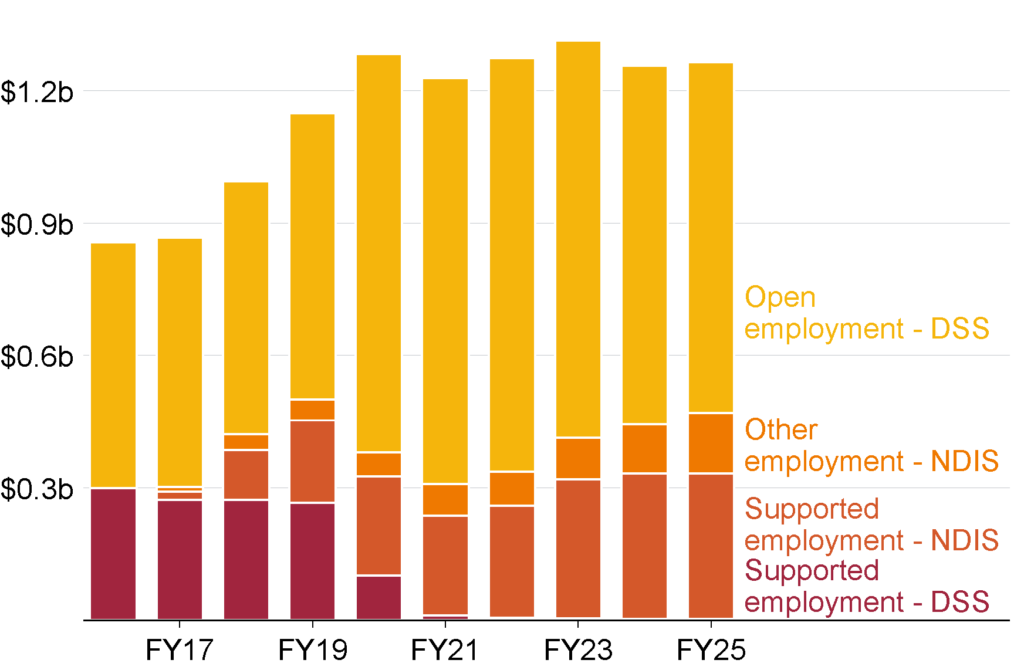
Notes: DSS = Department of Social Services. ‘Supported employment – DSS’ includes DSS services to people employed by the service provider. ‘Open employment – DSS’ includes DSS services to people who are employed or seeking employment in the open labour market. ‘Supported employment – NDIS’ includes line items from the ‘0133’ ‘Specialised Supported Employment’ registration group. ‘Other employment – NDIS’ includes capacity building employment supports: employment assistance, employment-related counselling, school leavers employment supports, psychosocial recovery coaching, and support coordination. Historical data adjusted to 2024-25 dollars using the General Government Final Consumption Expenditure chain price deflator.
Source: Grattan analysis of ABS (2026a) and Productivity Commission (2025, Table 15A.71 and Table 2A.27).
There is little obvious justification for the current division of responsibilities for disability employment supports between the NDIS and Inclusive Employment Australia. And since the 2025 federal election, those programs are also the responsibility of two different federal departments – the Department of Health, Disability, and Ageing, and the Department of Social Services.
Having all disability employment supports delivered by one agency would enable a more holistic approach to supporting people to build capability, obtain employment, maintain work, and develop their careers, regardless of their level of need.
2.2 Disability Support Pension access rules are a barrier to work
The vast majority of working-age disabled people with high support needs are eligible to receive the Disability Support Pension. For most, it is their main source of income (see Figure 1.10.)
While many disability advocates have pointed to the Disability Support Pension taper rate as a major barrier to people working more, or demanding higher wages,78e.g. Deloitte Access Economics (2026). This issue was also included in multiple submissions to the Disability Royal Commission: Royal Commission into Violence, Abuse, Neglect and Exploitation of People with Disability (2023, p. 405). reforming the taper should be a lower priority than removing restrictions on access to the Disability Support Pension for workers.
Disability Support Pension payments are reduced by 50 cents for every dollar earned over $113 per week.79Services Australia (2026a). People over 67 can also get the Work Bonus, which means they can earn $263 per week before their Disability Support Pension payments begin to reduce.80Grattan analysis of Services Australia (2026c).
While this taper rate creates a disincentive to work and earn more, it is not unique to disabled people. Most government benefits have similar tapers.81For example, JobSeeker payments are reduced by 50 cents for each dollar earned between $75 and $128 per week, then 60 cents for each dollar earned over $128 per week: Services Australia (2026d). Age Pension payments are reduced by 50 cents for each dollar earned over $263 per week after the impact of the Work Bonus: Grattan analysis of Services Australia (2026e) and Services Australia (2026c). Parenting Payment amounts are reduced by 40 cents for each dollar earned over a threshold of $116.30 per week, plus $12.30 per week for each additional dependent child: Services Australia (2026f). The withdrawal of benefits due to taper rates can create extremely high effective marginal tax rates when combined with high income tax rates. But few disabled people with high support needs will be affected in this way, because about nine in 10 supported employees earn less than the tax-free threshold.82Grattan analysis of ABS (2026a).
The government should consider extending the Work Bonus to Disability Support Pension recipients of working age, but further modifications to the taper should not be the priority for Disability Support Pension reform.
Rules restricting access to the Disability Support Pension for workers are a much bigger problem than the taper rate:
- Someone who works 30 or more hours a week at award wages will receive no Disability Support Pension payment, even if their earnings are low enough to qualify for a payment under the income test.83Services Australia (2026g). A person earning less than $1,313.90 per week (the equivalent of $68,557 per year) can still be eligible for a partial Disability Support Pension under the income test: Grattan analysis of Services Australia (2025) and Services Australia (2026a). This creates a clear disincentive to work more hours: in most cases, someone’s income will actually decrease as a result of the 30th hour worked in a week. Workers in an Australian Disability Enterprise or under the Supported Wage System are exempt from this 30-hours-a-week rule – an exemption which perversely disfavours open employment at award wages.
- Workers who earn too much to qualify for a Disability Support Pension payment, or who work more than 30 hours a week at award wages, can have their Disability Support Pension suspended for a maximum of two years, before their Pension is cancelled and their Pensioner Concession Card is revoked. If a person’s work arrangements change after this time, they need to reapply for the Disability Support Pension.84Services Australia (2026g). The time limit on suspension is a disincentive to work, because many people will fear being unable to restore access to benefits should their circumstances change in the future.
The government should abolish the 30-hours-a-week rule and allow an indefinite Disability Support Pension suspension period, during which a person will be able to keep their Pensioner Concession Card, to remove perverse disincentives to working more hours in open employment.
2.3 Open employment is rare for people with high needs
Despite access to a variety of NDIS supports aimed at helping people find and keep a job,85NDIA (2025a, pp. 69-70, 81–85). disabled Australians with the highest support needs continue to find it difficult to get into open employment. Less than 5 per cent of people aged 15 or over in the NDIS with intellectual disability, and less than 3 per cent with Down syndrome, are employed at full award wages.86Grattan analysis of NDIA (2023, pp. 44-45 and 60-61).
For these groups, the choice is more likely to be between a day program and working in an Australian Disability Enterprise. In fact, most NDIS spending on employment supports goes to supporting people with high needs to maintain a job in an Australian Disability Enterprise.87See Footnote 76.
For the supported employment system to be providing the most value for disabled people, transitions to open employment should be a viable and regular feature, even for people with the highest support needs.
When employment supports were transferred to the NDIS, Australian Disability Enterprises were expected to better function as a stepping stone to open employment, with policy settings adjusted to support this:
NDIS pricing changes in 2020 aimed to allow people with high support needs to use their employment supports in any workplace rather than just Australian Disability Enterprises. This aimed to enable ADEs to better support employees to experience different employment environments.88NDIA (2024, p. 9).
NDIS capacity building support items specifically include support to transition from Australian Disability Enterprises to open employment.89NDIA (2026b).
The NDIS also commissioned research in 2024 aimed at improving the way in which people in the NDIS with high support needs are enabled to find and maintain open employment.90NDIA (2024).
But the reality is that once people enter an Australian Disability Enterprise, they rarely transition to open employment.91Kregel et al (2020, p. v), and Gendera et al (2024, p. 4). In 2022, only 4 per cent of employees younger than 25 moved into open employment, falling to 2 per cent for those aged 25 and older. In both groups, more people left ADEs for no employment than for jobs in the open labour market (Figure 2.2).
Figure 2.2: People in Australian Disability Enterprises rarely move into open employment, especially as they get older
Transitions of ADE employees from ADE employment within a year, 2022
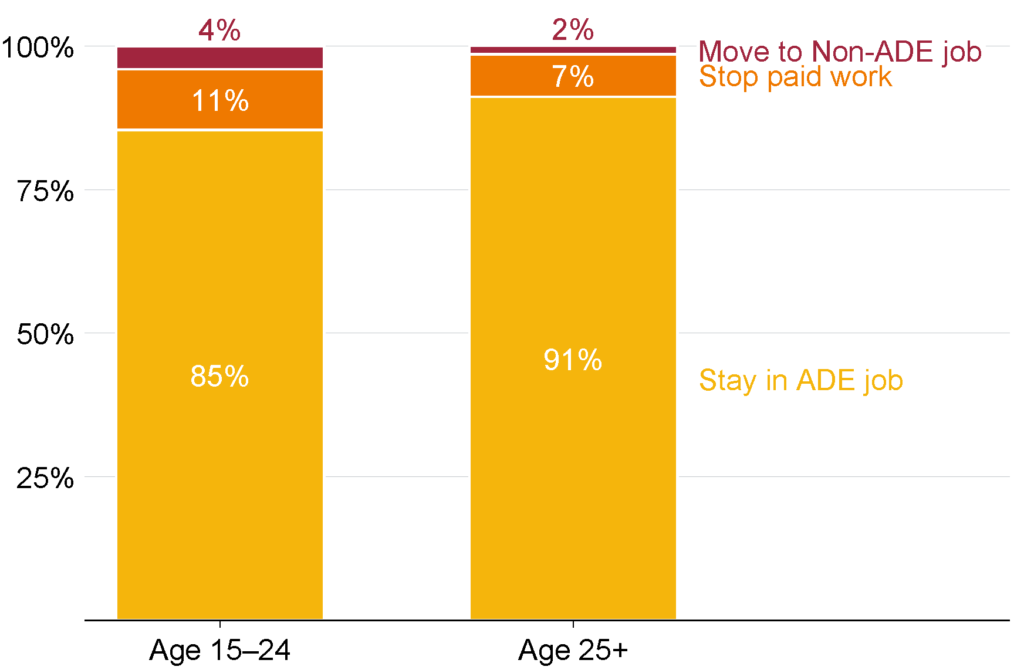
Note: ‘ADE job’ includes both staying with the same ADE and moving between ADEs. Source: NDIA (2023, p. 126).
This is not unique to Australia: a 2014 US study found that only 10 per cent of intellectually disabled people in open employment had commenced work in a disability-only setting.92Siperstein et al (2014, p. 173).
This result is also not surprising. Despite NDIS policy settings supporting transitions to open employment, Australian Disability Enterprise operators are not adequately encouraged to support this shift for their workers. Quite the opposite. The workers best able to move into open employment are likely to be the most productive in the ADE setting, and ADE operators with an eye on the bottom line can be reluctant to encourage their best workers to leave.
ADE operators have not regarded supporting their employees to transition to other jobs as part of their remit.93Disability Employment Australia (2025, p. 42).
Any strategy to improve pathways into open employment for disabled people with high support needs must include a focus on those entering the workforce for the first time, as well as people currently working in ADEs.
NDIS supports for school leavers have been particularly ineffective
The NDIS provides supports for young people with disability to assist them to transition from school into employment. Funded as School Leavers Employment Supports (SLES) until 30 June 2024, at an annual cost of about $85 million,94Grattan analysis of NDIA (2026a). these supports have had minimal impact.95After 30 June 2024, employment supports for school students began to be absorbed into the general ‘Employment Assistance’ item. The transition is slow. SLES payments dropped by only 14 per cent in the first year of the transition, from $84 million in 2023-24 to $73 million in 2024-25: Grattan analysis of NDIA (ibid).
Three years after first receiving SLES, 27 per cent of recipients were in a paid job, compared to 26 per cent of a comparison group.96The NDIA analysed the impact of SLES using a method called ‘propensity score matching’ to find a group of people who were similar to SLES recipients but did not receive SLES, referred to as the comparison group: NDIA (2023, pp. 182, 184). And only 18 per cent of recipients were in open employment.97Grattan analysis of NDIA (ibid, p. 181).
2.4 The number of people receiving sub-minimum wages remains high
About 21,000 disabled people were earning less than minimum wage in Australia in 2021 under the Supported Employment Services Award and/or the Supported Wage System – about 17,000 ADE employees and 4,000 people in open employment whose pay was reduced based on productivity.98Mitra (2022), and Taylor Fry (2024). And there is nothing to suggest this number has decreased in recent years.
Australia’s experience contrasts notably with the US. The number of disabled workers receiving sub-minimum wages in the US has dropped by more than 90 per cent this century. And every state in the US recorded a decline of at least 32 per cent between 2018 and 2023 (Figure 2.3).
Figure 2.3: US sub-minimum wage work has dropped steadily in the past quarter-century, with reductions in all states between 2018 and 2023.
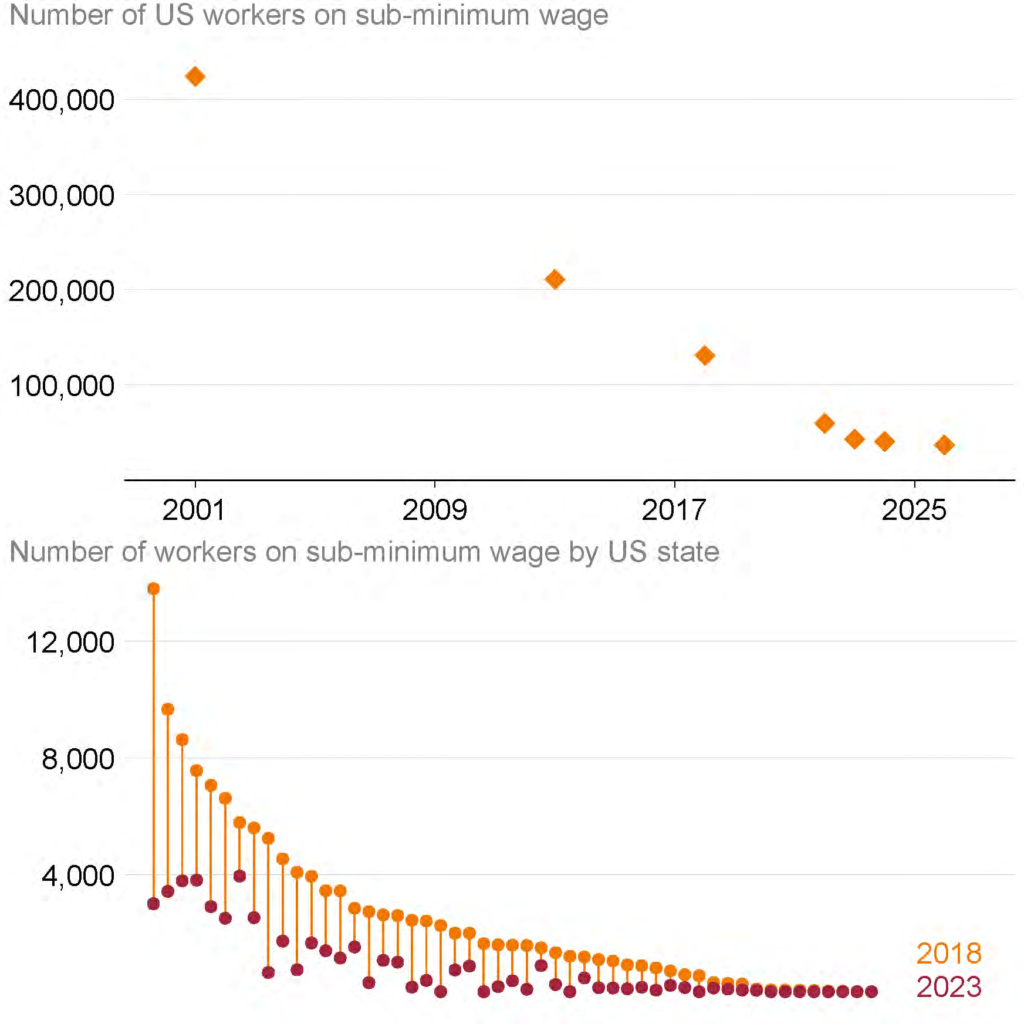
Source: Grattan analysis of US Department of Labor (2026a), Butterworth and Edelstein (2023), Heigl et al (2024a), and US Department of Labor (2026b).
And this change in the US has coincided with increased employment opportunities for disabled people. Between 2013 and 2022, the proportion of people with a cognitive disability who were employed increased from 23 per cent to 38 per cent,99Winsor et al (2025, p. 6), and Winsor et al (2019, p. 42). while the number of people receiving sub-minimum wages dropped from 211,000 to 60,000.100Butterworth and Edelstein (2023). And a study in New Hampshire and Maryland found increased labour force participation by people with a cognitive disability after the state-level repeal of Section 14(c), which allowed disabled workers to be paid sub-minimum wages.101Kakara et al (2024).
While the US national minimum wage of US$7.25 is about 60 per cent lower than the Australian minimum wage, most US states have minimum wages that are much closer to the Australian minimum wage. The population-weighted average minimum wage across US jurisdictions is US$12.03, the equivalent of AU$17.35. This is 34 per cent lower than the Australian minimum wage of AU$26.44. And most of the US states with the best experience of moving disabled people with high support needs into open employment have even higher minimum wages. Vermont’s minimum wage is US$14.42, 21 per cent less than Australia’s. Oregon’s is US$15.55, 15 per cent lower than Australia’s. And Washington state’s is US$17.13, only 7 per cent lower than Australia’s.102Grattan analysis of Paycom (2026), Britannica (2024), and Reserve Bank of Australia (2026a).
2.5 The elements of best-practice employment programs
There is a growing volume of international evidence that personalised employment programs can enable disabled people with high support needs to transition into open employment and remain there long-term, while enjoying enhanced job satisfaction.103Inge et al (2024), Smith (2023), Inclusion Australia (2023, p. 144), Arredondo et al (2024), Wehman et al (2020), Riesen et al (2015), Migliore et al (2012), Phoenix and Bysshe (2015, p. 13), Kregel et al (2020), Sayce (2011, pp. 11–12), and Taylor (2022).
Best-practice employment programs for this group are highly individualised, and focused on finding a match between the unique strengths, needs, and interests of a job candidate and the identified needs of employers.104Inge et al (2018, p. 156). They involve customising roles rather than slotting people into pre-defined jobs.105‘Customised employment’ can refer to a specific codified practice which was included in the US Workforce Innovation and Opportunity Act in 2014: US Office of Disability Employment Policy (2026). Australia need not slavishly follow the US model. Rather, standards should be developed that incorporate evidence-supported features of successful programs. This process works for people leaving supported employment, as well as for people entering the workforce.
The most successful employment programs for disabled people involve a multi-pronged approach, including:106Gendera et al (2024, p. 1), Inclusion Australia (2023, p. 144), Arredondo et al (2024), Phoenix and Bysshe (2015, p. 13), and Wehman et al (2020).
- understanding a person’s strengths, interests, and preferences,
- job customisation,
- ‘place and train’ employment support, and
- a focus on pathways from education.
Understanding a person’s strengths, interests, and preferences
Effective employment support generally begins with an employment specialist learning about the job-seeker’s preferences, interests, ambitions, abilities, and potential.107This process is referred to as ‘Discovery’ in the most commonly used US version of Customised Employment: Smith et al (2018a, p. 71) and Wilson and Campain (2020, p. 8).
This works best when it involves visiting a person where they are most comfortable, most commonly in their own home or community.108Inge et al (2018, p. 159), and Smith et al (2018a, p. 71). A skilled employment provider can observe the job-seeker performing daily activities, often in different settings, build rapport, and get to know the person through listening and watching.109Inge et al (2018, p. 160).
A job-seeker may also be supported to observe work at local businesses, and engage in job-related tasks. This can help determine whether the job-seeker has particular skills, wants to do a particular type of work, what job supports might be needed, and other conditions for success.110Inge et al (2018, p. 160), and Hall et al (2018, p. 212).
This can be an intensive process, taking from 20 to 60 hours, but averages 30 to 35 hours, usually spread over five to seven weeks.111Smith et al (2018a, p. 71), and Promising Practices (2026).
Job customisation
Next, the employment specialist uses what they have learned to design a job that matches the person’s strengths, preferences, and interests.112Kregel et al (2020, p. iii).
Rather than focusing on existing or advertised jobs, job customisation involves looking at tasks in a workplace and asking:
- What work actually needs to be done?
- Which tasks match a person’s strengths?
- How can those tasks be grouped into a meaningful, paid role?113Taleporos (2026).
A tool such as a job development matrix could be used to work with a business to identify tasks that are suitable for the disabled job-seeker.114Nash (2026).
Job customisation can include job carving, job sharing, job creation,115Wilson and Campain (2020, p. 9). and tailoring work environments to meet the needs of both the employee and the employer.116Arredondo et al (2024, p. 9).
Job customisation can have flow-on benefits for an employer such as freeing up a more highly-paid employee from mundane time-consuming tasks, offering a new service to customers, or addressing unmet needs.117Migliore et al (2012, p. 208), and Marc Gold & Associates and Employment for All (2017).
‘Place and train’ employment support
‘Place and train’ employment support includes direct job placement and ongoing support to the disabled person, and can also include support for the person’s family, employer, and co-workers. This support enables an individual to learn work skills while immersed in real work environments, and has been found to be more effective than traditional ‘train then place’ models.118Gendera et al (2024, p. 6), and Kregel et al (2020, pp. 2, 16). On-the-job training works well for intellectually disabled people, because it is highly realistic and, being set in the workplace, does not require learning to be transferred.119Alexander et al (2024, pp. 163–164).
Ongoing support services are provided to the worker throughout their employment, based on the individual’s needs at different points in time. These could include job coaching, practical workplace adjustment, mentoring, and transport.120Fulk (2018, pp. 72–73), and Gendera et al (2024, p. 1). These supports should be available for as long as workers need them.121Kregel et al (2020, p. iv).
An Oregon study concluded the most important factor in successful open employment was access to a long-term job coach. Almost 84 per cent of people receiving this support successfully obtained and maintained open employment.122Fulk (2018, pp. 71–72).
Randomised control trials have found ‘Individual Placement and Support’ to have higher success rates than traditional methods for job seekers with mental health challenges,123Hoffman et al (2014). though a Melbourne study found the difference was no longer evident after 12 months.124Killackey et al (2019).
A focus on training workers to support disabled co-workers, for example through buddy systems, mentoring, or basic systematic instruction training, can also lead to better outcomes. A US study showed that having co-workers train supported employees increased the length of time disabled employees were employed by more than a year.125Cimera (2001).
A focus on pathways from education
Young intellectually disabled people should be supported in their final years of schooling to have work placements that reflect their interests and employment goals.
Planning for a pathway to work should formally commence by the time students are 14,126Wilson and Campain (2020, p. 8). and should include work experience and training opportunities such as school-based apprenticeships and traineeships. Yet typical practice in Australia generally involves only limited transition planning conducted in the last year of school.127Ibid (p. 8).
Real-world work experience in employment settings has been identified as the number one predictor for young people with intellectual disability pursuing open employment after graduation.128Wehman et al (2018, p. 140). This could take the form of internships, work experiences, work evaluations, group work, or even trial work assessments.129Fulk (2018, p. 124).
It is important that internship programs can be demonstrated to provide genuine workplace skills and likelihood of future employment. This will ensure a valuable experience for interns, which is particularly important because these programs may involve many hours of unpaid work.
Education pathway programs that engage with families, schools, and community organisations will have the highest chance of improving post-school outcomes for disabled people.130Kohler et al (2016). Providing student-specific information about transition and employment planning can equip parents to make informed decisions.131Hall et al (2018, pp. 208–209). If parents are invested in the program, it can lift their expectations of what their child can expect from a workplace and a career.132Wehman et al (2018, p. 140).
2.6 The enablers of successful employment support
The body of evidence supporting personalised employment programs is promising, but lacks large-scale randomised control trials, particularly in an Australian context. This makes it difficult to accurately quantify the likely impact of adopting particular approaches in Australia at scale. There is a risk that practices that seem promising based on small-scale work in specific contexts might be found to have very little impact if employed at a large scale in Australia.
However, international research and experience indicates features of the disability employment system that are more likely to open up employment opportunities for people with high support needs.
Effective support requires highly-trained employment specialists
Staff training programs and ongoing technical assistance to providers have been found to significantly improve placement rates, and result in workers receiving higher wages and working more hours per week.133Kregel et al (2020, p. iv).
These specialists should have completed specialised training programs covering best-practice in individualised employment planning, skills assessment, job development, negotiation, systematic instruction, and tailoring work environments to meet the need of employees and employers.134Arredondo et al (2024, p. 9), and Wehman et al (2018, p. 139).
Closing sheltered workshops should not be the goal
Jurisdictions that have prioritised investment in best-practice in employment services have tended to fare better than places that set out to close sheltered workshops.
Between 2015 and 2022, Oregon focused on improving the quality of employment services for intellectually disabled people, and implementing specialised employment services that were individualised and flexible and reflected the emerging evidence-base.135US Department of Justice (2015, pp. 5, 9–11). This resulted in the number of Oregon workers in sheltered workshops falling from 1,926 in 2015136Ibid (p. 1). to zero by 2021 (Section A.3).137Jorwic (2022, p. 12).
Vermont’s investment in individualised employment services – including localised job search and matching, on-the-job training, follow-up services and support, equipment, transport, and career enhancement – similarly led to excellent employment outcomes (Section A.1).
But the experience in Maine was quite different. The closure of sheltered workshops there was not accompanied by a significant focus on improved employment services. Far fewer workers made a successful transition to open employment in Maine (Section A.2).
Realistic time-frames for reform
Lead times are needed for improved employment practices to become embedded and for employment providers to adjust their operations.
Vermont’s transition had roots going back to a 1982 pilot program, which demonstrated that with quality support and a presumption of competence, most disabled people can work in the community. That program resulted in Vermont’s business community becoming a supporter of the transition.
Then, starting in 1999, Vermont’s government invested heavily in improved employment services and education pathways, and collaborated with providers to move from sheltered workshops to individualised support. The government provided technical support and extra funding over several years (Section A.1).
Similarly, in the UK, Remploy, the major operator of sheltered workshops, gradually pivoted its operations towards providing employment assistance, over a period of more than 20 years. It was only after an independent review concluded that the cost of subsidies for Remploy factories was higher than the cost of supporting people into mainstream employment, and that movement to mainstream employment from Remploy factories was rare, that the last subsidy was removed (Section A.4).
In Washington state, a 2006 policy focused supports towards open employment, boosting provider capacity and partnership with the education system. Over the following decade-and-a-half, facility-based work declined, as open employment grew and providers developed improved strategies for working with people with high support needs (Section A.8).
Maine, by contrast, set a short, 18-month timeframe to phase out all state funding for sheltered employment. This timeframe proved insufficient for job placement services to evolve to the policy change. Maine failed to develop a robust system of tailored job placement, or deliver sufficient ongoing training and technical assistance to providers, leading to poor employment results (Section A.2).
In Massachusetts, a short reform timeframe may also have made the transition harder. In November 2013, the Massachusetts Department of Developmental Services published a plan to halt new referrals to sheltered workshops from January 2014, and close sheltered workshops by June 2015.138Massachusetts Department of Developmental Services (2013). The number of people in integrated employment increased following the closures, by about 1,500 over five years. But so did the number of people in day services, by about 3,600 over the same period.139Grattan analysis of Massachusetts Department of Developmental Services (2019). The Department struck difficulty in developing integrated paid employment opportunities for people with more significant challenges and support needs.140Massachusetts Department of Developmental Services (2018).
Strategies that target both existing ADE workers and potential new entrants
In Vermont, strategies focused both on the flow of new people into sheltered workshops, and the people already in sheltered workshops.
Vermont first restricted the use of state funds to sheltered workshops, to prevent new employees entering workshops – ‘closing the front door’.141Sulewski (2007).
Investments in improved employment services and education pathways supported existing workshop employees and potential new entrants.
Supporting providers to convert from sheltered workshops focused on people already in the workshops. This avoided ‘pulling the rug out’ from under providers, workers, and their families.142Golde (2016, p. 483), and Stockton (2014).
Innovative pathways
International and Australian examples show that successful education pathways can change expectations of employment opportunities for young disabled people.
Project SEARCH was launched in the UK in 2009 after being developed in the US. It is a business-led model that supports transitions from school to open employment for intellectually disabled students.143Inclusion Australia (2023, pp. 153–154). It combines individualised plans for job searching and three 10-12 week internships, where students spend most of their time learning and practicing job skills in real work settings.144Wehman et al (2018, p. 136). Local programs have been implemented at 60 sites, as partnerships between local businesses, education agencies, service providers, and employment service organisations. More than half of interns gain employment.145Inclusion Australia (2023, pp. 153–154).
Vermont colleges, with grant funding, developed post-secondary education programs for people with disability that have been successful in leading to employment (see Section A.1).
A similar national US program has been developed through Transition and Postsecondary Programs for Students with Intellectual Disability, providing grants to establish transition and tertiary programs that include individual supports and services for students with intellectual disability and integrate person-centered planning in course development for each student.146US Department of Education (2026). One year after completion, 74 per cent of graduates from the 2022-23 cohort had a paid job.147Grigal et al (2024, p. 30).
In Victoria, Integrated Practical Placement programs in TAFEs place intellectually disabled students with employers to develop work-related skills. Of 44 students commencing programs in 2018, 2022, and 2023, 20 were employed after completion, with a further 18 commencing further study. Students have reported increased confidence, social skills, and a sense of belonging.148Grattan analysis of Burgin et al (2026).
Some Australian enterprises provide employment largely as a means of transition to open employment. For example, Jigsaw offers a pathway including work-readiness foundations training, a paid traineeship in Jigsaw, and support to transition into a mainstream job.149Jigsaw (2026a). Jigsaw also works with mainstream employers to provide inclusion training, role scoping, work trials, and onboarding of disabled workers.150Jigsaw (2026b). About 63 per cent of Jigsaw placements into mainstream employment are sustained for at least 12 months.151Jigsaw (2026c).
2.7 Australia needs to embed best practice in employment support
Australian employment services providers are generally not following evidence-based best practice in employment support.152Smith (2023, p. 7).
The creation of Inclusive Employment Australia in 2025 aimed to improve the quality of services, but IEA’s deed, which documents contractual arrangements with providers, makes little mention of quality in employment service delivery.153Department of Social Services (2025e). Providers are required to be certified against the National Standards for Disability Services, but these are general in nature, rather than specific to best practice in employment services.154Department of Social Services (2013).
Embedding best practice across Australia’s disability employment service providers would require upfront investment in defining best practice, training, and quality audits.
Reallocate NDIS employment funding to Inclusive Employment Australia
The best-practice approach described in Section 2.5 requires strong co-ordination and links between the various stages of the process: learning from each stage can inform the others. It is particularly important that a disabled person’s strengths, interests, and preferences inform the approach to job customisation, placement, and ongoing training and support.
Concentrating the oversight of services which support disabled people to obtain employment in a dedicated agency would be the best way to ensure continuity between supports that target younger people transitioning from school, support to build skills, and support to secure a job.
Inclusive Employment Australia, as a dedicated employment program, is best placed to develop capability in best-practice disabled employment services, and ensure quality is maintained and duplication avoided.
A specific stream should be developed in Inclusive Employment Australia focused on enabling open employment for disabled people with high support needs. This stream should operate quite differently to existing IEA programs, which are not specifically designed to serve people with high support needs, or to drive best practice in employment services.
Funding available to employment service providers as part of this new stream should follow a different structure to other IEA funding. For one thing, it must include service fees that are significantly higher than in current IEA programs, to acknowledge the higher duration and intensity of employment services required to help people with high support needs into employment. The funding structure should also encourage fidelity to best practice and investment of sufficient time into each step of a best-practice process. An overemphasis on outcome funding should be avoided, because this risks encouraging providers to avoid working with people with the highest support needs.
Capacity and expertise would need to be built within IEA, and the new stream should not be limited to existing IEA providers.
Employers whose primary function is to provide pathways to open employment for disabled people with high support needs, such as Jigsaw (see Section 2.6), could register as Inclusive Employment Australia providers, and be eligible to receive funding from IEA, similar to other employment service providers operating in the new stream focused on people with high support needs.
In 2024-25, the NDIS spent $128 million on employment assistance and School Leaver Employment Supports.155Grattan analysis of NDIA (2026a). Neither program has been effective in getting people into open employment (see Section 2.3). This funding should be redirected to the new Inclusive Employment Australia stream focused on people with high support needs, where it would contribute to funding the cost of delivering evidence-based best-practice employment support.
‘Supports in Employment’ line items would continue to be available in the NDIS, as the cost of direct supervision, physical assistance, personal care, and ongoing support to manage complex needs at work would continue to be paid from people’s individual NDIS plans.
Define best practice
Australia does not have a rigorous or consistent definition of best practice in disability employment services. Many providers claim to be providing customised employment, but are not required to demonstrate fidelity to the model, and very few have done training that meets internationally-acknowledged standards.156Smith (2023, p. 7).
Standards exist in other countries that could provide a template for the development of a definition of best practice for Australia. The UK’s Supported Employment Quality Framework (SEQF) was developed by The British Association for Supported Employment, which also has a role in building the evidence base and monitoring fidelity to the SEQF by employment service providers.157British Association for Supported Employment (2026). The Association of Community Rehabilitation Educators in the US has developed a set of competencies that could also inform the development of an Australian model.158Association of Community Rehabilitation Educators (2017).
The Centre for Inclusive Employment should continue its work to develop an official Australian definition of best-practice employment supports for disabled people with high needs, including the competencies that workers need to be able to understand the disability and provide appropriate support. This definition should be updated as the evidence continues to develop and implementation is evaluated.
Preference award wages over the Supported Wage System
When supporting disabled people into open employment, the first and best option should be a job paying full award wages. The Supported Wage System should be used only as a last resort, once all options for award wage employment have been exhausted.
Before a candidate accepts a role at a sub-minimum wage, the employment service provider should be required to document an in-depth process aimed at matching the candidate’s strengths, needs, and interests to a customised job in open employment at an award wage.
This documentation should provide evidence of adherence to best practice standards as defined by the Centre for Inclusive Employment. It should include:
- Evidence of a candidate assessment that identifies employment preferences, strengths, and any situations to avoid. The assessment should be approved by the candidate as the basis for the job search.
- Evidence of job search and job customisation consistent with the candidate’s preferences, strengths, and any situations to avoid. The job customisation should be approved by the candidate and employer.
- Evidence that the worker’s productivity has plateaued, despite structured training and job customisation aimed at improving productivity, prior to the finalisation of a Supported Wage.
- Evidence that further job customisation and systematic training to improve productivity is provided as the worker’s and employer’s needs change.
The employment service provider should share information with the employer, to help the employer maximise the worker’s productivity. Personal information should only be shared with permission.
Providers should be subject to audit, to ensure they are following best practice and that job-seekers have been placed into sub-minimum wage work only as a last resort, and at the highest assessed productivity possible (see the ‘Audit the quality of provision’ subsection below).
Employers paying sub-minimum wages under the Supported Wage System should be required to make use of job design and technology that maximises the productivity of each worker, given their particular strengths and abilities. Employers should also be required to regularly provide each worker with opportunities to improve their productivity and thus receive higher wages. This could include career counseling, access to advocacy, or peer mentoring training.159Similar requirements exist for US employers applying for 14(c) certificates: US Department of Labor (2016).
Invest in training and accreditation
The definition of best practice should inform a set of requirements that employment providers operating in the new Inclusive Employment Australia stream for people with high support needs must meet in order to be accredited. Only providers that meet training requirements and consistently demonstrate fidelity to evidence-based practices should be accredited as Inclusive Employment Australia providers.160Initial deeds have been issued to providers with a deed term running until 31 October 2030, which creates a barrier to immediately changing requirements for existing providers. However, an option exists to terminate the deed at any time under clause 69, provided the Department of Social Services pays any reasonable, unavoidable costs actually incurred by the provider: Department of Social Services (2025e).
Specialised training should be developed and rolled out to employment providers. Training could cover best practices for discovering a person’s strengths, interests, and preferences; job development; negotiation; tailoring work environments to meet the needs of employers and employees; business development; systematic instruction; and positive behavioural supports.161Arredondo et al (2024, p. 9), and Wehman et al (2018, p. 139).
Training should start with a small number of providers, to enable subsequent training to be improved based on feedback. The Department of Social Services should directly fund providers via grants to cover costs of the staff training necessary to achieve required standards.
Audit the quality of provision
Once specialised employment training is universally available, providers should be given a short grace period to do the training and enhance their practices to meet the new requirements. After this transition period, accreditation as a best-practice employment services provider should be required to receive funding from Inclusive Employment Australia.
The Department of Social Services should conduct regular quality audits to ensure standards and fidelity to the best-practice definition are being consistently maintained. This should include checks that appropriate amounts of time are being spent on each aspect of employment support and that the Supported Wage System is used only as a last resort.
The Department may need to increase and develop its internal expertise in order to effectively conduct these audits.
Approach Australian Disability Enterprise employees
Inclusive Employment Australia’s funding and remit should be expanded to directly fund providers to actively approach employees in Australian Disability Enterprises and working in jobs paid under the Supported Wage System, and encourage and support those workers to seek options for work in open employment at award wages. This should be a core activity, in addition to offering enhanced employment services to people not currently in employment.
These approaches could build on the Supported Employment Advocacy Project conducted between 2024 and 2027 by Inclusion Australia and Disability Advocacy Network Australia, and incorporate learning from that project.162Inclusion Australia (2024).
These direct approaches will help ensure disabled people are empowered to make informed decisions about their employment, consistent with ‘Employment First’ goals (see Box 2).
Box 2: Employment First
Employment First is a US framework which states that all people are capable of full participation in competitive, integrated employment and community life, regardless of disability status.
Under this approach, open employment, with pay at the same level as similar work performed by workers without a disability, is the priority option for people with disability before other services and supports are offered.
Employment First requires that people with disability have opportunities to make informed decisions. This is ensured via regular conversations with people employed in sheltered workshops, who receive information about the benefits of open employment, and reasonable effort to address any concerns they might have.aKainz (2026, pp. 25–26).
3 Expand mainstream employment opportunities
Expanding employment for people with disability requires more than better employment services and better pathways into work. Even where people with disability want work, have relevant skills, and get employment support, too few employers recruit, accommodate, and retain them.
This is even more pronounced for people with the highest support needs. Too few mainstream employers are willing and equipped to hire people with high support needs.
Changing this will require a shift in employer expectations and beha-viour. But employer behaviour also reflects wider community attitudes about disability.
Government cannot solve those cultural barriers through awareness building and education alone. That work is important, but needs to sit alongside policies that create real incentives and accountability for employers. Mandatory reporting, public-sector leadership, and procurement can help shift inclusion from a voluntary aspiration to a practical expectation.
3.1 There are too few open labour market opportunities
The employment gap for people with disability is large, persistent, and worse for people with high support needs, as shown in Chapter 1. Employment rates for people with significant disability are much lower than for non-disabled people and have barely shifted in decades (see Figure 1.1).
Many people with disability who are not currently employed, want to be. An estimated 348,000 people with disability who are not retired or permanently unable to work want a paid job,163Grattan analysis of ABS (2026c, Table 2.1). yet they are more than twice as likely to report low satisfaction with their employment opportunities as people without disability.164AIHW (2024a).
Employer behaviour is central to this picture. In 2022, only 38 per cent of employers reported hiring someone with disability in the previous 12 months, and only 30 per cent said their workplace was more prepared to hire someone with disability than 12 months prior.165AIHW (2024c).
Common barriers cited by employers include a lack of knowledge about disability, uncertainty about the costs involved with hiring people with disability, and the belief that the work they do cannot be done by people with disability (see Figure 3.1). These barriers are not insurmountable, and in many cases reflect misconceptions and capability gaps that government can help to overcome.
Figure 3.1: Employers fear costs associated with hiring people with disability
Share of employers identifying each factor as a challenge, 2022
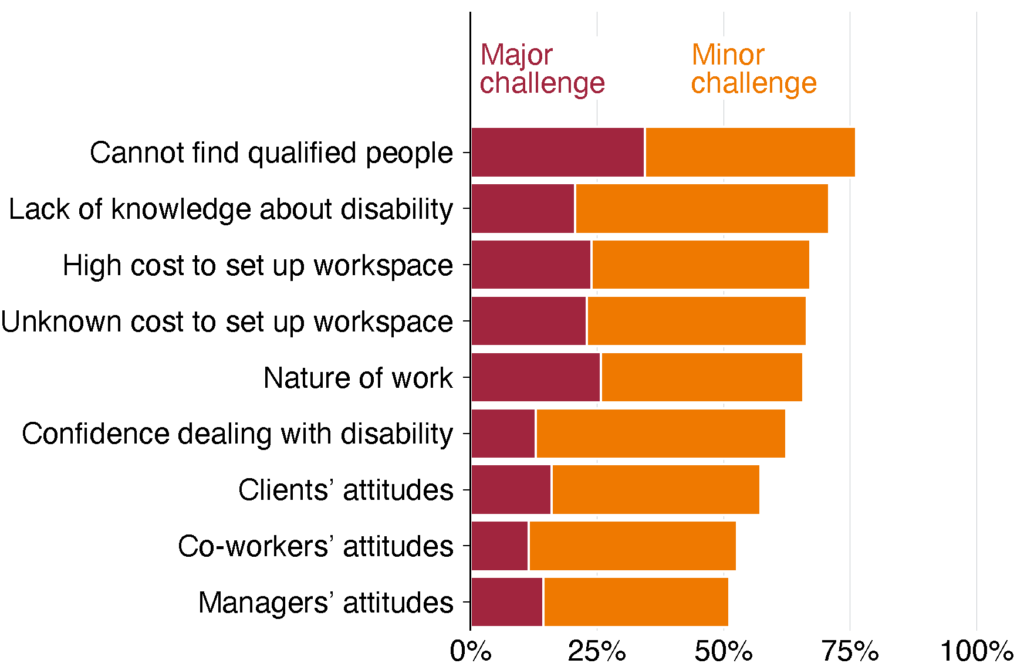
Source: AIHW (2024c).
Open employment needs to be good employment. When people with high support needs do get jobs with mainstream employers, their experiences are not always positive.166Some people with intellectual disability report positive experiences in open employment, including better pay and greater inclusion. But Australian research also shows that others have left open employment because of unstable work, lack of support, disrespect, under-valuing, and discrimination: Meltzer et al (2018, pp. 227–228, 233) and Meltzer et al (2016, pp. 26–28, 47). Ongoing support from employment services should be available for both the employee and employer, as discussed in Chapter 2.
The proposals in this chapter aim to expand mainstream employment opportunities for disabled people with the highest support needs – the group most likely to only be offered supported employment under current policy settings. Employers who are equipped and confident to support people with high support needs will be better employers of disabled people overall, so these reforms will have wider benefits for all disabled Australians.
3.2 A culture shift is needed from employers
Negative attitudes, stereotypes, and implicit biases remain significant barriers to the successful integration of disabled people into open employment.167Arredondo et al (2024, p. 10). Overcoming these requires promoting education, awareness, and training, to reduce implicit bias and foster inclusive workplace cultures.168Ibid (p. 11).
But employer attitudes also reflect wider community attitudes about people with disability. The willingness of managers, colleagues, families, and job-seekers themselves to imagine people with disability in ordinary jobs is shaped by social expectations. A study of Australian public opinion and mindsets concluded Australians often link social value to economic productivity, assume people with disability may be unable to work effectively, and place the burden of inclusion on individuals rather than on systems and communities.169FrameWorks Institute (2023, pp. 7–16).
Shifting these attitudes is difficult. Australia’s Disability Strategy includes seven measures of progress on community attitudes; in 2025, only one had improved since 2022, most had seen no change, and one – measuring employer attitudes – had regressed.170AIHW (2026b, pp. 68–69).
Government has recognised these challenges. Its national disability employment strategy, Employ My Ability, explicitly acknowledges the need to shift employer attitudes and build workplace confidence,171Department of Social Services (2021, pp. 14, 23). and the JobAccess service provides free advice to employers on workplace adjustments and inclusive hiring, primarily through its National Disability Recruitment Coordinator (NDRC) service.172JobAccess (2025a), and JobAccess (2025b).
Yet despite these efforts, the employment gap has not closed. Government’s awareness-raising and attitudinal-change activities have so far failed to make much difference.173Lawrence et al (2026, p. 119). This does not mean these services are ineffective. The NDRC service has reported positive shifts in confidence, capability, and attitudes among participating employers.174JobAccess (2026, p. 5). The problem is that this kind of support is not reaching enough employers. In its first six years, the NDRC supported 223 employers – about 37 per year.175Ibid (p. 4).
Employers who lack awareness or confidence about disability employment are unlikely to seek out support unprompted. Current efforts are too passive: the government produces toolkits and runs advisory services, then waits for employers to engage. JobAccess research found that more than 70 per cent of Australians remain unaware of how to make workplace adjustments, suggesting that two decades of awareness campaigns have not reached far enough.176JobAccess (2023, p. 6).
Government should continue direct engagement with employers, especially large employers with the capacity to create many jobs. It can provide tailored, long-term, sustained support to employers and workplaces to adopt practices and policies that create safe and inclusive working environments.177Gendera et al (2024, p. 1).
Engagement and awareness-building need to be complemented by structural policy change. Incentives for employers to engage can drive better individual outcomes and make inclusion more visible, normal, and expected. While sustained progress in community attitudes is a broad ambition, there are practical building blocks we can put in place (see Section 3.3 and Section 3.5).
3.3 Disability employment should be more visible to the public
Disability employment in Australia’s corporate sector remains largely invisible. Few firms publicly report how many employees with disability they hire, retain, or promote.
Big firms can also pay employees with disability sub-minimum wages, with little visibility or public scrutiny. Under current settings, a firm paying employees disability productivity-adjusted sub-minimum wages can point to its disability hiring record as evidence of inclusive practice, with no obligation to disclose whether those employees are being paid full award wages.
Where data exist, they are fragmented, voluntary, and difficult to compare. This obscures performance, weakens accountability, and limits pressure for change.
Large employers should report disability employment outcomes
Mandatory reporting has been shown to shift employer behaviour. In Australia, gender equality reporting has improved transparency, enabled benchmarking across firms, and increased accountability at senior levels. It has also driven action: most large employers now track gender outcomes, and just more than half have reduced their median total remuneration gender pay gap year-on-year.178Workplace Gender Equality Agency (2026a, p. 6). This reporting has made workforce composition visible – something that organisations measure and manage. Disability employment lacks an equivalent system.
The UK Government has committed to introducing mandatory ethnicity and disability reporting for employers with 250 or more employees. Although framed around pay gaps, the proposed framework would also require employers to report workforce composition by disability status and declaration rates, aligned with the existing gender pay-gap reporting framework.179Malhotra and Timms (2026).
The federal government should establish a national disability employment reporting framework for large employers.
Reporting should go beyond headcount
Reporting should go beyond headcounts to capture the quality and fairness of employment, including for those with the highest support needs:
- the proportion and number of employees who disclose having a disability;
- the proportion and number of employees who choose not to state their disability status;
- the proportion and number of employees who were referred to the employer by the Inclusive Employment Australia (IEA) stream proposed in Section 2.7;
- the number of employees receiving productivity-adjusted or sub-minimum wages under the Supported Employment Services Award.180In addition, the government should publish data on the number of employees being paid under the Supported Employment Services Award or Supported Wage System: currently no such data are available publicly.
Reporting on headcount alone would risk encouraging employers to prioritise hiring people with disability who face fewer barriers to work, while doing little to create jobs for people with high support needs.
A small number of practical indicators should be reported alongside headcount – referrals from IEA’s new stream, usage of the supported wage system and/or the Supported Employment Services Award, and disclosure rates. Importantly, these indicators do not include the type of disability, level of impairment, or support needs of every employee. That would be intrusive, difficult, and imprecise, and would risk discouraging people from disclosing disability in the first place.
Transparency alone will not change behaviour. Reporting should be complemented by practical guidance, benchmarking tools, and support to help firms translate data into action.
Disclosure must be safe and voluntary
A legitimate concern with mandatory workforce reporting is disclosure. Reported disability figures will understate true prevalence — many employees will choose not to disclose, for fear of stigma and adverse career consequences.181AHRC (2016, p. 172). This is a genuine limitation, but it is not an argument against reporting – it just requires careful mitigations.
The UK’s proposed framework requires reporting on declaration rates alongside workforce composition data.182Malhotra and Timms (2026). This tells employers and the public something meaningful about whether a workplace culture is safe enough for disclosure to occur.183Ibid. Over time, a well-designed reporting regime can itself create pressure for the cultural change that makes disclosure more likely. Australia should follow suit.
Care should be taken to protect the confidentiality of employees’ data. Data should be aggregated, de-identified, and results should not be reported for groups so small that individuals could be identified. Employees must retain full control over whether they disclose disability status. Trust in how data are collected, protected, and used will be critical: poorly designed reporting regimes risk entrenching under-disclosure.
Reporting requirements should be designed to minimise the burden on employers and build on existing infrastructure
Mandatory reporting is not without opposition. One concern, which was raised in the UK during its recent consultation on mandatory disability reporting, is the administrative burden and cost of compliance it places on businesses.184Ibid. And in the Australian context, governments have been seeking to reduce unnecessary reporting burdens on employers as part of broader efforts to lift productivity.185Chalmers and Gallagher (2025).
This concern can be mitigated. The UK’s approach to mandatory disability pay gap reporting is designed to align with existing gender pay gap requirements to minimise additional burdens on business, allowing employers to use the same processes, timelines, and reporting infrastructure across multiple characteristics.186Malhotra (2026).
The reporting could be administered in different ways. One option would be to expand the Workplace Gender Equality Agency’s remit to cover disability, as previously recommended by the Australian Human Rights Commission.187AHRC (2016, p. 233). Large employers already report to the Workplace Gender Equality Agency annually.188Workplace Gender Equality Agency (2026b). WGEA already has the employer relationships, reporting infrastructure, and compliance experience that a new body would take years to build. It also already recognises disability as a dimension relevant to gender inequality.189Workplace Gender Equality Agency (2025, p. 10).
Reporting should be limited to firms above a minimum size threshold, as is the case already for WGEA and in the UK.190Malhotra and Timms (2026), and Workplace Gender Equality Agency (2026b). This will reduce the risk of individuals being identified. It will also ensure any additional administrative burden is placed only on firms big enough to absorb it, and who are likely to be already subject to reporting requirements.
Government should engage with WGEA to assess its appetite for an expanded remit and organisational capacity, and consult with the disability community on whether this model would meet their needs.
3.4 Government should lead as a large employer
Governments have already promised to lift disability employment across the public sector. But those commitments have not yet been matched by the specific targets, reporting, and employment pathways needed to drive change.191Department of Health, Disability and Ageing (2025, Recommendations 7.18, 7.19, 7.22).
Outside the National Disability Insurance Agency (NDIA),19223 per cent of NDIA staff in 2025 reported an ongoing disability, though the limitations of the data mean it is not possible to determine how many disabled staff members have high support needs: NDIA (2025c, p. 12). progress has been slow. The proportion of APS employees with disability has increased from 4.1 per cent in 2015 to 5.9 per cent in 2025 (see Figure 3.2), less than the government’s 2025 target of 7 per cent.193Australian Public Service Commission (2020).
Figure 3.2: Disability employment rates in the public service have remained stubbornly low
People with disability as a share of the Australian Public Service workforce, 2006 to 2025
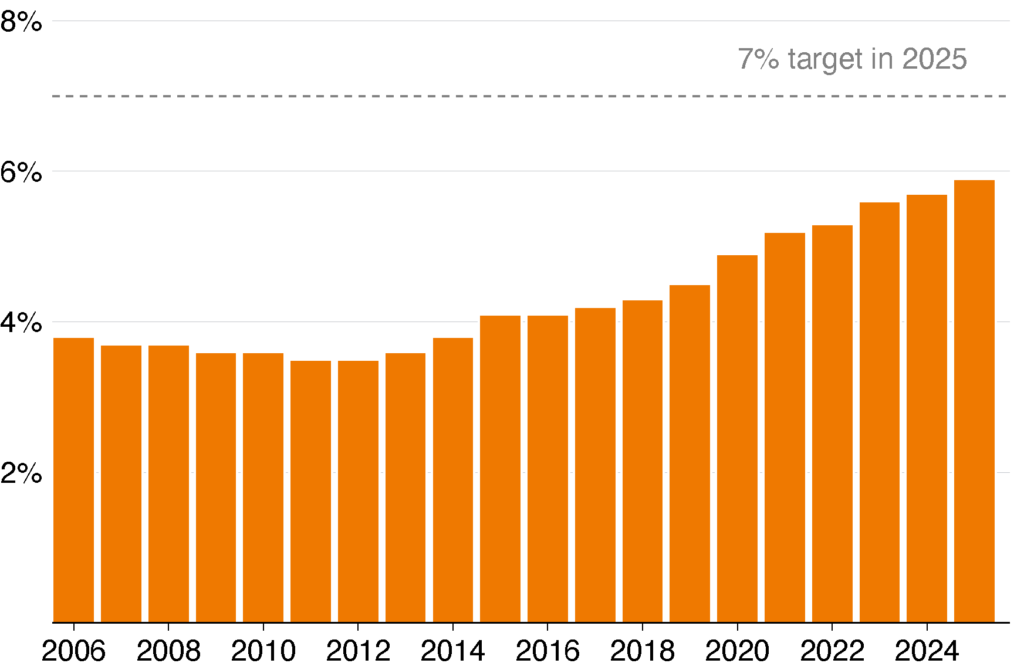
Note: Percentages are calculated against headcounts that include missing/choose-not-to-give values.
Source: Australian Public Service Commission (2025, Table 77).
The Disability Royal Commission recommended pushing further. It called for targets for people with disability to make up at least 7 per cent of new hires by 2025, rising to 9 per cent by 2030.194Department of Health, Disability and Ageing (2025, Recommendation 7.19). Canada’s experience shows ambitious targets are achievable. Canada set a target to hire 5,000 additional employees with disability by 2025 — and exceeded it, with nearly 7,000 net new hires since 2019.195Government of Canada (2025). Representation in Canada’s federal public service has grown from 5.7 per cent in 2010 to 9 per cent in 2025, though it still falls short of the workforce availability benchmark of 12 per cent.196Workforce availability is an estimate of the available people with disability as a percentage of the workforce that could be considered as available talent for hiring into the public service: Government of Canada (2026).
Governments have accepted the Disability Royal Commission’s public sector employment recommendations in principle, but have not yet put the recommended targets in place. The 2025 update says governments are still analysing workforce data and exploring how disaggregated targets could work, while some jurisdictions have raised data and privacy concerns. Reporting is also lagging: most jurisdictions still report only at the whole-of-workforce level, and further reporting reform is being deferred until the targets work is more advanced.197Department of Health, Disability and Ageing (2025, Recommendation 7.22).
Governments should follow through with the recommendations of the Disability Royal Commission regarding more detailed targets and reporting.198Ibid. But putting that infrastructure in place will not be sufficient on its own. Targets need to be matched with deliberate pathways into public sector work, especially for people with intellectual disability.199Macali et al (2025). Evidence from NSW suggests that successful approaches combine structured work experience, careful job matching, in-situ training, specialist employment support, and ongoing support for employees and managers.200Ibid.
3.5 Procurement policy could create stronger incentives to hire
Governments are major purchasers of goods and services. The federal, state, and local governments collectively spend hundreds of billions of dollars each year — the federal government alone signed contracts worth $104.9 billion in 2024–25.201This figure represents the total maximum value of each contract over its life, not annual expenditure: Department of Finance (2026). This scale gives governments significant influence over supplier behaviour, and procurement is increasingly used to pursue broader social and economic objectives alongside value for money.202McCrudden (2004).
That logic applies directly to disability employment. Firms compete for government contracts; if inclusive employment affects who wins work, it can also affect how firms hire.
Governments already use procurement in this way in other contexts, including to support Indigenous economic participation (see more in Section 4.8). Similar thinking should be extended to disability employment in the mainstream economy.
Some governments have already moved in this direction. Victoria’s Social Procurement Framework applies to all Victorian Government procurement.203Buying for Vic (2025). For contracts under $20 million, suppliers must provide information about employment opportunities for Victorians with disability; for contracts over $20 million, measurable employment targets are required and enforced through contract management.204Victoria Government Services (2025).
Internationally, the UK’s Social Value framework goes further still, requiring that social value, including disability employment, comprise at least 10 per cent of the tender evaluation criteria for major government contracts.205UK Cabinet Office (2020).
The federal government should establish a procurement framework for disability employment that balances value for money with the objective of increasing disability representation in mainstream employment.
At a minimum, the government should require suppliers bidding for major contracts to demonstrate their accessible recruitment practices, timely provision of workplace adjustments, and participation in disability employment reporting. More ambitiously, the government could require firms to make contract-specific, time-bound commitments — such as the proportion of roles filled by people with disability or the number of new hires supported — and assess these competitively as part of the tender process.
Any procurement mechanism of this kind must also be consistent with value for money. Well-designed requirements, targeted at larger contracts and larger suppliers, with clear and measurable commitments, need not come at the expense of government priorities for prudent spending.
The purchasing power of the NDIA could also be more effectively used to support better disability representation within the disability services workforce. Many disability service providers report employing no employees with disability.206Mellifont et al (2023, p. 646). This is despite there being strong reasons to expect disability service providers to lead the way in disability employment and them operating in a sector facing significant workforce shortages.207NDIS Quality and Safeguards Commission (2023, p. 14), and Mellifont et al (2023, p. 643). And their services can be delivered better with greater lived experience expertise to hand, which can strengthen peer support, improve organisational understanding of customer needs, and make services more responsive.208Mellifont et al (2023, p. 643).
The NDIA oversaw expenditure of $50.1 billion in the past year.209In the year ending 31 March 2026: NDIA (2026c, p. 62). The NDIA directly funds some services currently, and there is scope for more services to be directly commissioned using the NDIA budget in future.210Currently Local Area Coordinators and Early Childhood Partners are funded from the NDIS budget: Bennett et al (2025, p. 49). Grattan Institute has previously recommended that foundational supports could be funded from within the existing NDIA budget: Bennett et al (ibid, p. 4). And government has recently announced plans to extend direct commissioning of services to Support Coordination, Plan Management and Supported Independent Living services: National Disability Insurance Scheme Amendment (Securing the NDIS for Future Generations) Bill 2026 – Explanatory Memorandum (2026, p. 260). The NDIA should establish similar requirements to those set out above for government procurement, to ensure provider workforces have higher disability representation when they are directly commissioning services in the marketplace.
Beyond direct procurement, the NDIS Quality and Safeguards Commission should also impose minimum representation requirements for provider registration. Registration is currently mandatory for providers of Specialist Disability Accommodation, Supported Independent Living, specialist behaviour support services, plan management providers and ‘platform services’ that connect disabled people with support workers.211NDIS Quality and Safeguards Commission (2026). Attaching disability representation requirements to registration would extend the reach of workforce standards beyond directly commissioned services to the broader NDIS provider market.
Procurement is also explored elsewhere in this report as a mechanism to support disability enterprises directly (see Section 4.8). That model and the mainstream employer incentives described here are complementary — together they could lift expectations across both supported and open employment.
4 Raise the bar for disability-focused enterprises
Disability-focused enterprises have long provided employment for Australians with disability. For many people with high support needs, these enterprises have been the only employment option.
These organisations were established with the primary objective of creating employment opportunities for people with disability, rather than creating a clear value proposition for customers. Because they exist to create employment for people who face greater barriers in the labour market, these enterprises often carry higher costs than similar businesses with no such goal. As a result of compounding pressures and a difficult operating environment, many disability-focused enterprises struggle to stay afloat, and pay very low wages.
Government should play an active role in raising expectations across the sector, encouraging a model that sets a higher bar for commercial performance in service of social mission. This does not mean shutting down existing models. It means defining what good social enterprise looks like, and using certification, and linked social procurement, to encourage a shift toward stronger models — both by supporting existing providers to transition and by attracting new entrants.
In order to be accredited as a Disability Social Enterprise, an organisation should have to be a commercially sound business, with returns reinvested to provide high-quality, inclusive employment. Disability Social Enterprises that meet these higher standards should be rewarded with expanded social procurement opportunities from government.
4.1 The current model is structurally fragile – and that’s a threat to jobs and wages
Disability-focused enterprises have evolved in name over successive policy eras, from sheltered workshops to Business Services to Australian Disability Enterprises, and more recently many have begun to describe themselves as social enterprises (see Box 3 for more detail on social enterprises).212Wilson et al (2022, pp. 1–3, 6). But despite the re-brands, many features of the model have persisted: workforces with majority disabled employees (or disabled employees doing distinct and separate work activities from other workers), persistently low wages, and a heavy dependence on government-funded supported employment revenue to stay in business.213Smith et al (2019).
Most disability enterprises operate as supported employment services, combining commercial activity with structured on-the-job support for disabled people. This model has two core revenue streams: NDIS funding for disability support services provided to employees, and trading revenue earned through the sale of goods or services (e.g. packaging, manufacturing, grounds maintenance, cleaning). A third revenue stream for many disability enterprises is philanthropy or other grants.
Many disability-focused enterprises are financially precarious. A recent survey found that the median net margin of Supported Employment Services was -1.2 per cent, indicating that most are operating at or below break-even (see Figure 4.1).214Net margin represented here only reflects the revenue and expenses associated with the organisations’ supported employment business activities and does not account for other business activities (many organisations offer other disability services). The survey covered 33 organisations that employ a total of 8,024 supported employees: Ability Roundtable (2025, p. 10).
Box 3: What is a social enterprise?
A social enterprise is a business that exists primarily to achieve a social or environmental purpose, rather than to maximise profit. It generates revenue through the sale of goods or services in competitive markets, but directs a substantial share of its profits and resources toward delivering public benefit.aSocial Traders (2026a), and Defourny and Nyssens (2017).
Unlike traditional charities, social enterprises operate with a commercial model. They trade like any other business – competing for customers, managing costs, and generating income – but are distinguished by a clear social mission embedded in their purpose, governance, and use of profits.bSocial Traders (2026a).
In Australia, social enterprises are commonly defined by three core features: they have a public or community benefit mission; they derive a significant portion of their income from trade; and they reinvest most of any surplus back into that mission.cIbid.
Work-integrated social enterprises are of particular relevance for the purposes of improving employment outcomes for people with disability. These are social enterprises whose mission is to create employment opportunities for people facing barriers to, and exclusion from, the labour market.dKhan and Barraket (2024).
Figure 4.1: Many supported employment providers operate close to – or below – break-even
Distribution of sustainability ratios from a sample of Supported Employment Services, 2024-25
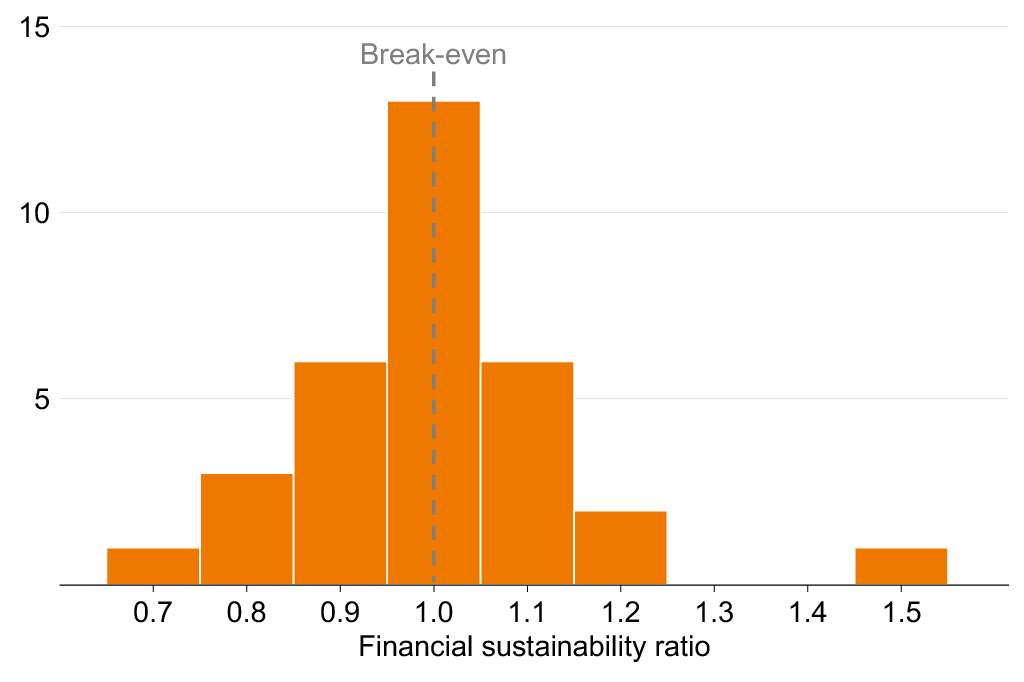
Notes: Sustainability ratio is determined by (trade revenue + impact revenue) / total costs. Survey included 33 Supported Employment Services, employing 8,024 supported employees. Not all organisations provided data for all survey questions.
Source: Ability Roundtable (2025).
Many disability enterprises operate in low-margin industries
Financial precarity results in part from the industries in which disability enterprises operate. Supported employment providers are concentrated in manufacturing, packaging, commercial laundry, grounds maintenance, cleaning, and recycling – sectors that are labour-intensive and price-competitive.215NDIA (2025b, p. 10). Manufacturing, retail trade, wholesale trade, and administrative and support services all sit in the lower half of industry profitability nationally (see Figure 4.2).216Grattan analysis of ABS (2025c). Even efficient, well-run firms in these sectors struggle to lift margins or absorb higher costs.
Figure 4.2: Supported employment is concentrated in low-margin industries
Operating profit margins by industry division, 2023-24
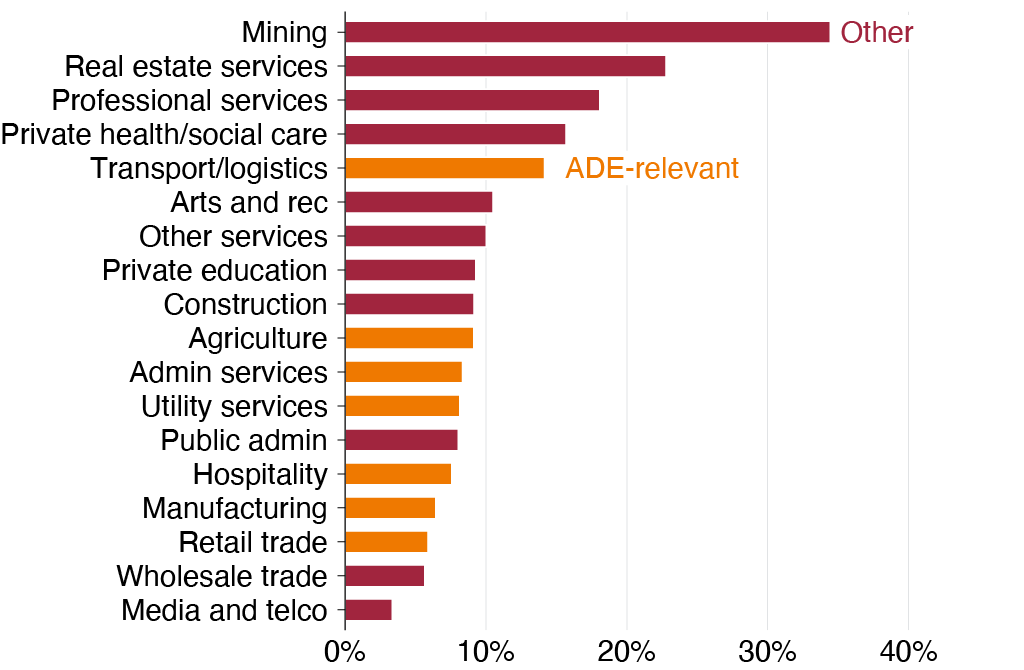
Notes: ADE = Australian Disability Enterprise. Operating profit margin calculated as operating profit before tax divided by total income. NDIS industry categories do not directly correspond to ABS ANZSIC divisions; mapping was done on a best-fit basis and is indicative only. ADE-relevant industries are ABS divisions containing at
least one industry category with any Australian Disability Enterprise employment, as reported in NDIA (2025b, p. 10). Some industry names have been shortened.
Sources: ABS (2025c) and NDIA (2025b).
They also generate additional costs from their social purpose
Disability enterprises do not operate on the same cost base as other businesses in the same industries. Work-integrated Social Enterprises incur ‘impact costs’: the additional costs of delivering their social purpose that a comparable business without that purpose would not incur, or would incur to a lesser extent.217Pullen et al (2023).
For disability enterprises, many of these costs relate to supporting workers to participate and develop at work. They can include more structured supervision, on-the-job coaching, adapted task design, workplace adjustments, flexible rostering, mentoring, training, transport support, and support to build capability over time.218Ibid. Other costs may vary by industry. A logistics business, for example, may face additional vehicle, transport, or insurance costs; other enterprises may face higher property costs where larger or more accessible premises are needed.219White Box Enterprises (2026).
A lot of the impact costs in disability enterprises – particularly those related to employee costs – are covered by NDIS funding for on-the-job supports for supported employees. These supports can fund job customisation, on-the-job training and intermittent support with daily work tasks, direct supervision and support, physical assistance and personal care in the workplace, behaviour support, and non-face-to-face activities that support employment.220NDIA (2025a). This funding is important and should continue to be available. It enables people with high support needs to access employment without requiring employers to absorb all of the additional costs of inclusion.
Importantly, organisations should rigorously track impact costs (as with all costs) to ensure that they are driving impact and that the organisation has full visibility of its margins.221White Box Enterprises (2026).
Many providers have deeper disability-support capability than commercial capability
Most disability enterprises are embedded within larger disability service providers for whom supported employment is not the primary activity or main income source.222Grattan analysis of Ability Roundtable (2025, p. 7). The ability to offset trading losses with other income can reduce the pressure to build a strong trading business, particularly where supported employment is not the organisation’s primary activity.
It is perhaps not surprising then that many disability enterprises sustain their trading operations not through competitive strength, but through cross-subsidisation from disability service funding. Most providers run negative net trade margins, offsetting commercial losses with NDIS funding and other ‘impact’ revenue (see Figure 4.3).223Impact revenue is revenue derived from supported employees through the NDIS, grants, donations, or government funds for supported employees. It is unrelated to trade revenue or funding from the Department of Social Services as part of the Structural Adjustment Fund grant program: Ability Roundtable (ibid).
The dual missions of disability enterprises can sometimes result in conflicting incentives. On the one hand, as a disability support provider, the enterprise is encouraged to support employees to transition to open employment.224The NDIA has improving transition rates from ADEs to open employment as a goal and has made changes to its pricing structure to encourage providers to better support employees to experience different employment environments: NDIA (2024, p. 9). On the other, as a commercial business, the enterprise is incentivised to keep its most talented and high-potential employees to ensure efficient delivery of its trade.
Figure 4.3: Most disability enterprises cross-subsidise trade activities with disability services activities
Net impact margin and net trade margin of Supported Employment Services, 2024-25
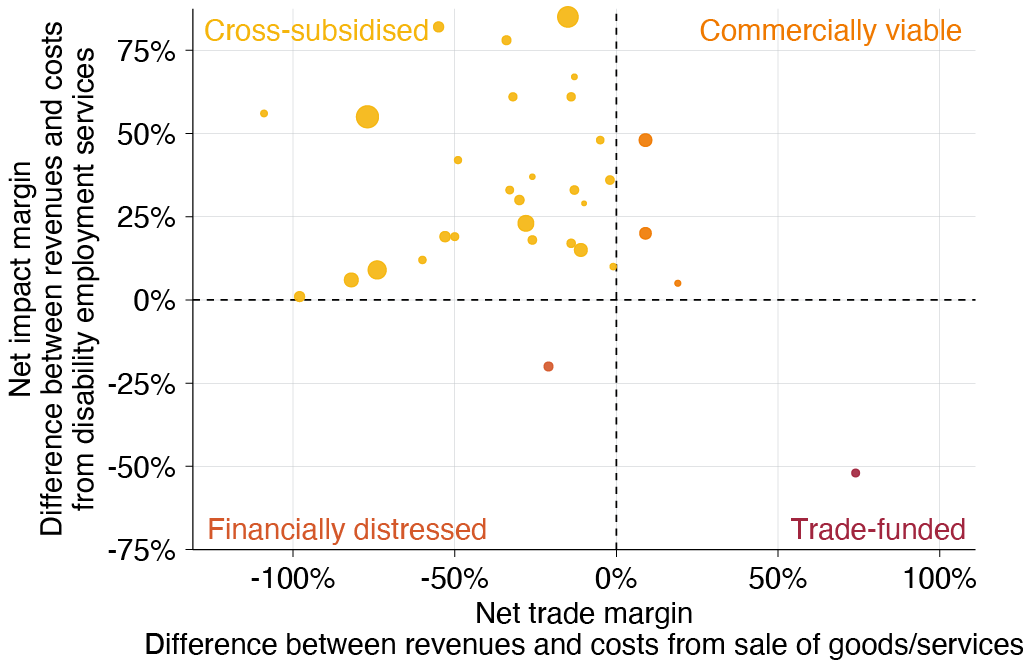
Note: Net impact margin represents the difference between impact revenue (comprised of NDIS revenue, Structural Adjustment Fund revenue, and other impact revenue) and impact costs (support staff salary and wages, and other beneficiary costs).
Source: Ability Roundtable (2025).
Improving the commercial sustainability of disability enterprises is critical to enabling better wages
The operating environment for disability enterprises is challenging, and financial pressures can compound. In that context, good commercial stewardship matters. Providers need to know where they make money, where they lose money, and what they can do to improve the underlying performance of the business.
This matters for workers. Sustainable wage growth is unlikely to come from pursuing more disability-support funding, philanthropy, or short-term grants. Those sources of revenue can play an important role, but they cannot make up for a weak trading model. If disability enterprises are to offer better-paid, higher-quality jobs over time, they will need stronger trading businesses behind them. Without that, low wages will remain built into the model.
4.2 Commercial viability isn’t out of reach – but current settings do little to incentivise it
Financial fragility is real, but it is not inevitable. A small number of disability-focused enterprises are achieving positive trading margins — with the strongest performer reaching 74 per cent.225Ability Roundtable (2025, p. 17). And there are also examples of work-integrated social enterprises that have been able to establish commercially viable models while offering full award-wage employment (see Box 4). This could be more widely replicated.
There is a market for businesses with a strong social purpose. Research has shown that consumers respond favourably to businesses that employ people with disability, with one survey finding that more than nine in 10 consumers hold a more favourable view of such companies.226Siperstein et al (2006). Broader evidence confirms that consumers are willing to pay more for products from a business with a perceived social purpose – particularly when the beneficiaries are people.227Tully and Winer (2014). And public buyers are also increasingly interested in social procurement (more detail in Section 4.8).
But goodwill isn’t enough. Disability enterprises still need to make the same kinds of commercial choices as other businesses: choosing business lines that fit the skills and support needs of their workforce; designing jobs, training, and supports to lift productivity over time; pricing contracts to reflect the true cost of delivery; investing in technology (including AI) and equipment to improve process efficiencies; building stronger management information on costs and margins, and using this to inform industry and offering selection; and pursuing more reliable revenue through procurement relationships. These are commercial decisions, and government should not prescribe the right answer for each organisation. But current policy settings should do more to encourage providers to build commercially stronger enterprises, rather than treating commercial viability as separate from the goal of better jobs and wages.
Box 4: Some social enterprises have worked out a better way
There are examples of social enterprises creating ongoing, fairly paid jobs for people with disability or other workers facing barriers to employment.
Ability Enterprises in Queensland provides award-wage employment for people facing barriers to work, including disabled people, people with mental health concerns, refugees, and Indigenous Australians. Its enterprises employ almost 90 people in a range of industries.aAbility Enterprises (2026).
Outlook Australia operates a waste-management social enterprise across Queensland and Victoria. Its social enterprise division employs more than 250 people, 77 per cent of whom have experienced barriers to employment, including disability, long-term unemployment, or other barriers.bOutlook (2025, pp. 4, 9). Outlook says all employees, including supported employees, are paid 100 per cent of the award or enterprise agreement rate that applies to their role.cBuyability (n.d.).
Australian Spatial Analytics provides digital engineering services while creating stable, long-term employment for disabled workers. It has employed more than 220 neurodivergent people.dAustralian Spatial Analytics (2026).
Spain’s ILUNION group shows that inclusive employment can operate at significant commercial scale across a diversified business. In 2024, ILUNION reported 43,000 employees, 39 per cent of whom were disabled. The group operates across more than 50 business lines, including industrial laundries, contact centres, industrial services, hotels, and retail.eIlunion (2024, p. 13).
4.3 Current standards are too weak to distinguish good practice
Many organisations claim a purpose linked to disability employment. But too often, that claim is not matched by consistent inclusive employment practices or fair wage standards. Organisations can present themselves as disability-inclusive while falling well short of that promise — and still benefit from the label.
The claim can generate public goodwill, attract customers, and unlock government procurement advantages tied to organisational classifications that are not always subject to rigorous standards. For example, many governments continue to preference ‘Australian Disability Enterprises’ in procurement (see Table 4.1), despite the serious concerns documented by the Royal Commission and others.228Royal Commission into Violence, Abuse, Neglect and Exploitation of People with Disability (2023, pp. 461–531).
Table 4.1: Jurisdictions have varied levels of recognition of disabled employment in procurement policies
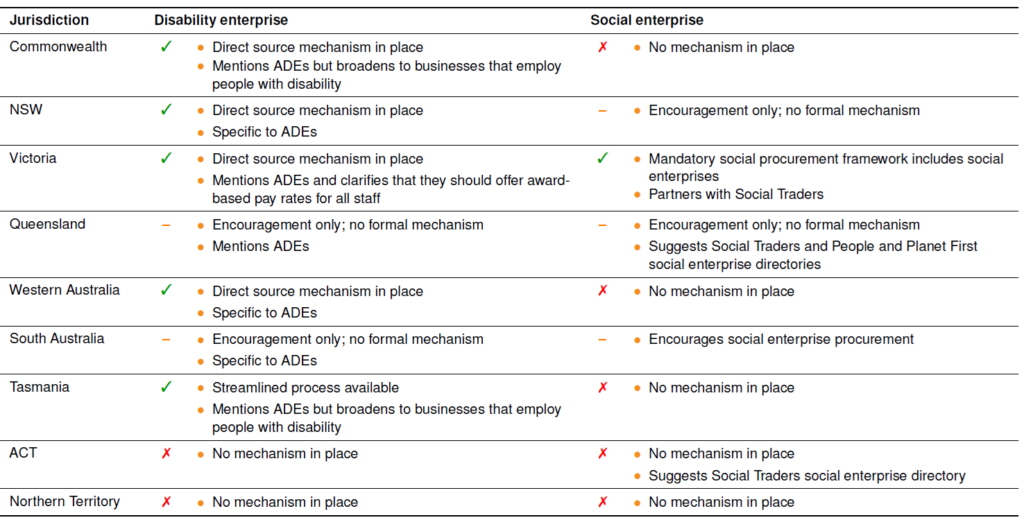
Note: ADEs = Australian Disability Enterprises.
Source: Grattan analysis of Department of Finance (2025a), Department of Finance (2025b), Buy NSW (2026), Buy NSW (2024, p. 29), Buying for Vic (2024), Victoria Government Services (2025, pp. 5–6, 14), Queensland Government (2026), Department of Treasury and Finance Western Australia (2025, p. 10), Procurement SA (2023, p. 3), Tasmanian Government (2025), Procurement ACT (2026, p. 4), Government Procurement (Charter of Procurement Values) Direction 2020 (2020), and Northern Territory Government (2026).
Social enterprise is a growing choice of classification, with many organisations now describing themselves as social enterprises seeking to create employment opportunities for people with disability.229Gales and Khalil (2022, p. 16). Australia’s social enterprise sector is estimated to comprise about 12,000 organisations, including several hundred operating in disability services and employment-related activities.230Ibid (pp. 4, 16).
Without a credible standard distinguishing enterprises that deliver genuinely inclusive employment from those that do not, public and private buyers risk rewarding organisations whose employment practices fall short of inclusive employment.
Certification could fill this gap. In the context of social enterprise, certification frameworks are meant to verify that organisations pursue social objectives through sustained economic activity.231Defourny and Nyssens (2017). But certification is not just a box-ticking exercise. It also operates as a market signal, giving certified organisations a form of recognised status that can help them attract customers, funders, and procurement opportunities.
For that reason, certification standards should be demanding: the benefits of certification should only be extended to organisations that meet a high bar for genuinely inclusive employment.
There are two primary social enterprise certification bodies in Australia – Social Traders, and People and Planet First.232Social Traders (2026b), and People + Planet First (2026a). Social Traders has certified about 770 social enterprises nationally, and People and Planet First has certified about 260.233Wolff (2025, p. 9), and People + Planet First (2026b).
People with disability are the most common beneficiary group among Social Traders-certified organisations, comprising the target cohort for more than one in five enterprises.234Wolff (2025, p. 19).
Given its existing reach and recognition, Social Traders certification could be a suitable vehicle for setting clearer employment standards for Disability Social Enterprises. However, the current Social Traders certification framework has two notable gaps.
Current certification standards can recognise enterprises that pay very low wages
The current framework allows enterprises paying productivity-adjusted wages at far below the national minimum wage to qualify as certified social enterprises.235Social Traders (2021). Social Traders’ rationale is that this aligns with legal requirements and enables employment for people who might otherwise be excluded from the workforce.236Ibid. This reflects a long-standing feature of Australian policy: the view that some people with disability can only access work under sub-minimum wage arrangements.237This logic is explicitly embedded in the Supported Wage System (SWS), which is explained as allowing employers to ‘use an SWS assessment to decide a fair wage’ where someone’s ‘disabilities might affect how much a person can get done each day’: JobAccess (2025c).
But this framing is out of date and does not reflect the contemporary reality that many open workplaces employ disabled people and pay them fair wages. Allowing organisations to pay very low wages, without any credible plan to lift wages, sits uneasily with the purpose of social enterprise certification.
Certification should instead reflect a commitment to full and fair workforce participation, including equitable pay. International definitions of social enterprise emphasise labour market integration, with the expectation that workers participate on terms that reflect their genuine economic contribution.238Defourny and Nyssens (2017, p. 2487).
Current certification blurs the lines between trading revenue and disability support services revenue
A central premise of social enterprise models internationally is that social objectives are pursued through sustained economic activity, including earned income from the sale of goods or services, rather than relying solely on grants, donations, or direct public provision.239Doherty et al (2014), and Barraket et al (2010). Social enterprises can, and often do, rely on a mix of income sources, including public funding and philanthropy. But meaningful trading activity remains important to the ‘enterprise’ part of social enterprise.240Defourny and Nyssens (2017, p. 2478).
Social Traders certification assessments treat income received through NDIS employment supports as trading revenue.241Wolff (2025, p. 10).
NDIS employment supports play an important role in enabling participation. The issue is that treating this funding as ordinary trading revenue obscures how much of the employment model is supported by market-facing activity and how much is funded to deliver disability supports.
This dilutes the value of certification as a tool to distinguish commercially sustainable disability social enterprises and risks reinforcing a model in which low wages are treated as an inherent feature of disability employment.
4.4 There is a strong case for specialist disability employers – we just need to set the bar higher
The shortcomings of the current system do not mean that organisations that create employment opportunities for people with disability have no future role. There is a strong case for enterprises that deliberately create inclusive employment pathways – particularly for people with high support needs.
As discussed in Section 1.1, people with high support needs face particular structural barriers to employment. Work-integrated social enterprises are well positioned to help break down these barriers. Unlike other employers, who may hire people with disability as a discretionary practice, enterprises that have organised their businesses around inclusive employment have made structural commitments that are durable.
This is not a replacement for efforts to expand open employment opportunities for people with disability. For many people, open employment remains the right goal — and in Chapter 2 we outlined ways to improve pathways to get there.
Disability Social Enterprises should be understood as a specific form of social enterprise. Like other social enterprises, they should have a primary public or community purpose, derive a substantial portion of income from trade, and direct their efforts and resources toward that purpose.242Social Traders (2026a).
But because their purpose is to create employment opportunities for people with disability, general social enterprise criteria are not sufficient. Recognition should also depend on whether the employment they create is fair, inclusive, developmental, and commercially sustainable.
Disability Social Enterprises can play two distinct roles. Some operate as pathways, providing paid work experience, training, job matching, and transition support to help people move into open employment. Others operate as destinations, creating ongoing integrated jobs for people who want or need a more intentionally inclusive workplace. Some organisations do both. Both models should play an important role in the future disability employment ecosystem, but their operating models, funding arrangements, and accountability requirements should be distinct.243Sykes et al (2024).
Social enterprises focused on transitions are discussed in Section 2.6 as an innovative pathway model. These enterprises should be eligible for Inclusive Employment Australia funding as providers of evidence-based training services and placements, where they can demonstrate high-quality training, participant choice, and durable employment outcomes. This chapter focuses on destination enterprises seeking to offer longer-term, meaningful employment opportunities to people with disability.
As we showed in Box 4, some social enterprises are already showing that a different and better way is possible.
4.5 Criteria for the new model should align commercial and social objectives
A reformed ‘destination’ Disability Social Enterprise should employ people with disability in integrated, fairly paid work, sustained primarily by trading revenue rather than disability service funding.
Commercial and social objectives should be mutually reinforcing: customers receive goods and services that meet their needs, and workers get fair wages and real opportunities to develop and progress. The organisation does not maximise profit. That trade-off is what allows inclusive employment to be the mission. But the model only works if it is commercially viable. Without that, employment outcomes remain limited and wages constrained.
The following criteria should guide what we expect from a contemporary Disability Social Enterprise focused on creating long-term employment opportunities for people with disability (see Figure 4.4).
Figure 4.4: Disability Social Enterprises should meet four criteria
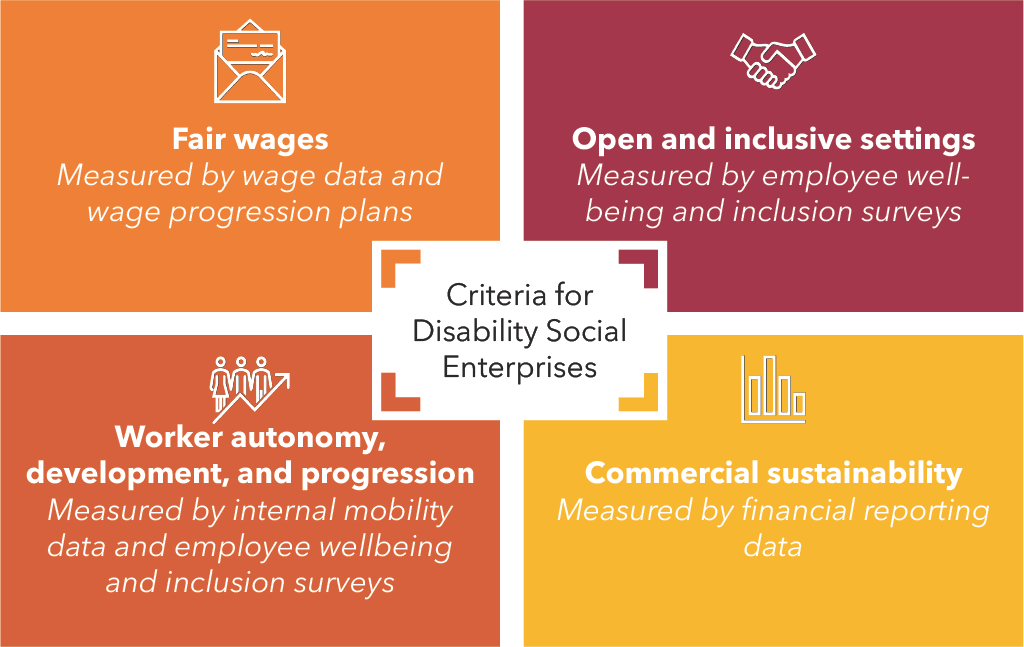
Fair wages
Enterprises seeking recognition as Disability Social Enterprises should be expected to move toward fair wages for all workers, regardless of disability status. In the long term, fair wages should mean full award wages under the relevant industry award, not the Supported Employment Services Award.
This would be a significant shift from current practice. Productivity-adjusted wages are currently used in both open employment and supported employment, and many existing disability enterprises have built their operating models around these wage settings. Requiring an immediate move to full industry award wages, without changes to commercial models, revenue, job design, and support settings, could place pressure on already fragile enterprises and reduce their capacity to employ people with significant disability.
For this reason, use of wage adjustments under the Supported Wage System may need to continue during a transition period. But use of the Supported Employment Services Award should not be permitted. Employees should be paid under the relevant award in their industry. Organisations seeking recognition as Disability Social Enterprises should be required to demonstrate a credible wage progression plan with clear timeframes, and accountability.
Progress should be independently reviewed as part of certification, with organisations required to report against their plan at regular intervals. Organisations that fail to make reasonable progress should lose access to certification or preferential procurement treatment.
Organisations should not receive recognition or preferential treatment simply because they create employment opportunities for people with disability if those opportunities continue to rely on unfair wages.
Open and inclusive settings
Disability Social Enterprises should operate integrated workplaces. Workers with disability should participate alongside non-disabled colleagues within ordinary workplace structures.244Joyce et al (2024, p. 2).
Integration should be reflected not just in who is employed, but in how work is structured and performed.245Campbell et al (2024, p. 8). This means embedding workers with disability in core teams and workflows, with shared roles, standards, and accountability.246Ibid (p. 44). Jobs should involve meaningful tasks that contribute to the enterprise’s ordinary work, with shared standards and accountability, while providing the adjustments and support needed for each worker to participate fully.247Joyce et al (2024, p. 7).
Work should be designed so it is inclusive and accessible. This should include accessible equipment and layouts, task design matched to workers’ strengths and support needs, flexible rostering, and a mix of quieter and more social work environments where appropriate.248Ibid (pp. 6–7). An inclusive setting should also offer opportunities to learn new tasks, move between roles, build independence, and progress over time.249Joyce et al (2024, p. 6), and Campbell et al (2024, pp. 37–44).
Worker autonomy, development, and progression
Disability Social Enterprises should provide clear pathways for skills development, promotion, and progression.
Progression should be a structured process of capability-building, supported by real work experience, role mobility, and gradually reducing reliance on support.250Campbell et al (2024). Supports such as mentoring, check-ins, and co-ordination with external services should be used to build independence over time.251Ibid. A focus on progression should also include regular career conversations with workers about their long-term goals, the skills and experience they want to build, and the supports or adjustments needed to get there.
Some enterprises might have a focus on transitioning employees into other open employment work opportunities, but provided there are pathways for internal promotion, this need not be a requirement.
Workers should retain full autonomy, including the freedom to seek and transition to other employment without penalty or loss of support.
Commercial sustainability
Disability Social Enterprises should demonstrate that trading activity can sustain employment operations without structural reliance on disability service funding to offset commercial losses. A majority of revenue should be earned from trading activities. Organisations need to have the economic capacity to support fair wages and sustained employment. Consistent with social enterprise principles, any surplus should be reinvested into the organisation’s social purpose, including creating, sustaining, and improving employment opportunities for people with disability.
Together these criteria define a new model in which commercial and social objectives are complementary rather than in tension.
Most traditional Australian Disability Enterprises would not meet these standards today, but many could transition to this model with support. Alongside those who choose to transition, clearer standards and stronger procurement demand should also help attract new market entrants with commercial acumen.
4.6 Transitioning to the new model will require support
These criteria represent a significant shift from the current operating model for many organisations in the sector. Not all Australian Disability Enterprises will want to embrace this model. But support should be available for those that do.
Australian Disability Enterprises wanting to transition will need support, including business coaching, to boost their commercial capability.252Disability Employment Australia (2025, pp. 38–39).
The federal government should also consider offering a payment-by-outcomes incentive as part of the Disability Social Enterprise reformed model,253Suchowerska et al (2024). tying government investment directly to sustained employment results. The design should draw on lessons from previous payment-by-outcomes trials, including the importance of intermediary or aggregator models and flexible milestones that recognise sustained employment, progression, and supported transitions.254Ibid. Given that final evaluations of those trials are still to be published, this option should be developed in step with the full evidence as it becomes available.
4.7 Certification standards should only recognise organisations that clear this higher bar
Certification standards for Disability Social Enterprises need to be strengthened.
The Department of Social Services should work with an existing certification body to define minimum standards for Disability Social Enterprise certification. This process should draw on input from relevant federal and state procurement agencies, disability representative organisations, disability enterprises, and workers with disability, with the criteria in Section 4.5 as a starting point.
Evidentiary requirements should be extended to validate that enterprises meet the criteria.
At a minimum, enterprises seeking certification should report:
- wage data showing commitment to full award wages or a credible wage progression plan;
- internal mobility data showing promotion outcomes for employees with and without disability;
- employee well-being and inclusion survey data, including measures of psychological safety, autonomy, access to adjustments, development opportunities, and confidence in raising concerns;
- revenue data sufficient to assess commercial sustainability.
These requirements should be integrated into existing certification processes and subject to the verification and review mechanisms already in place.
Enterprises should be reassessed at regular intervals, with certification revoked where standards are not maintained. The framework itself should also be subject to independent review, with a scheduled evaluation built in from the start.
4.8 Procurement should reward enterprises that clear the higher bar
Strengthened certification standards would clarify what constitutes a high-quality Disability Social Enterprise. But standards alone are insufficient. To shape behaviour, they must be linked to economic incentives.
Government procurement can be a powerful tool to shift markets when standards are credible and demand is predictable.255Edler and Georghiou (2007, pp. 956–957, 959). If implemented well, a stronger procurement framework would give economic force to certification and support the growth of a larger, more sustainable market for inclusive employment.
Procurement policies should reward enterprises that are moving toward fairer wage models, not simply those that employ people with disability. Without strengthened wage and employment-quality standards, procurement policies could risk expanding demand for the same low-wage model this report seeks to move beyond.
Current procurement policies don’t cut it
Australian governments already use procurement policies to support organisations employing people with disability. Federally, rules allow entities to directly procure from certain disability enterprises without an open tender above the $80,000 threshold.256Department of Finance (2025a, Appendix A). Several states have similar arrangements or broader social procurement frameworks (see Table 4.1).
But these mechanisms are fragmented and generally weak. They vary across jurisdictions and provide limited incentive for agencies to give priority to disability enterprises.
They are also poorly targeted. Many policies preference Australian Disability Enterprises, or Social Traders-certified social enterprises, seeking to support employment opportunities for people with disability. The shortcomings of this approach were detailed in Section 4.3. New certification standards are required, as set out in Section 4.5.
Incentives are further diluted by discretion. In most jurisdictions, social procurement is encouraged rather than required, and agencies retain broad flexibility in how, or whether, they apply it.257Australian jurisdictions currently rely primarily on discretionary direct sourcing. The federal government and the NSW, Victorian, Western Australian, and Tasmanian governments all allow for buyers to bypass open tender processes if they choose to purchase from a disability enterprise: Department of Finance (ibid), Buy NSW (2026), Buying for Vic (2024), WA Government (2021), Tasmanian Government (2025).
Current purchasing patterns reflect this. Government procurement from disability enterprises is concentrated in small contracts. More than half of purchases fall below $100,000 and about three-quarters below $250,000 (see Figure 4.5). Large contracts are rare, and participation in major supply chains remains limited. Engagement exists, but it is shallow and fragmented.
Figure 4.5: Government purchasing from disability enterprises is concentrated in small contracts
Distribution of goods and services purchasing from Australian Disability Enterprises by spending band and buyer, 2024
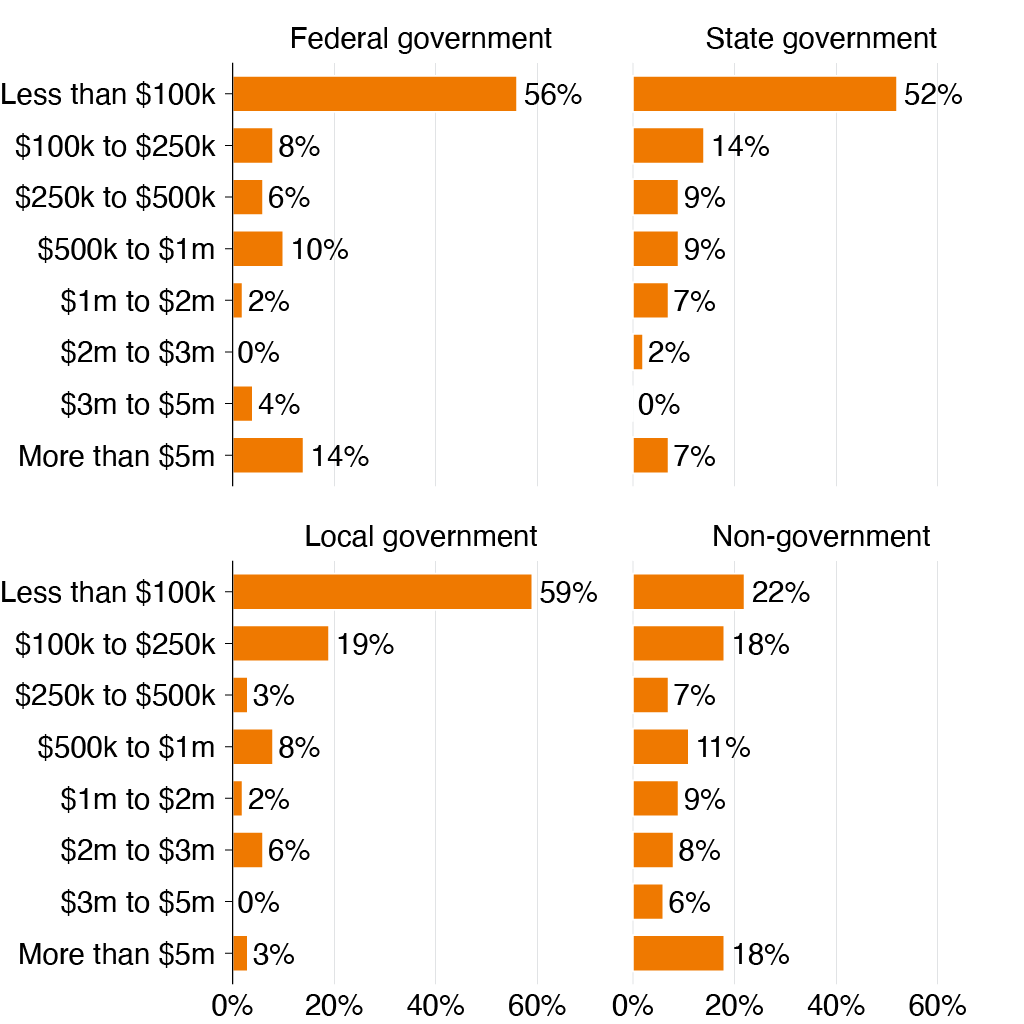
Note: 112 of 145 NDIS Supported Employment Services responded to this survey question.
Source: Grattan analysis of NDIA (2025b, pp. 10–11).
Australia needs a Disability Procurement Policy
Governments should adopt a suite of complementary procurement mechanisms to direct demand towards Disability Social Enterprises. The Indigenous Procurement Policy shows the value of a multi-pronged approach – set-asides, participation requirements, and portfolio targets – while also illustrating the need for careful design, verification, and monitoring.258National Indigenous Australians Agency (2026), and Eva (2025). Together, these mechanisms have expanded the number of Indigenous businesses winning contracts, and the value of contracts awarded.259Polidano et al (2025, p. 7). In 2024–25, all federal portfolios exceeded their targets.260National Indigenous Australians Agency (2026).
A Disability Procurement Policy should follow this logic: combining direct sourcing arrangements, participation requirements in large contracts, and an explicit portfolio-level target for procurement spending directed to certified Disability Social Enterprises. Contracts with Disability Social Enterprises should ensure industry award-level wages are being paid to any workers involved with the contract.
The Department of Social Services should design the policy and set targets. The Department of Finance should classify the policy as a Procurement-Connected Policy within the Commonwealth Procurement Rules, giving it the same treatment as the Indigenous Procurement Policy.261Ibid (p. 8).
Targets should be informed by an assessment of the current and projected capacity of the certified sector, and designed to grow as certification expands. Accountability for meeting the targets should sit clearly with agencies.
The Disability Procurement Policy should be available only to enterprises that meet rigorous certification standards
The benefits of expanded disability procurement mechanisms should be available only to enterprises that meet the criteria set out in Section 4.5. If government is using its purchasing power to support disability employment, it should be confident that the enterprises it is purchasing from offer inclusive employment and pay fair wages.
Intermediaries could bridge scale and discovery challenges
Scale is a challenge for disability enterprises. More than half of Australian Disability Enterprises employ fewer than 200 workers.262NDIA (2025b, p. 12). This can make it difficult to access larger government contracts.
Comparable procurement models use market infrastructure to reduce this barrier. In the US, AbilityOne channels federal demand through a mandatory procurement list and central non-profit agencies that match and distribute work across approved disability-employing providers.263General Services Administration (2026).
Discovery and verification are also important. Supply Nation plays this role in the Indigenous procurement system, giving Australian buyers a verified database of Indigenous businesses and a practical way to identify suppliers.264National Indigenous Australians Agency (2026, pp. 8–9).
A disability procurement policy would benefit from both of these intermediary roles, whether delivered by the same organisation or by separate bodies.
5 A transition plan for Australia
Australians with significant disabilities should have far greater opportunities for inclusive employment, receive fairer wages in a variety of mainstream settings, and get the support they need.
Improving pathways and supports into open employment, expanding mainstream employment opportunities, and enabling an evolution of the current social enterprise model are the best ways to achieve this, as we have described in previous chapters (see Figure 5.1).
These improvements would raise expectations about the work disabled people can do with the right supports, and what younger disabled people can expect from their careers.
And we are confident that the success of these strategies over time should temper and eventually negate any requirement to continue the use of the Supported Employment Services Award and the Supported Wage System to set disability pay in Australia.
But it will be important that the implementation and sequencing of these proposals is carefully managed, monitored, and adjusted if needed, because it is vital that the improved experience we envisage for future generations does not come at the expense of job losses for those employed under current settings.
This change will require upfront investment from government, but it should be budget positive over the longer term, with the better direction and allocation of existing funding for supports, and offsets from reduced welfare payments and higher tax revenue more than accommodating the costs of ensuring that no one is left behind.
Figure 5.1: Our proposed employment pathway for people with disability facing barriers to employment
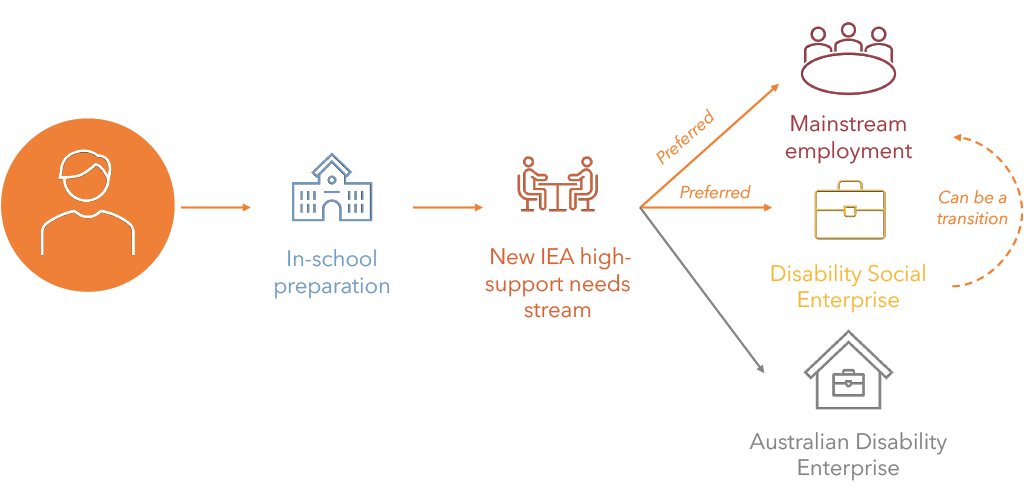
Notes: IEA = Inclusive Employment Australia. Not intended to be comprehensive with respect to post-school options for people with disability (e.g. vocational pathways and mainstream employment services may be alternative pathways) but intended
to represent a specialist pathway for those needing greater support to access employment.
Source: Grattan analysis.
5.1 Better options for disabled people must be the first step
The starting point for reform should be expanding employment options for people with high support needs.
The Department of Social Services should establish a new stream, as part of the Inclusive Employment Australia program, specifically focused on supporting disabled people with high support needs into open employment, and reflecting the evidence-based, best-practice employment supports outlined in Chapter 2.
This stream should be partially funded by re-purposing money currently allocated to NDIS employment assistance. In 2024-25, the NDIS spent $128 million on capacity building line items for employment assistance and school leavers’ employment support.265Grattan analysis of NDIA (2026a). Includes item numbers 10_016_0102_5_3 and 10_021_0102_5_3. Neither program has been effective in getting people into open employment (see Section 2.3). This money should be redirected to Inclusive Employment Australia to contribute to funding the cost of the new stream.
The new stream should focus on young people entering the workforce for the first time, people currently in day programs, and existing Australian Disability Enterprise employees, who should be offered targeted employment supports with the explicit aim of exploring options for open employment and enabling a supported transition to new jobs.
Funding available to employment service providers as part of this new stream must include service fees that are significantly higher than in current Inclusive Employment Australia programs, to acknowledge the longer duration and higher intensity of employment services required to help people with high support needs into employment.
Support families through their transition
Reform needs to focus on lifting aspirations for people with disability and their families by showing them what’s possible, while retaining their choice, control, and autonomy.
Many families of disabled people value the structure and perceived safety that Australian Disability Enterprises provide, and are wary of change.266Our Voice Australia & the Activ Action Team (2022). Families of disabled people are often vocal supporters of ADEs because they are concerned that, without an ADE job, their loved one would be unable to find alternative work, and be socially isolated.267Inclusion Australia and People with Disability Australia (2022, p. 6), and National Disability Services (2014, p. 18).
It is important that families’ concerns are not ignored, and that families are engaged with the transitions and reforms that will affect their loved ones. Parental expectation is the greatest predictor of paid work experiences.268Hall et al (2018, p. 208). But low expectations are often ingrained by school programs,269Ibid (p. 208). and the deficit-focused assessment that disabled people undergo at age 16 for the Disability Support Pension.270Inclusion Australia (2021, pp. 4–5).
When family members understand the services available to them, and have a sense of ownership and commitment to their role in the process, employment outcomes improve.271Hall et al (2018, p. 210).
Through the transition from sheltered employment in Vermont, US, one provider organisation held ongoing ‘family forums’. These meetings provided an opportunity for family members to raise concerns and influence the process.272Butterworth et al (2007, p. 37).
An evaluation of a customised employment service in Australia concluded the involvement of family and friends in the process built trust, allayed fears, and fostered a richer understanding of the disabled person.273Smith et al (2018b, p. 14).
Legislation can wait
Progress in the US in lifting the participation in open employment of people with cognitive disabilities suggests it is better to focus first on policy change and targeted investment in support, rather than on changes to legislation.
Only 16 states have outlawed sub-minimum wages through legislation.274US Government Accountability Office (2025a). But all 50 states have engaged with the Employment First model, a framework that has guided the reform of employment systems to support disabled people into open employment (see Box 2).275Heigl et al (2024b, p. 43).
States that have invested in improving employment services and opening up opportunities for people to move into open employment have achieved better outcomes for affected workers, including reductions in the numbers of people in sheltered workshops (see the example of Washington state in Section A.8).
In contrast, overseas jurisdictions that have attempted to lead with legislative change to remove sub-minimum wages have found that reform stalled. In British Columbia, Canada, sheltered workshop operators used a loophole to get around minimum wage requirements, by recategorising activities as ‘support’ or ‘preparation’ rather than employment (Section A.5). In Arizona in the US, organised opposition led to proposed legislation being watered down (Section A.6). And in Ontario, Canada, legislation was reversed after a change of government (Section A.7).
Australia can make a step change in open employment opportunities and improved wages for people with high support needs by pursuing these policy objectives and aligning government investment to their delivery. Legislative change may ultimately follow, but it does not need to be a precursor to improved results.
5.2 Next, support Australian Disability Enterprises that seek to transition to Disability Social Enterprises
New certification standards for Disability Social Enterprises will impose greater requirements on many Australian Disability Enterprises that are likely to require shifts in their operating model (see Section 4.5).
Each existing Australian Disability Enterprise should be given 18-to-24 months to choose whether to transition to this new model and develop a plan to make the transition.
The transformation required is likely to be challenging for ADEs (see Section 4.1). ADEs that seek to pivot to becoming a Disability Social Enterprise should be supported financially and practically to do so.276Disability Employment Australia (2025, pp. 38–39).
The Department of Social Services should directly support ADEs that choose to transition, through access to entrepreneurial expertise and support, as well as providing funding via grants to enable investment in the changes needed to make the transition successful.
ADEs that do not seek to transition to the new model of a Disability Social Enterprise would be able to continue to operate. But they would serve a shrinking number of workers as improved pathways, supports, and opportunities allowed more disabled people with high support needs to seek and obtain open employment.
The per-person pricing of NDIS employment supports for employees remaining in ADEs may need to increase slightly to enable a similar level of continued support for a shrinking number of people that choose not to take up other opportunities, or are unsuccessful in obtaining open employment.
For an ADE to continue operating, it should be required to register as a provider with the NDIS. This would reflect the heightened risks for people employed in these settings, give government a clear and current record of active ADE providers, and create a centralised list that could be used to ensure engagement with all ADE employees from the new IEA stream.
For any new entrants, the ADE would be required to demonstrate that the person has completed a full course of best-practice employment support and made an informed choice to enter ADE employment.
Funding would be subject to a five-yearly review of the ADE sector, which would include consideration of whether ADEs should continue to accept new entrants.
5.3 Subsequently, reconsider use of the Supported Wage System
The Supported Employment Services Award and the Supported Wage System are unfair, discriminatory, and entrench the idea that disabled people are less valuable, and incapable of making a full contribution in the workplace.
Disabled people are the only Australian workers, except prisoners, who can be paid below minimum wage indefinitely.277Workers under 21, apprentices, and trainees can be paid less than the national minimum wage (Australian Unions (2026)). But these cases are all temporary. In the case of apprentices and trainees, the low wage also acknowledges the value of training provided as part of the arrangement. They are also the only Australian employees whose pay is linked to assessed productivity.
Decades of reviews and legal challenges have questioned both the reliability of productivity-based wage assessments and the equity of paying workers a fraction of the award rate.278See for example Nojin v Commonwealth of Australia (2012), Duval-Comrie, Tyson and Commonwealth of Australia (2016), and Fair Work Commission (2019).
But abolishing the Supported Wage System immediately would risk significant job losses for disabled workers. Many disabled employees and their families value the social connections, structure, and sense of belonging from Supported Wage System employment, despite the low wages. Losing this employment could harm people’s sense of self and purpose.279Royal Commission into Violence, Abuse, Neglect and Exploitation of People with Disability (2023, p. 503), and Our Voice Australia & the Activ Action Team (2022). A reform that risks leaving many people worse off is not one we would recommend.
Instead, our recommendations to improve pathways and supports into open employment, get the open employment market working better for disabled people, and raise the bar for Disability Social Enterprises, should create increased opportunities for disabled people with high support needs to obtain open employment at full award wages. This, in turn, should lead to decreased reliance on the Supported Wage System as a means of enabling disabled people to obtain employment.
By 2034, the government will have evidence to hand regarding the extent to which these reforms have reduced the need for the Supported Wage System. At that point, the Minister for Social Services should make an application to the Fair Work Commission to review the Supported Employment Services Award and the Supported Wage System.
The Minister should request that the commission consider how far wages for disabled people under the Supported Employment Services Award and the Supported Wage System can be increased without introducing the risk of significant job losses.
It should also direct the commission to consider abolishing the Supported Employment Services Award and moving employees to the relevant award for the sector in which the ADE is operating, and/or abolishing wage reductions based on productivity assessment.
5.4 Helping disabled people into open employment can be cost effective
The changes we propose will all cost money:
- Training and accreditation to enable employment providers to meet new standards will require an upfront investment.
- Australian Disability Enterprises that seek to pivot to becoming Disability Social Enterprises will require financial support to do so.
- Providing best-practice employment support will require more time and require investment in each disabled person being supported.
But helping more disabled people into open employment, where their earnings are higher and where they can work more independently, will also lead to savings for the federal government:
- Higher earnings will lead to lower Disability Support Pension payments. DSP payments are reduced by 50 cents for every dollar earned over $113 per week.280Services Australia (2026a).
- Higher earnings will lead to increased income tax receipts.
- Ongoing costs of employment supports will be lower for disabled people in open employment. ‘Place and train’ employment support involves some continuing supports, such as job coaching, practical workplace adjustment, mentoring, and transport. While these supports should be available for as long as workers need them,281Kregel et al (2020, p. iv). and will often continue for several years, they will generally be lower than employment supports for people in Australian Disability Enterprises, or supports for people in day programs (see Appendix B). They will also commonly decrease slightly over time, whereas the costs of employment supports for people in Australian Disability Enterprises, or supports for people in day programs, continue unabated.282Cimera (2008). The lower cost for workers in open employment would be due to a lower quantity of support required, rather than a drop in the per-unit price the government pays.
We have estimated costs and associated savings resulting from a stream that includes:
- A $150 million Department of Social Services grant program to fund upfront investment in provider training and accreditation.
- An additional $100 million for direct support to Australian Disability Enterprises that seek to pivot to becoming Disability Social Enterprises.
- Supporting 10,000 disabled Australians annually through a two-year program of best-practice employment support. This would include some of the 17,000 people currently working in Australian Disability Enterprises,283Mitra (2022). as well as some people currently not in paid work.
The estimated net cost of this stream would be $1.1 billion over the next four years (see Table 5.1). But as more and more people are assisted into open employment, the savings would increase, and the reform would be cost-neutral within a decade. More detail of our costing model is in Appendix B.
Table 5.1: The estimated costs to government of our proposal
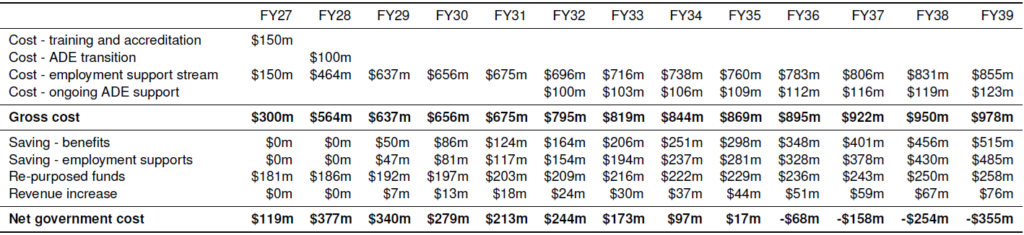
Note: ADE = Australian Disability Enterprise.
Source: Grattan analysis.
5.5 Ensuring no one is left behind
The reforms proposed in this report would improve the lives of many disabled people with high support needs. But open employment will not be the outcome for everyone. Some disabled people face barriers that cannot be fully overcome by these reforms, and others may choose to continue to work in an Australian Disability Enterprise – a choice that deserves respect.
To protect this group, we propose a dedicated grandfathering fund to maintain support for those who do not transition from an Australian Disability Enterprise to open employment. This fund would ensure continued access to meaningful activities and structured support, which may be more expensive, per person, than current employment supports as the Australian Disability Enterprises population shrinks. Importantly, this support would not be open to new entrants into Australian Disability Enterprise employment — its purpose would be to ensure no current ADE employees lose out.
We estimate the cost of this fund at $86 million annually, commencing in 2031-32, after all ADE workers have had the opportunity to undertake a two-year program of best-practice employment support. Of more than 17,000 people currently working in ADEs, we estimate about half will obtain open employment (see Section B.3), leaving about 8,600 people requiring continued support. This fund would allow about $10,000 per person on average to cover additional costs on top of the supports they currently receive.
As the reforms take hold and expectations shift, more people are expected to be willing and able to make the transition to open employment. The grandfathering fund therefore would be a safety net during a period of change — not a permanent parallel system. It would be expected to run for 20 years at most.
Acknowledgements
This report was written by Sam Bennett, Owain Emslie, and Reilly Polaschek. Alastair McEwin made a substantial contribution. The report was edited by Paul Austin.
We would like to thank the members of Grattan Institute’s Disability Program Reference Group for their helpful comments, as well as numerous government and sector participants and officials for their input.
The opinions in this report are those of the authors and do not necessarily represent the views of Grattan Institute’s founding members, affiliates, individual board members, reference group members, or reviewers. The authors are responsible for any errors or omissions.
Grattan Institute is an independent think tank focused on Australian public policy. Our work is independent, practical, and rigorous. We aim to improve policy by engaging with decision makers and the broader community.
We acknowledge and celebrate the First Nations people on whose traditional lands we meet and work, and whose cultures are among the oldest in human history.
For further information on Grattan’s programs, or to join our mailing list, please go to: www.grattan.edu.au. You can donate to support future Grattan reports here: www.grattan.edu.au/donate.