How planning stops more housing – and how to fix it
by Brendan Coates, Joey Moloney, Matthew Bowes
Housing in Australia’s cities is now among the least affordable in the world.
At the heart of the problem is the fact we just haven’t built enough homes to meet rising demand.
In the second half of last century, the growth in Australia’s stock of homes consistently outpaced the growth in Australia’s adult population.
It meant the nation could absorb the rise in demand for housing from our booming and increasingly wealthy population, and house prices barely moved.
But since the turn of the century, growth in the housing stock has lagged that of the adult population.
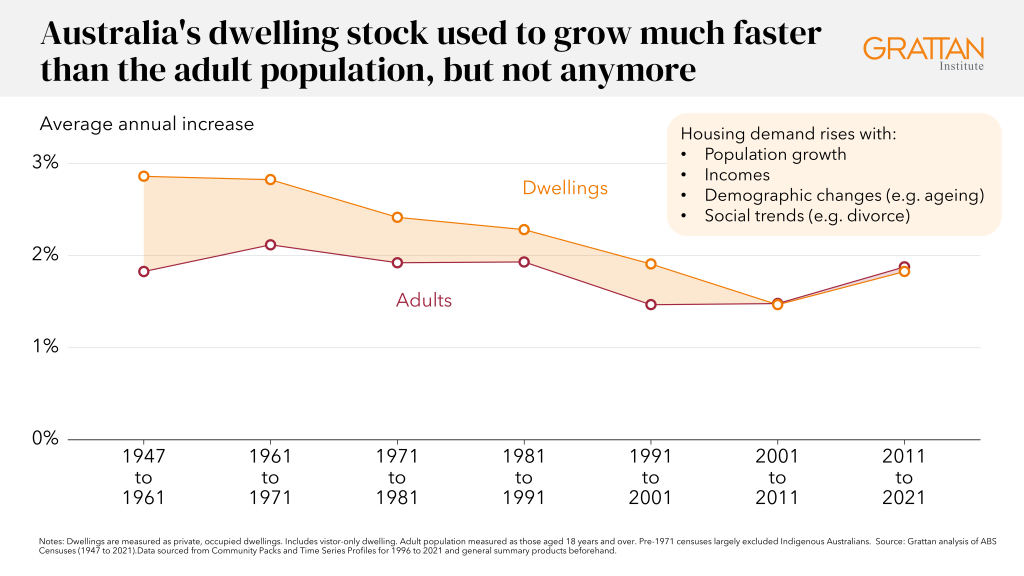
And in that time house prices have exploded. Median prices have increased from about four times median incomes in the early 2000s, to more than eight times today (and around 10 times in Sydney).
Australia has a particular shortfall of housing in places where people most want to live – in the established suburbs of our major cities, close to jobs, transport, schools, and other amenities.
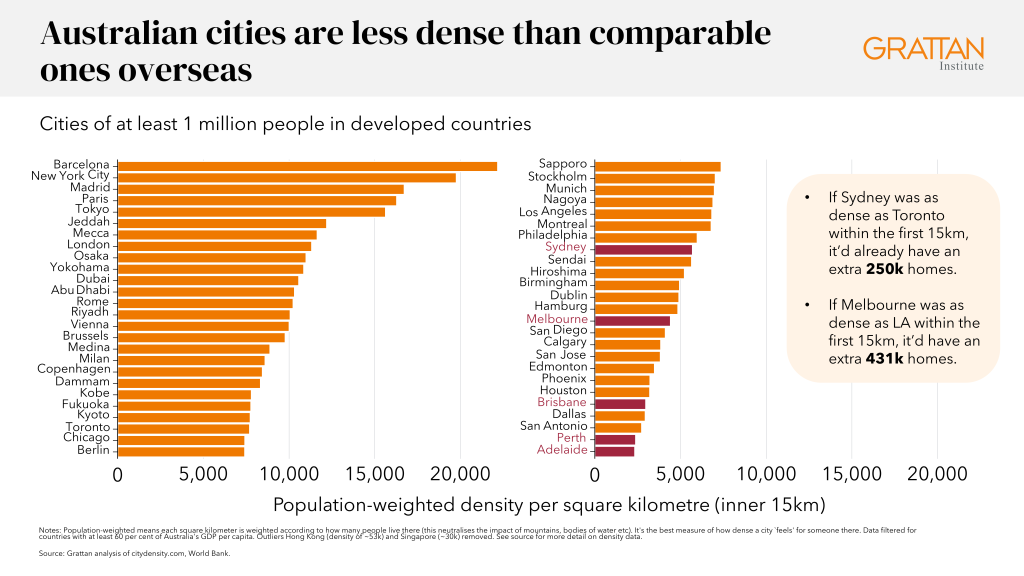
Our lack of density makes us an international outlier. Our capital cities are less dense – they are home to many fewer people per square kilometre – than almost all other wealthy cities of 1 million people or more. And that list includes many of the cities that Australians most love to visit.
Australia’s housing woes are largely caused by a failure of government policy.
State and territory planning systems say “no” to new housing by default, and “yes” only by exception.
About 80 per cent of residential land within 30 kilometres of the centre of Sydney, and 87 per cent in Melbourne, is restricted to housing of three storeys or fewer. And three-quarters or more of residential land in Brisbane, Perth and Adelaide is zoned for two storeys or fewer.
Other prescriptive rules – such as minimum lot sizes, maximum site coverage and floor-space ratios, and slow and uncertain approval processes – often make it impossible to build the extra housing that is allowed.
Thankfully, the politics of planning are shifting.
The state governments of NSW and Victoria have responded to the crisis with bold reforms to planning controls to allow more homes to be built in the established suburbs of Sydney and Melbourne – cities that collectively house two in five Australians.
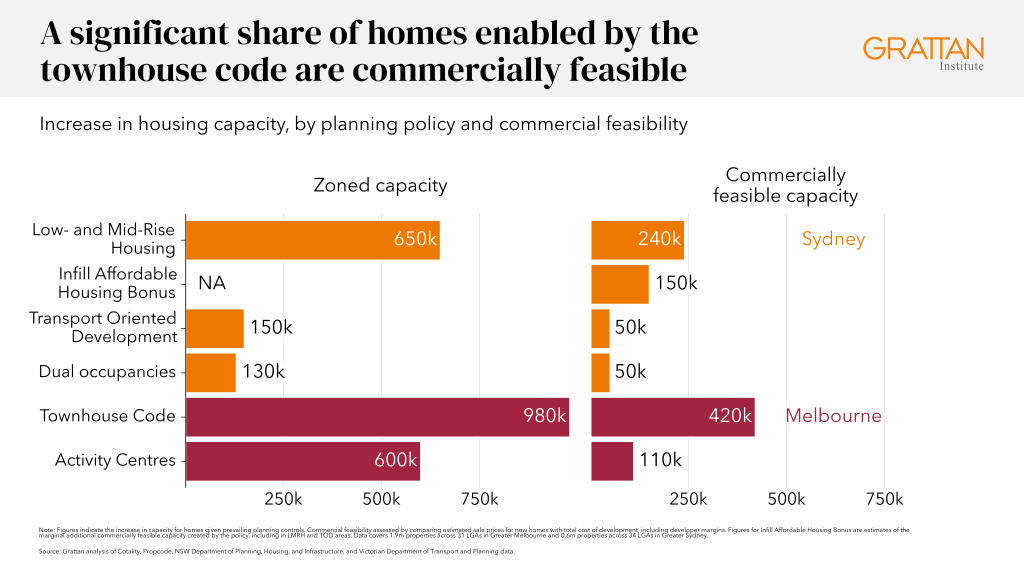
Grattan Institute calculations show that these policies could boost zoned capacity – the number of homes that are permissible to build – within Sydney by more than 900,000 dwellings, the equivalent of 40 per cent of the city’s existing housing stock.
Whereas similar reforms in Victoria allow for an extra 1.6 million homes in Melbourne. That’s the equivalent to 70 per cent of all homes in Melbourne today.
And the better news is that about a third of that capacity can be profitably built today, despite higher construction costs. This is particularly the case for townhouses in both cities, and taller apartments in the eastern and northern suburbs of Sydney.
But both states’ reforms fall short of recent reforms in Auckland, New Zealand, which lifted zoned capacity by the equivalent of 100 per cent of all existing homes, leading to a building boom that added 4 per cent to the city’s housing stock in just six years and reduced rents by 28 per cent.
Our latest Grattan Institute report, More homes, better cities: Letting more people live where they want, shows that all state and territory governments need to go further to build the homes their communities desperately need.
It recommends three key reforms.
First, state governments should permit townhouse and apartment developments of up to three storeys on all residential-zoned land in Australia’s capital cities, as Victoria has now largely done.
These developments should not require a planning permit, just like many knock-down rebuild homes in most states already.
Subdividing large family homes for townhouses is an easy way to boost density and allow more housing on scarce inner-city land without the need for lot amalgamations.
About half of all residential-zoned blocks in Sydney and Melbourne are larger than 600 square metres, as are nearly two-thirds in Brisbane, Perth and Adelaide.
We estimate this change could unlock capacity for more than 1 million homes in Sydney alone that could be profitably built today.
Second, state and territory governments should also allow housing developments of at least six storeys around key transit hubs, as NSW and Victoria have begun to do.
Many of the world’s most iconic and liveable cities – such as Paris, Vienna, and Copenhagen – allow six or more storeys broadly across much of their inner areas.
And third, taller apartment building should be permitted in high-demand locations, including in and around capital city CBDs.
Applied nationally, these changes could lift housing construction by an average of up to 67,000 homes a year. That’s enough to cut house prices and rents by 12 per cent within a decade, and more than 20 per cent over two decades.
They could also boost Australians’ incomes by up to $25 billion a year (in today’s dollars), or 1 per cent of GDP, in the long term.
Building more homes where people most want to live will make housing cheaper and create wealthier, healthier, and more vibrant cities. What are we waiting for?
This report and accompanying materials have been updated since publication. We have slightly changed Figures 1.4, 1.5, and 1.6 (and their accompanying text) after we identified an inconsistency in the way dwellings data were reported between the 2001 and 2021 Censuses.